Platform on production and process automation

Injection molding machines perform at top level. Therefore, the supply of raw materials must always be guaranteed. At a Dutch company, level sensors from VEGA therefore reliably monitor the supply of plastic granules in the raw material silos.
For more than thirty years, Haval has been known as a manufacturer of disposables and packaging materials for the food industry. Every year, some 5 billion single-use packages leave the state-of-the-art production site in Gemert, the Netherlands, on their way to customers throughout Europe. All products are developed in cooperation with renowned design agencies, focusing not only on design but also on physical requirements. Because the EU bans disposables, Haval has for some time been putting extra effort into the company's second branch: the production of food packaging used, for example, for the storage and sale of salads, vegetables, fruit ...
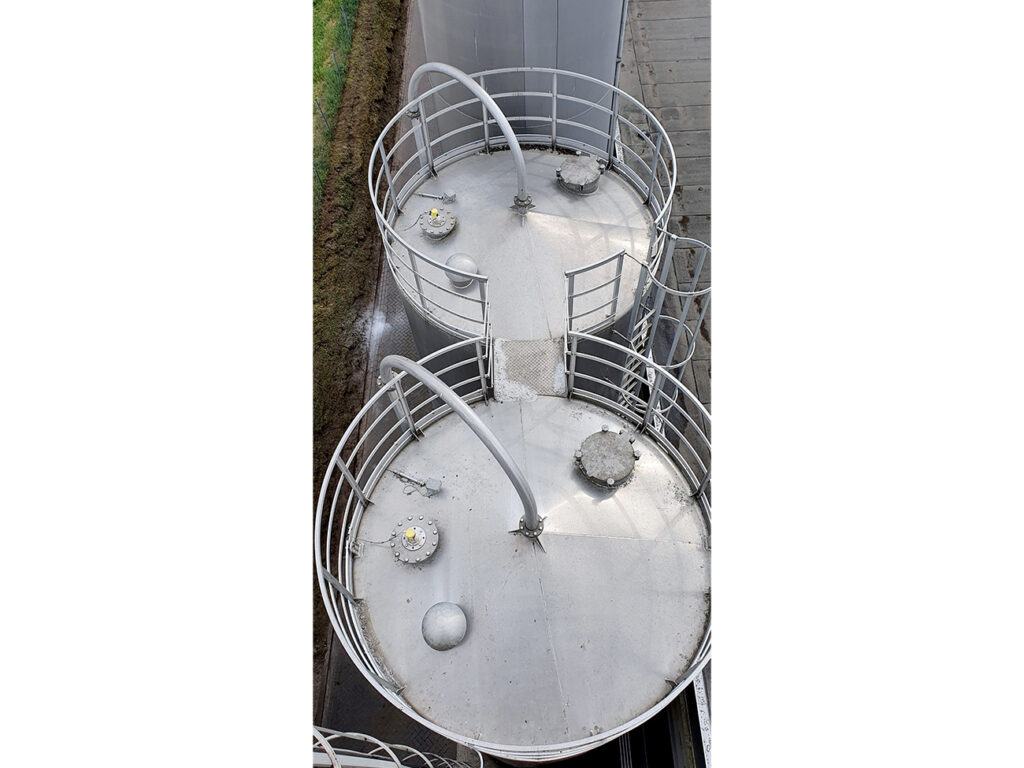
The basis of all these products are high-quality plastic granules of polystyrene and polypropylene. These raw materials are transported from the aluminum silos to the injection molding machines, where the plastic is melted and injected into its final form under high pressure. The total volume of the now nine stock silos is 900 m3. "For a reliable supply and smooth running of the production process, we must have accurate and reliable values of the volume. If the raw material were to run out, we would have to shut down one or more of our injection molding machines," says Ron Kastermans, production manager at Haval. "We therefore opted for a combination of level measurement based on radar and visualization with the VEGASCAN."
In two silos, the VEGAPULS 68 has been in use for more than seven years and is doing its job flawlessly. In the other three silos, the VEGAPULS 69 was installed. "For level measurement, the biggest challenge lay in the low dielectric constant (1.2) of the plastic granules," Kastermans explains. "In addition, the sensors must not allow themselves to be out of the field due to dust accumulation. After all, we are working with polystyrene." Before the VEGAPULS 69 made its appearance, the level of poorly reflective products such as plastic granules was mostly measured with a sensor whose measuring principle relies on the guided microwave. This worked, but once the interference signals became as large as the level echo, reliable measurement was not always possible. Unfortunately, this situation occurs with many plastic powders and granules due to very low Dk values. Added to this, there are often interference signals. For example, plastic powders are generally stored in high, very narrow silos. Surrounding welds, even if they are only a few millimeters thick, always lead to interference reflections again in silos. The reliability of a measurement signal is therefore a top priority for Kastermans: "The most important thing is to have a good measurement every day. This is not even so much about the highest accuracy, but actually more about always having a reliable result, without interference."

These unsatisfactory measurement results in the plastics industry only really changed a few years ago, when VEGA launched the VEGAPULS 69 on the market. This operates at a frequency of 80 GHz and an antenna of about 75 mm. Together, this results in much stronger focusing of the transmission signal and an opening angle of only 4° - ideal for narrow, high silos. The strong focusing helps to better distinguish the actual measurement signal from the interference signal. This was made possible at the time by new microwave components that can detect even the smallest reflection signals. A second aspect that has now made many users choose the VEGAPULS 69 is its dynamic range. In radar sensors, this parameter answers the question of in which application areas a sensor can be used. The greater the dynamic range, the wider the application spectrum of the sensors. Due to the large dynamic range of 120 dB of the VEGAPULS 69, even the smallest reflections can be measured. For media with poorly reflective properties, it ensures that these can now be measured at all.
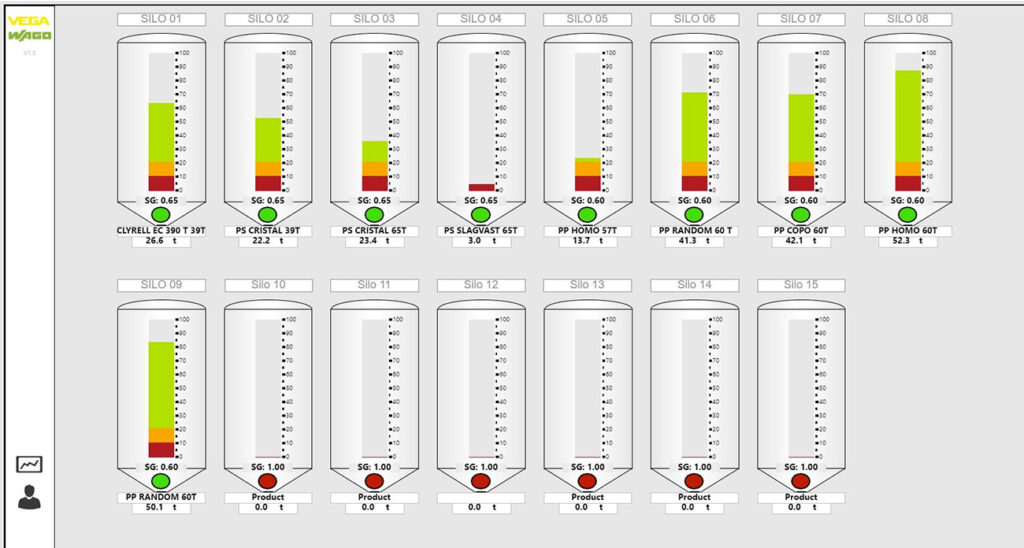
After the use of radar level sensors first proved positive in six raw material silos, not only were three more silos commissioned in May 2018, but three radar sensors from VEGA were also installed immediately. At that time, it was also decided to introduce a raw materials inventory management system. Until then, this had been done manually. A better overview was therefore highly desirable. Therefore, the VEGA sensors were supplemented by the VEGASCAN 693, which literally displays the current stock. The VEGASCAN 693 is a universal controller for a variety of measurement applications. "With the visualization function, we now have the ability to track very easily when a new delivery takes place and in which silo this delivery was unloaded," Kastermans said. "Should an error ever occur in our production, we know very quickly as of when we need to recall our products. Given the high demands in the food industry, this is crucial."
Neem dan rechtstreeks contact op met VEGA.
 Contact opnemen
VEGA - innovative level, switching and pressure measurement technology that makes processes safer and simpler The process industry is becoming increasingly complex. With innovative solutions, VEGA helps to simplify the industry. We do this with measuring instruments, which are easy to install and commission and where quality, safety and reliability are always paramount. VEGA is a specialist in the field [...]
Bekijk Bedrijfsprofiel