Industrial Ethernet in eight out of ten new nodes: Fieldbus decline accelerates, according to HMS Networks’ annual analysis
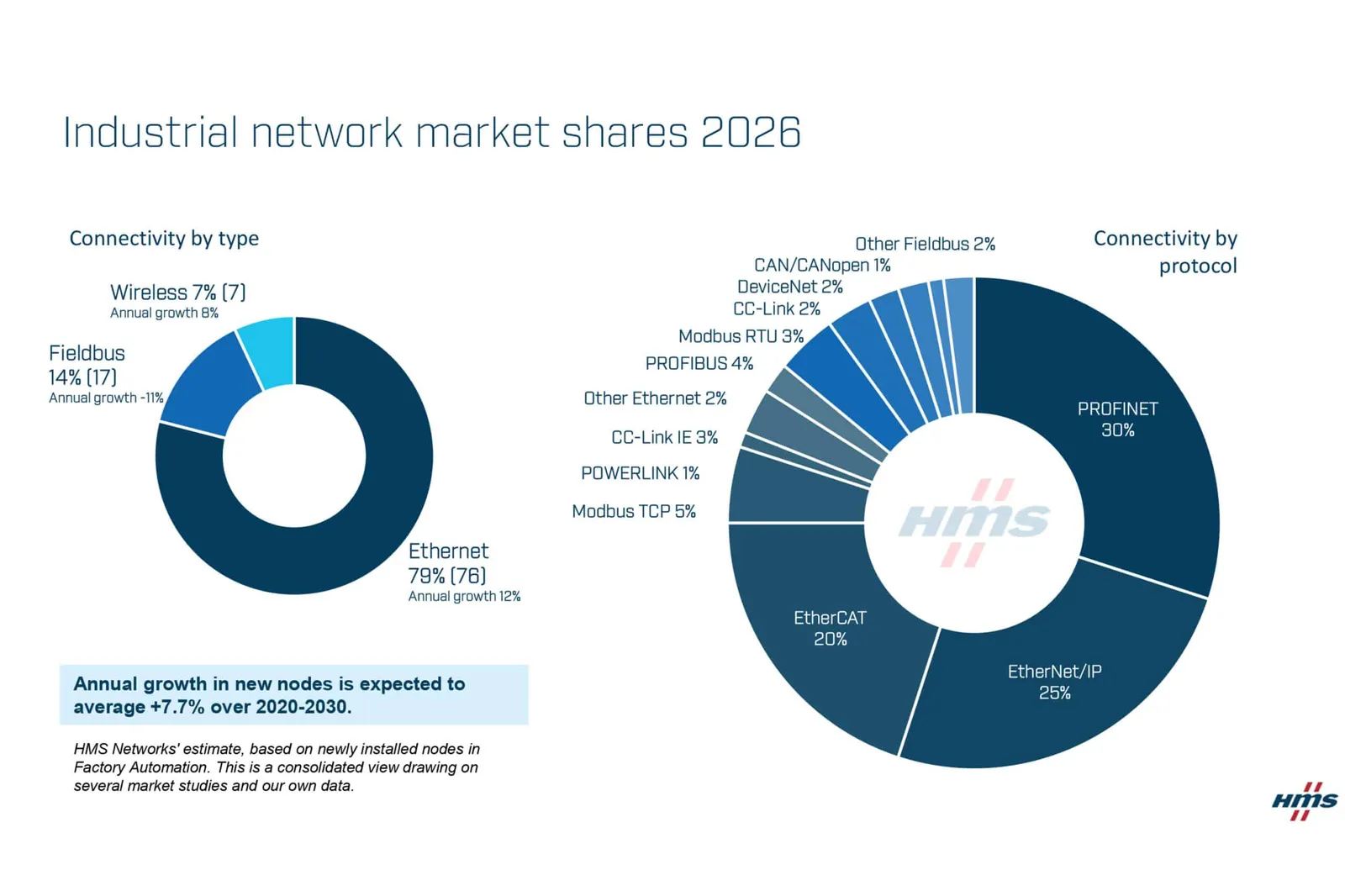
HMS Networks has published its annual analysis of the industrial network market. For twelve years running, the company has tracked how factories and machine builders connect their automation systems. The 2026 study shows that the long-running shift from traditional fieldbus technologies to Industrial Ethernet continued this year. Industrial Ethernet now accounts for 79% of newly installed nodes worldwide, up from 76% in 2025 and just 34% when HMS first published these figures in 2015.
Following the downturn in 2024, the market stabilised in 2025. Component availability returned to normal, and inventory cycles in highly automated sectors largely ran their course. Although the European automotive sector continued to face headwinds, production activity recovered slightly more broadly, and capital expenditure on new automation projects resumed in most regions. The 2026 study confirms HMS Networks’ expectation that the number of newly installed nodes will grow by an average of around +7.7% per year over the next five years, with the ongoing migration of the remaining installed fieldbus base to Industrial Ethernet driving a large share of that growth.
Industrial Ethernet accounts for 79% of new installations
The 2026 analysis shows that Industrial Ethernet now accounts for 79% of new nodes, up from 76% in 2025. The three leading Ethernet protocols have further strengthened their position and together represent around three-quarters of the wired protocol market.
For Industrial Ethernet:
- PROFINET strengthens its leading position at 30% (up from 27%)
- EtherNet/IP follows at 25% (up from 23%)
- EtherCAT continues its strong growth at 20% (up from 17%)
- Modbus TCP remains stable at 5%
- CC-Link IE remains stable at 3%
- POWERLINK falls to 1% (from 3%).
- The remaining 2% is accounted for by other Ethernet protocols, while market consolidation around the major networks continues.
Fieldbus share falls to 14% as PROFIBUS declines
Fieldbus technologies currently account for 14% of new nodes, down from 17% in 2025. Figures published by PROFIBUS & PROFINET International itself show that installations of new PROFIBUS nodes fell from 1.1 million in 2024 to 1.0 million in 2025, a decline of 9% confirmed by HMS Networks’ internal data from its industry research.
For fieldbus:
- PROFIBUS remains the largest fieldbus, but falls to 4% (from 5%)
- Modbus RTU remains stable at 3%, reflecting its continued role as a universal, low-cost serial protocol
- CC-Link, DeviceNet and CAN/CANopen all remain in the 1-2% range, with a modest further decline
- Other fieldbus protocols account for 2% combined, down from 4% as the long tail of legacy networks dwindles.

Wireless technologies remain stable at 7%
Wireless technologies are still used for 7% of new node installations, unchanged from 2025. They retain their established role as a complement to wired industrial networks and are particularly valuable for mobile equipment such as AGVs (automated guided vehicles) and AMRs (autonomous mobile robots), retrofitted machines and IIoT sensors in hard-to-reach locations.
5G continues to attract considerable interest, but industrial deployment is progressing slowly. The complexity of private 5G infrastructure is most often cited as a barrier. The number of early industrial 5G deployments continues to grow, particularly in Asia, but the technology has yet to achieve the widespread adoption many in the sector expected.
Regional insights
Europe: PROFINET and EtherCAT remain the leading protocols, with considerable activity around APL (Advanced Physical Layer) for process automation and SPE (Single Pair Ethernet) for sensor-level connectivity. The decline of PROFIBUS is most evident in Europe, where installations are most numerous and the transition to PROFINET is furthest advanced.
North America: EtherNet/IP remains the dominant protocol, particularly in the automotive industry and discrete manufacturing. Adoption of IO-Link, APL and SPE is gaining clear momentum, supported by interest in operational technology (OT) cybersecurity as regulations around CRA and IEC 62443 take shape.
Asia: Both PROFINET and EtherCAT continue to grow in the Chinese market. CC-Link IE, the first industrial protocol with a TSN mechanism, retains a strong regional position.
HMS Networks’ perspective
“Twelve years of data paint a remarkably consistent picture. The transition from fieldbus to Industrial Ethernet is now in its final phase, but the more interesting question is what happens next. When almost everything runs on Ethernet, the discussion shifts from ‘which protocol?’ to ‘what runs on it?’: functional safety, cybersecurity, TSN, OPC UA, Single Pair Ethernet and IT/OT convergence. That is where complexity and differentiation are increasingly found,” says Magnus Jansson, Director of Product Marketing at HMS Networks.
Magnus continues: “The 2026 figures also confirm what we found in our industry research: almost half of respondents now cite cybersecurity as one of the biggest integration challenges, while 93% expect OT cybersecurity to change significantly over the next five years. Protocols matter, but the layers above them increasingly determine how factories actually operate.”
Beyond protocols: a broader look at industrial networks
Complementing its annual market-share analysis, which it has published for many years, HMS Networks is releasing the ‘State of Industrial Networking’ report, a comprehensive companion report exploring the wider factors shaping industrial communications: cybersecurity, leading voices from industry worldwide, regional or industry-specific developments, and much more.
The comprehensive report is based on the ‘Future of Industrial Networks’ study, an external panel survey now in its second annual edition. The 2026 edition gathered responses from industrial designers and users across all major regions and sectors; participation in the 2027 edition opens in June this year. As year-on-year changes in individual protocol-level shares become smaller, the broader picture presented in the comprehensive report will increasingly shape discussion about the direction of industrial networks.
Question about this story? Ask your question
Keep following this
Get an email when a new story is published. No account needed.
- ThemeReliable industrial network connectivity
- SubjectControl & networks