On the move: when cables determine punctuality
Reliability at the airport: REEL GmbH optimises automated passenger boarding bridge with igus energy chains
The train is delayed, the tickets are still on the kitchen table, a child has forgotten their favourite toy: there are plenty of reasons why you might miss your flight. Less well known are the factors at play behind the scenes of airport operations, such as the automated passenger boarding bridges that carry passengers from the terminal to the aircraft. Here, countless cables have to follow complex 3D movements as the bridge connects to the aircraft. A fault in one of the cables can delay boarding. To minimise this risk, German company REEL has opted for igus energy chains.
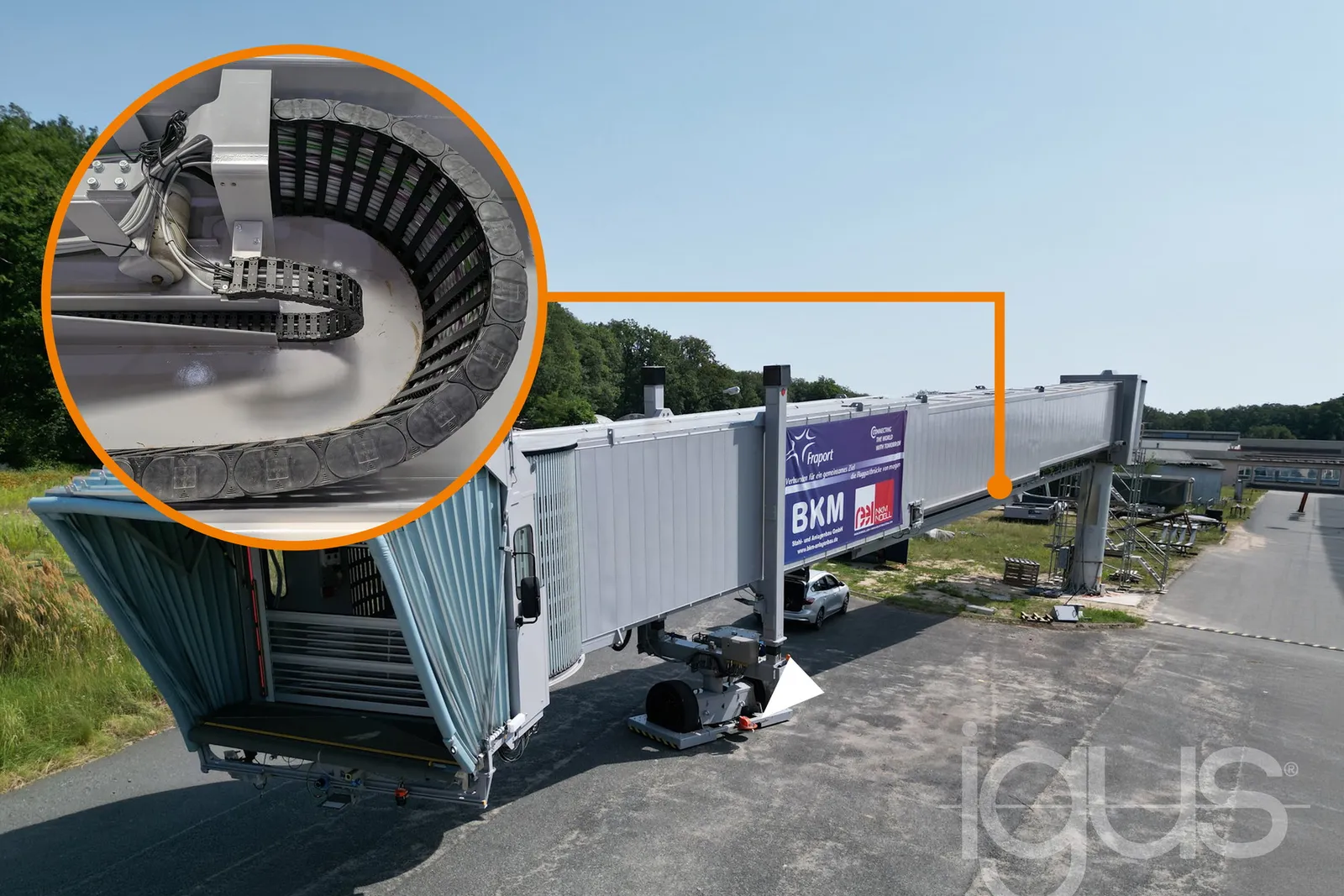
REEL’s automated passenger boarding bridge has to move between different levels: it extends and retracts like a telescope, turns, and moves up and down to reach different types of aircraft. This puts the numerous cables running through the bridge, which supply power and data to sensors, for example, to the test. If left unprotected inside the structure, they could rub against metal edges, become trapped between components or be damaged by repeated bending. “Airports expect maximum availability. Cable guidance is therefore one of the critical design considerations,” says Sven Helbig, design engineer at REEL. “We therefore decided to use energy chains from igus’s E4.42 series to guide the cables.”
Cable protection for complex 3D movements
The design engineers mounted the energy chain vertically in an enclosed metal guide channel. This prevents the energy chain from shifting sideways and protects it from dirt, ice and foreign objects. As it extends and retracts through three telescopic sections, with a total travel of 17.35 metres, one part of the energy chain moves with the moving bridge section, while the other remains attached to the fixed section. An additional E4.21 series energy chain, running horizontally between the upper and lower runs of the stationary energy chain, houses the power and data cables for the central telescopic section. At the end of the guide channel, the design engineers routed a number of cables through a second energy chain from the triflex series. This provides height adjustment and can move in three dimensions. “Thanks to the clever interaction between the energy chains, the cables are guided in a controlled manner throughout the entire movement and protected against mechanical stresses such as abrasion, snagging and excessive bending. This reduces the risk of cable faults and increases the operational reliability of the passenger boarding bridge,” explains Markus Marienfeld, technical sales consultant at igus. He is overseeing the project.
Built for demanding airport conditions
When developing the cable guide, REEL’s designers had to consider more than just the sequence of movements. Another challenge was that passenger boarding bridges are exposed to changing weather conditions outdoors all year round: heat, frost, rain and UV radiation. They are also exposed to aggressive chemicals such as cleaning agents, de-icing fluids and kerosene. “These stresses can cause cables and guides to wear prematurely, and plastics to become brittle or swell. This can have a negative effect on the system’s operational reliability,” says Helbig. “igus energy chains are made from high-quality plastics designed for long-term use in these demanding environmental conditions. This helps ensure high system availability and long maintenance intervals.”
Reliability through optimised system technology
One of the biggest challenges for the design engineers was finding suitable power and data cables that could withstand the movements, long travel distances and harsh environmental conditions typical of airport operations. “Combining energy chains and cables from different manufacturers would have required a great deal of coordination,” says Helbig. “So we were very pleased that igus now offers more than 1,350 cable types in its chainflex range, specifically developed for use in energy chains.” The cables and energy chains are perfectly matched in terms of bend radius, dynamic performance and service life, and are designed as an integrated system to ensure reliable operation over the long term. For added peace of mind, the plastics specialist offers a warranty of up to four years on its products, based on an igus service-life calculation. “In this way, energy chains and cables play a crucial behind-the-scenes role in ensuring that our passenger boarding bridge operates reliably and that your journey does not get off to a delayed start at the gate,” explains Helbig.
Question about this story? Ask your question
Companies in this story

Keep following this
Get an email when a new story is published. No account needed.
- ThemeReliable industrial network connectivity
- SubjectNews
- Companyigus B.V.