Humanoid robots and grippers
Text Valérie CouplezImage iStock
Global market estimated at three billion dollars
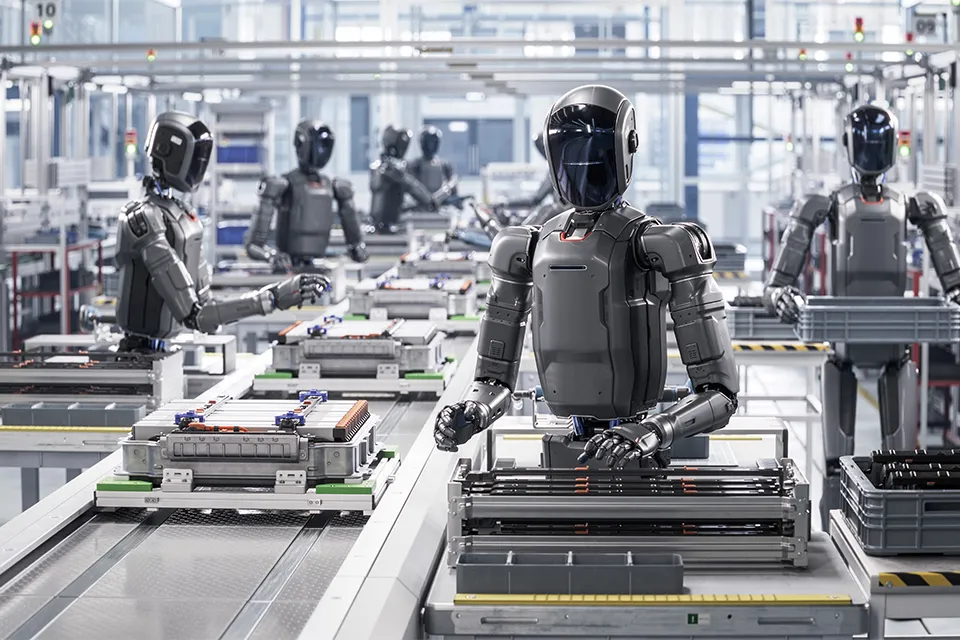
In the near future, humanoid robots could become a reality: machines powered by artificial intelligence and equipped with interfaces that can imitate human conversations. Companies capable of developing such humanoid robots could gain an edge over their competitors. But what is also certainly needed is a framework: setting out a vision and continuing to invest in R&D to support the robotics ecosystem.
The global humanoid robotics market is estimated at around three billion dollars and, according to Technavio, will grow by double digits each year. Although no manufacturer has yet produced a true general-purpose platform, the industry is building advanced hardware platforms and developing sophisticated prototypes that use general artificial intelligence to solve problems, rather than simply carrying out specific tasks as AI does. These machines can already perform tasks in various sectors. One estimate predicts that such robots could eventually replace around 35% of existing jobs. Applied to the US labour market, for example, that would mean 55 million jobs.
What sets a humanoid robot apart?
Humanoid robots have four capabilities: perception, locomotion, manipulation and autonomy. Perception uses sensors and cameras to provide spatial awareness. Locomotion, using wheels or bipedal movement, enables navigation, while manipulation through dexterous ‘hands’ enables interaction. Autonomy is the ability to operate independently, using machine learning for continuous improvement.
Humanoid robots set to revolutionise industries
The combination of these capabilities means that humanoid robots could revolutionise industries. Repetitive tasks, particularly in customer-facing roles, are the most likely candidates in the short term. In healthcare, for example, robots could carry out routine tasks and provide basic patient care, such as measuring vital signs. They could eventually transform hazardous industries by working in mines, on oil rigs and in nuclear power plants. As space exploration advances, humanoid robots could maintain equipment and operate in hostile environments.
Boosting productivity and cutting costs
Humanoid robots are resilient. The average person works 240 eight-hour days a year. Humanoid robots can work for up to twenty hours a day for more than 350 days a year, stopping only for maintenance and recharging. That amounts to around four times the labour productivity of humans. Robots are also more accurate and are not affected by fatigue or distraction. They also reduce labour costs. Goldman Sachs reports that prices have already fallen as production has increased, from 250,000 dollars per unit in 2022 to around 150,000 dollars per unit in 2023. Tesla is even aiming for a price of 20,000 dollars per robot. Assuming a conservative lifespan of three years, the cost of ownership would be 5 dollars per hour, considerably lower than the average wage for low-skilled workers in the US, even before factoring in the cost of benefits and extensive HR and training processes.
Addressing risks and ethical concerns
However, humanoid robots come with potential risks and ethical concerns. These systems collect and store vast datasets, including personal information and behavioural patterns, without necessarily having obtained consent from the people they interact with. Bias in programming, already evident in generative AI models as a result of their training data, could lead to biased behaviour. Similarly, robots could be programmed to manipulate users’ decisions, undermining trust. Given their size, strength and speed, faulty machines could pose a physical safety threat to people.
Question about this story? Ask your question
Keep following this
Get an email when a new story is published. No account needed.
- ThemeFlexible production with robots
- SubjectMotion, gears & drives