Software, IT, OT & cybersecurity
How data connectivity is becoming the backbone of industry
Text Christobal van LeeuwenImage iStock
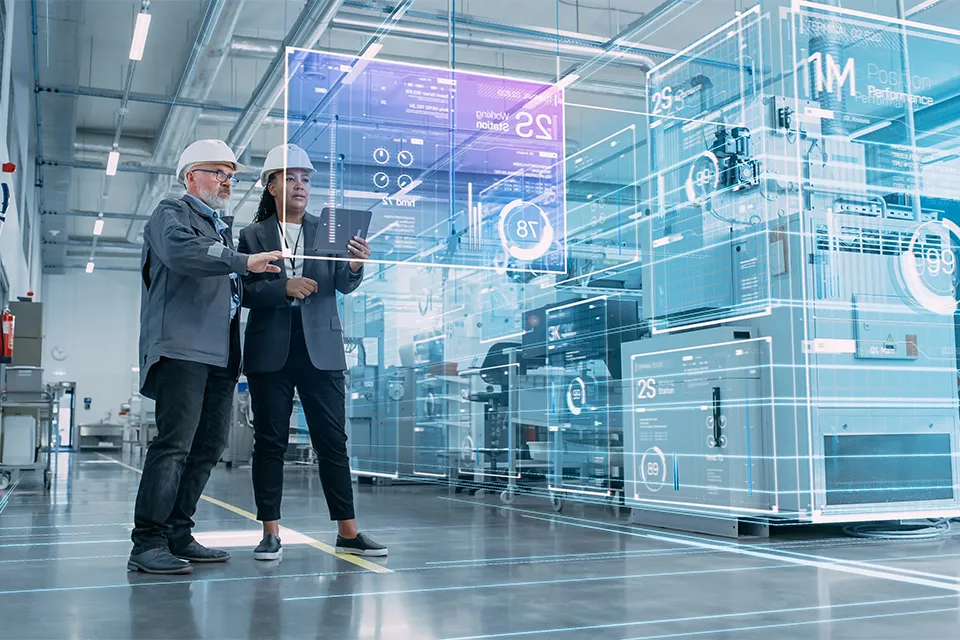
Connecting machines is one thing. Getting data to flow reliably, securely and usefully throughout the factory is the real challenge…
In industrial automation, connectivity is about much more than simply ‘connecting machines to the network’. In modern production environments, the data layer determines how quickly companies can optimise, maintain, secure and scale their operations. For machine builders, integrators and manufacturers, connectivity is therefore a technical and strategic design challenge.
Anyone building or modernising a production line today will almost inevitably have to deal with connectivity. PLCs, sensors, variable speed drives, robots, HMIs, vision systems, SCADA, MES and cloud platforms all generate or use data. Yet that does not mean the data is automatically available, reliable or useful.
In many factories, the automation layer comprises several generations of technology. A packaging line runs on PROFINET, an older process plant uses PROFIBUS and a robot cell communicates via EtherNet/IP, while new sensors provide additional diagnostic data via IO-Link. On top of that, maintenance, production, quality and management all want to extract different information from the same installation. The key question is no longer whether machines need to be connected, but how to do so in a manageable, secure and future-proof way.
Not every protocol serves the same purpose
A common mistake is to reduce connectivity to the choice of a single protocol. In practice, different communications technologies each have their place. At machine level, industrial Ethernet protocols such as PROFINET, EtherNet/IP, EtherCAT and Modbus TCP remain important for real-time communication between PLCs, drives, I/O and machine components. They are designed for deterministic processes, cycle times and reliable control. OPC UA is more commonly used for data exchange between machines, SCADA, MES and IT systems. The OPC Foundation describes OPC UA not just as a protocol, but as a framework for standardised data exchange with built-in end-to-end security across multiple transport layers. This matters because OPC UA does more than pass on values: it can also provide context. What does this temperature mean? Which machine does this motor current belong to? What unit is used for this parameter?
MQTT is also gaining ground in IIoT architectures. It is lightweight, scalable and suited to sending data from edge devices to brokers, dashboards or cloud platforms. In practice, it is not a question of OPC UA or MQTT. Increasingly, the two are combined: OPC UA for structured industrial data and MQTT for efficient distribution to higher-level systems. OPC UA over MQTT and Time-Sensitive Networking are also being cited as building blocks for faster, more standardised industrial data flows.
IO-Link brings data right down to sensor level
Connectivity does not stop at the PLC. A great deal of valuable information is generated at sensor level. Conventional sensors often provide only a switching signal or an analogue value. With IO-Link, sensors and actuators can share additional data: signal margin, contamination, temperature, status information, error codes or parameters. This may seem like minor detail, but it is particularly valuable for maintenance and troubleshooting. An optical sensor that reports a falling signal margin can be cleaned before it causes faults. A pressure or level sensor can provide diagnostic data that helps pinpoint a process deviation more quickly. Modern IO-Link masters also often support connections to higher-level networks and sometimes to OPC UA or MQTT, making it easier to pass sensor data on to IT or cloud systems.
For machine builders in the Benelux, this is a tangible selling point. A machine that can diagnose itself more effectively is quicker to commission, easier to maintain and more attractive to end users with limited technical staff.
Edge computing prevents data bottlenecks
More data is not automatically better. A production line can generate thousands of data points per second, but not every data point needs to go to MES or the cloud. Without filtering, data structures become expensive, slow and difficult to navigate. This is why edge computing is becoming more important. Edge devices or industrial gateways collect data close to the machine, translate protocols, buffer information and run local logic or analysis. Only relevant events, KPIs or trends are forwarded.
One example: vibration data from a motor does not need to be sent in full to the cloud continuously. The edge device can analyse locally whether the vibration value deviates from a normal pattern. A notification is sent to the maintenance system only if a threshold is exceeded or a trend changes. This keeps data volumes manageable while ensuring the response is fast enough for the production environment. This is relevant to sectors such as food, pharma, chemicals, logistics and metalworking. Production must not become dependent on a slow or unstable external connection. Critical decisions remain local, while reporting and optimisation are made available at higher levels.
Unified namespace: promise and pitfall
The term unified namespace crops up in many digitalisation projects. The idea is appealing: all relevant production data is published in a standardised way, so systems do not have to be connected point to point every time. In practice, this requires discipline. Data points must be named logically, given context and maintained throughout the installation’s lifecycle. Without a data model, a unified namespace can quickly become a digital junk drawer.
This is where integrators have an important advisory role. It is not just the technical connection that matters, but also the data structure: which assets, lines, machines, modules and parameters are distinguished? What naming convention is used? Which data is needed in real time and which only for reporting? Connectivity is therefore also an exercise in industrial information modelling.
Cybersecurity belongs in the design
As OT and IT become more interconnected, cybersecurity becomes increasingly important. Remote access, cloud connections, supplier connections and IIoT gateways increase the attack surface. The ISA/IEC 62443 series provides an international framework for cybersecurity in industrial automation and control systems, covering areas such as risk analysis, zones, conduits and a lifecycle approach. For industrial companies, this is complemented by the broader European NIS2 context. The NIS2 Directive has been in force since January 2023 and had to be transposed into national law by the Member States by 17 October 2024. In practice, national implementation is not progressing at the same pace everywhere, but the direction is clear: cyber resilience is becoming more explicitly regulated in industrial environments too. For Belgian companies, the Centre for Cybersecurity Belgium is the central point of contact for information and registration relating to NIS2. In the Netherlands, essential and important entities register via the National Cyber Security Centre under the Cybersecurity Act. This means that industrial connectivity in the Benelux also has a more explicit compliance and cybersecurity dimension.
In practical terms, this means industrial connectivity can no longer be considered separately from network segmentation, access management, patch management, monitoring and logging. A machine with remote service is only professionally connected when it is clear who has access, when, to which components and with what permissions.
Connectivity choices start with the use case
The biggest pitfall remains taking a technology-driven approach. Companies then start with ‘we want data in the cloud’ or ‘we want OPC UA’, without clearly defining the problem they want to solve. A better approach starts with the use case. Is the goal predictive maintenance? Then condition data, trend analysis and alarm context matter. Is it energy management? Then consumption data must be correctly linked to the line, batch or product type. Is it quality control? Then traceability, timestamps and links to process parameters are crucial. Connectivity is therefore not a standalone IT project, but an automation challenge that starts with the machine and ends with the business objective.
From cable to competitive edge
The value of industrial connectivity lies not in the connection itself, but in what it makes possible: faster fault diagnosis, less downtime, better energy insights, remote service, flexible production and better-informed decisions. This is particularly relevant to industry in the Benelux, with its strong machine-building, process, food, logistics and high-tech manufacturing sectors. Companies that build their data layer thoughtfully create a foundation for future digitalisation. The smart factory therefore does not start with a dashboard, but with a robust, secure and well-modelled connectivity architecture. Only then does data become a factor of production rather than a by-product.
Question about this story? Ask your question
Keep following this
Get an email when a new story is published. No account needed.
- ThemeReliable industrial network connectivity
- SubjectSoftware, IT, OT & cybersecurity