Designing for safety is more strategic than ever
Text Christobal van LeeuwenImage iStock
Safety is truly effective only when risk analysis, control systems, software and human behaviour are designed together from the engineering phase
Machine safety is about much more than an emergency stop, guarding or CE marking. In modern production environments, where machines are connected, robots operate closer to people and software controls an increasing number of functions, safety is becoming an integral design principle. This approach is becoming increasingly important for machine builders, integrators and end users.
The fundamentals remain unchanged: risks to operators, maintenance technicians and bystanders must be reduced to an acceptable level. This starts with a thorough risk assessment. What hazards are present? Who could be exposed to them? How serious could any injury be? How often does exposure occur? And can the risk be avoided, guarded against through technical measures or reduced through organisational measures?
In practice, this exercise has become more complex. Machines are more flexible, faster and more closely connected to IT and OT systems. Operators intervene more frequently for changeovers, cleaning, quality checks or troubleshooting. Robots, cobots and mobile systems move through environments where people are present. As a result, safety needs to be factored into the design much earlier.
Safety does not start at the end
A classic pitfall is considering machine safety only when the machine is almost complete. That is when it becomes clear that a light curtain obstructs the workflow, guarding makes maintenance more difficult or an emergency stop circuit does not meet the required Performance Level. The result: modifications, delays and frustration.
A sound safety concept starts in the engineering phase. Layout, access points, maintenance zones, moving parts, operator stations and software functions all need to be considered together. Safety therefore affects not only compliance, but also ergonomics, cycle time, availability and ease of maintenance. This is crucial for OEMs. Machines are often built for demanding sectors such as food, pharmaceuticals, chemicals, logistics and manufacturing. Customers expect not only productivity, but also demonstrable compliance, safe operation and easy access for maintenance and cleaning.
Functional safety requires substantiation
For safety-related control systems, standards such as EN ISO 13849-1 and EN IEC 62061 provide guidance. They help determine how functions such as an emergency stop, guard locking, safe speed monitoring, two-hand control or area monitoring should be designed, calculated and validated. It is about more than components bearing a safety label. The entire safety channel matters: sensor, logic, actuator, diagnostics, fault response and reset behaviour. A guard lock, safety PLC and drive only form a safety function when it is clear which risk they reduce and what Performance Level is required for that purpose.
Documentation and validation are just as important as the hardware itself. A safety function must demonstrably do what it promises, even under fault conditions. This requires calculations, diagrams, software validation, test procedures and clear limits on use. Good safety documentation can prevent a great deal of debate, especially when machines are later modified or expanded.
European regulations raise the stakes
The European Machinery Regulation replaces the current Machinery Directive and will apply from 20 January 2027. This is particularly relevant to machine builders and end users because the regulation applies directly across the European market. The new rules take greater account of technological developments such as software, cybersecurity, artificial intelligence, autonomous systems and digital documentation. This brings machine safety more closely into line with digital reliability. A machine may be mechanically sound by design, yet still be exposed to risk if software settings, remote access or network connections are not adequately controlled. Cybersecurity and safety are therefore converging. This does not mean every machine is suddenly an IT project, but manipulation, unauthorised access or uncontrolled software changes can pose safety risks. Remote access, user permissions, logging, updates and network segmentation are therefore increasingly part of the safety file.
People remain central
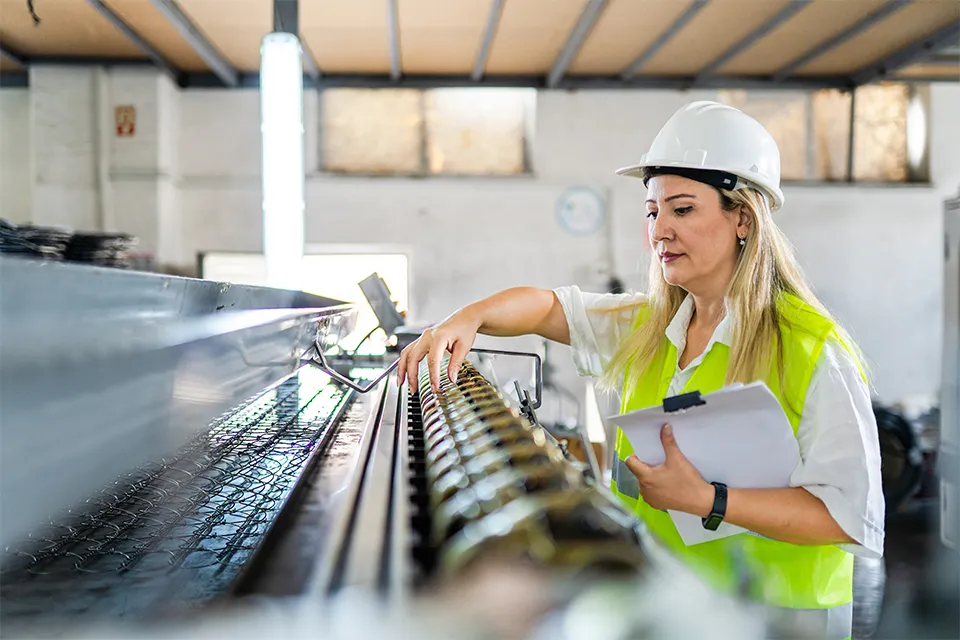
Automation changes the operator’s role, but does not remove people from the process. People set up machines, troubleshoot faults, clean equipment, carry out quality checks and perform maintenance. These are often the moments when the greatest risks arise, because safeguards may be temporarily opened, movement may start unexpectedly or there may be considerable pressure to resume production. Machine safety must therefore be assessed not only during normal operation, but also in all reasonably foreseeable situations: setting, cleaning, troubleshooting, maintenance, product changeovers and interventions by external technicians. Safe maintenance modes, reduced speed, hold-to-run controls, lockout/tagout procedures and clear status information can make all the difference.
Communication is also essential. Operators need to be able to see whether a machine is safely stopped, running in automatic mode, in maintenance mode or waiting for a reset. Clear HMIs, easy-to-understand alarms and logical operating procedures are therefore not minor details, but part of safe design.
From box-ticking exercise to design strategy
Machine safety is evolving from a box-ticking exercise into a strategic design principle. Integrating safety early means building machines that not only comply with the rules, but also work better in practice. A sound safety concept makes maintenance more accessible, reduces unplanned downtime and prevents users from bypassing safeguards because they are obstructive or illogical. For industry, this is not a brake on innovation, but a prerequisite for reliable, efficient and future-oriented automation. The safest machine is not the one with the most guarding, but the one in which risks, production flow, maintenance and human behaviour have been designed together from the outset.
Question about this story? Ask your question
Keep following this
Get an email when a new story is published. No account needed.
- ThemeFlexible production with robots
- SubjectServices & solutions