Three simple steps to a reliable vacuum system
Text Mattias Sundberg, SMCImage SMC
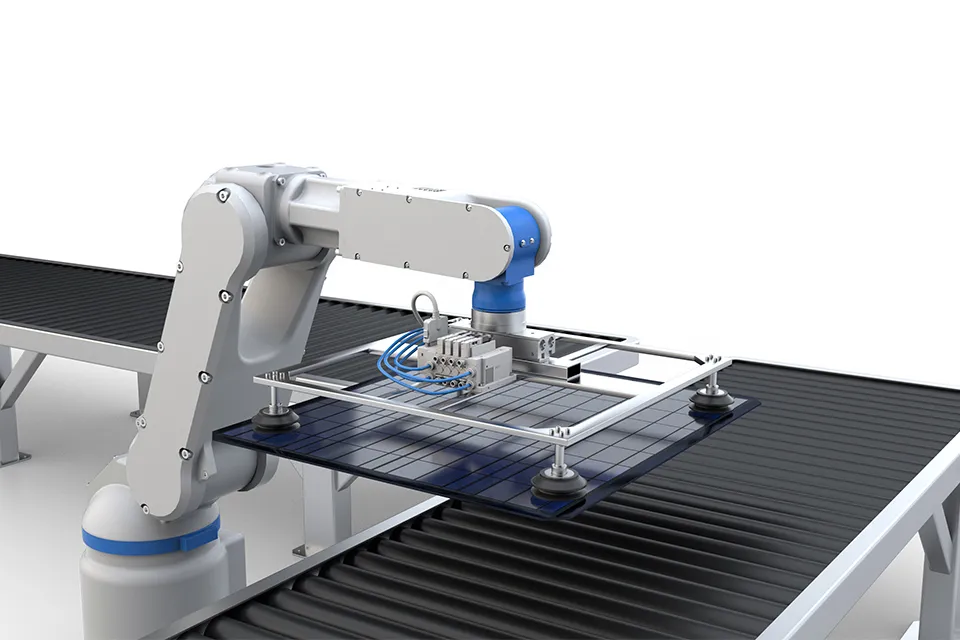
Vacuum systems are the basis of many industrial applications, from packaging to material handling. They integrate easily with automation systems, but choosing the right solution early in the design process is essential to the success of a project. To help you make this choice, Mattias Sundberg, Product Manager Nordic and Baltic Countries at SMC, shares his insights into the key considerations in the specification process, using three clear steps. You will discover which type of vacuum system is suitable for each application, what to consider for each type of workpiece (non-porous or porous) and which gripper to select.
Step 1: Centralised or decentralised?
The first step is to choose between a centralised or decentralised ejector system for vacuum generation. Put simply, a centralised system houses everything in a single module, from the ejector and valve to the pressure sensor and filter, while a decentralised configuration consists of separate components. What are the main advantages and disadvantages?
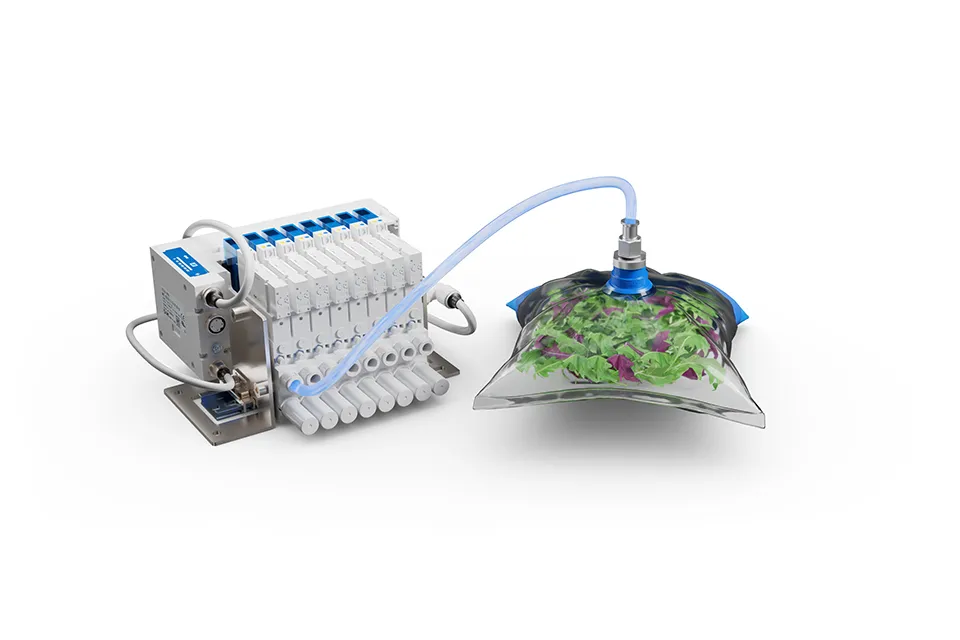
An ‘all-in-one’ design saves installation time and simplifies maintenance by bringing all the components together in one place. In a centralised system, the option of IO-Link or fieldbus communication provides full connectivity across the factory and access to data for intelligent decision-making. A good example of a centralised solution, with energy savings and the ability to control several ejectors and positive-pressure units simultaneously, is the SMC ZKJ vacuum ejector manifold. The ZKJ can control up to 16 ejectors and/or 5/2 valves via various fieldbus protocols and IO-Link. It can also generate negative pressure (vacuum) and positive pressure (for actuators, for example) at the same time, saving space and costs.
Although decentralised systems are more flexible and may be slightly less expensive, they are less ‘intelligent’ than centralised alternatives. They are useful when vacuum cups are positioned far apart. However, intelligent control requires a central PLC, which adds complexity to the process. ❯
Step 2: Choosing the right ejector
The starting point for ejector selection is the suction flow rate required to remove air from the vacuum cups. The time taken to reach the required vacuum pressure also matters. The pressure required depends almost entirely on the workpiece. Non-porous plastics and metals allow little air to pass through, but porous materials can cause significant leakage, as is the case with cardboard.
Once the basic parameters have been established, factors such as efficiency (flow rate/air consumption), energy savings, workpiece drop prevention, communication options, noise level and installation constraints can be considered. There is a strong need for customised solutions, and SMC offers a wide range of ejector types, from highly compact in-line models to fully integrated manifold solutions, to optimise vacuum generation for every application.
A normally open supply valve maintains the vacuum in the event of a power failure, preventing the workpiece from falling. The energy-saving function, using a vacuum sensor, keeps the pressure within an acceptable range and consumes compressed air only when vacuum is required. This delivers significant savings compared with systems that generate vacuum continuously. For example, the ZK2 high-efficiency vacuum ejector can reduce air consumption by more than 90%. Operating for 10 hours a day, 250 days a year, it consumes 58 l/min ANR (compared with 85 l/min for the ZM series), with a blow-off time of 0.6 seconds. This amounts to 93% annual air savings.
Selecting a supplier with proven expertise is crucial. SMC supports customers worldwide in determining the right suction flow rate for reliable handling with optimum energy efficiency.
Step 3: Selecting vacuum cups
Cup selection depends on the size, shape and material of the workpiece. Oily metal sheets require a robust cup with high lateral grip. Glass requires cups that leave no marks. Extremely flexible lip cups are essential for thin plastic bags.
The operating environment also determines the choice of material. In dusty environments, cups with an integrated filter or extra-wear-resistant materials are desirable. For high temperatures or harsh conditions, FS61 fluororubber cups (such as the SMC ZP3C and ZP3M) offer more than twice the service life of urethane and can withstand temperatures of up to 200°C.
SMC supplies the optimum vacuum cup for every workpiece, shape and material, matched to the operating environment and designed with a focus on reducing energy consumption.
Future-proof your project
SMC offers design and application support to maximise safety, reliability, productivity and energy efficiency in vacuum handling.
Have a business enquiry for SMC? Get in touch
Companies in this story
Keep following this
Get an email when a new story is published. No account needed.
- SubjectSensors & vision
- CompanySMC