Software, IT, OT & cybersecurity
Essential components of modern SCADA technology
Text Valérie CouplezImage iStock
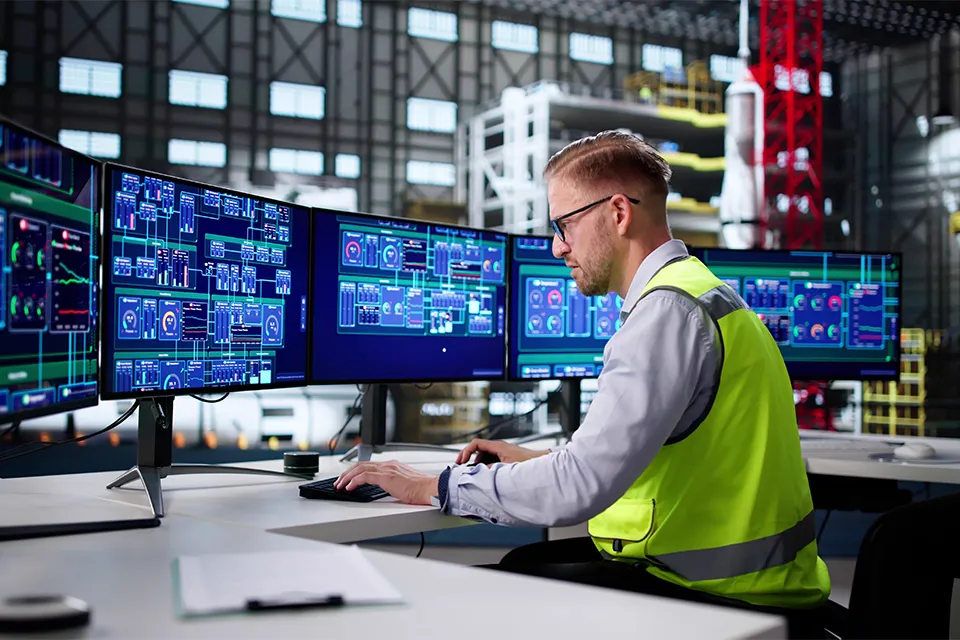
In industrial automation, SCADA (Supervisory Control and Data Acquisition) is the central nervous system of critical infrastructure. Whether managing a city’s water supply, a vast electricity grid or a high-speed production line, SCADA systems enable operators to monitor and control processes from a single location, even across vast geographical areas.
As we move further into the era of Industry 4.0, SCADA architecture has evolved from isolated local installations into highly integrated, data-driven ecosystems.
1. Field instrumentation and control equipment
At the bottom of the architecture, often referred to as Level 0 and Level 1, are the physical devices that interact with the industrial process. Sensors measure physical parameters (temperature, pressure, flow rate, …), while actuators perform physical actions (opening a valve, starting a motor, …). PLCs are the workhorses of the factory floor. They receive data from sensors and execute local logic to control machines in real time. Unlike PLCs, RTUs are designed to communicate over long distances. They are typically used in remote environments, such as a pipeline in the middle of a desert, to send data back to the central station via wireless or satellite connections.
2. The communications network (the data highway)
In a modern system, the communications network provides the link between the field and the control room. Traditionally, this relied on proprietary serial cables, but modern SCADA has moved to Industrial Ethernet and wireless protocols. Modern systems use robust protocols such as Modbus TCP, EtherNet/IP and DNP3. With the rise of IIoT, many SCADA architectures now use MQTT (Message Queuing Telemetry Transport), a publish-subscribe protocol that is much lighter and more efficient for remote data transmission. High-availability networks often use ring topologies to ensure that, if one cable is cut, data can still reach its destination via an alternative route.
3. The MTU or SCADA server
The MTU (Master Terminal Unit) is the brain of the entire operation. It is the central server that collects, processes and stores data from field devices for analysis. The server polls the PLCs and RTUs at fixed intervals to obtain the latest readings. The MTU is also responsible for triggering alarms. If a pressure sensor reports a reading above a safety threshold, the SCADA server detects this and immediately alerts the operators.
Most modern MTUs include a Data Historian, a specialised database optimised for time-series data. This enables engineers to identify trends in the data or investigate the cause of a previous fault.
4. HMI (Human-Machine Interface)
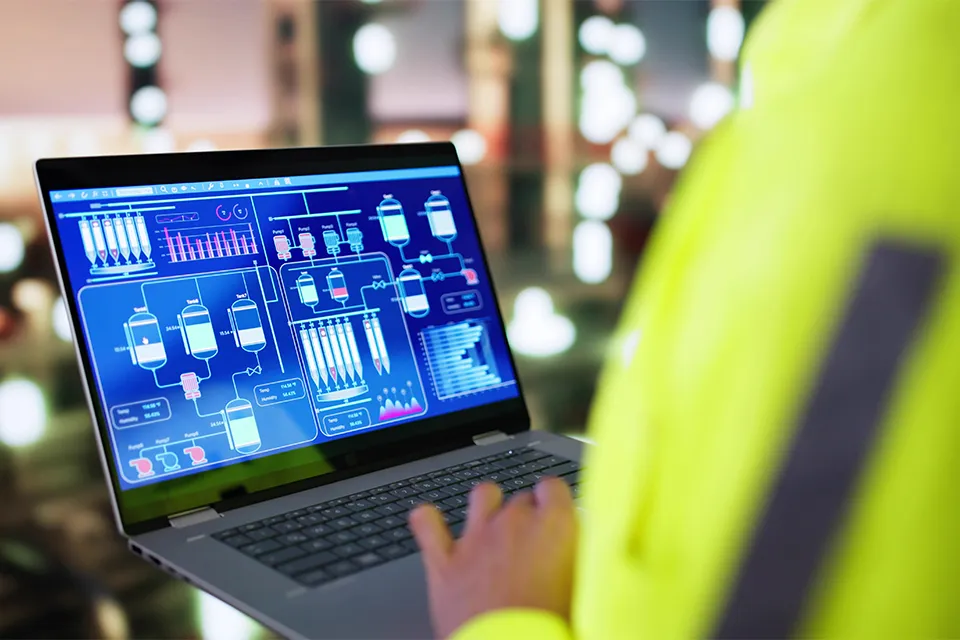
The HMI is the ‘face’ of the SCADA system. It is the software interface that translates complex machine data into visual graphics that a human operator can understand. Instead of looking at raw code or spreadsheets, operators see a digital twin of their installation. They can see a pump turn green when it is running or red when there is a fault. HMIs work in both directions. An operator can click a button on a touchscreen to adjust a setpoint or shut down a turbine remotely. A defining feature of modern SCADA is the shift to web-based HMIs (HTML5). This allows supervisors to monitor the plant from a tablet or smartphone anywhere in the world, rather than being tied to a specific desktop in a control room.
5. Security and integration layer
In the past, SCADA systems were ‘air-gapped’ (disconnected from the internet). Today, they are connected to corporate networks and the cloud, making cybersecurity a core part of the architecture rather than an afterthought. Modern architectures use a Demilitarized Zone (DMZ) to separate the sensitive industrial network (OT) from the corporate business network (IT). By processing certain data using edge computing at the ‘edge’ (close to the machine), companies can reduce latency and filter out ‘noise’ before sending the most important data to the cloud. Modern SCADA does not operate in isolation. It feeds data directly into ERP systems to help management make better business decisions based on real-time production costs.
Why architecture matters
A well-designed SCADA architecture ensures that an industrial operation is not only efficient, but also resilient. By choosing the right field equipment, securing the communications network and using modern HMI tools, companies can turn their raw data into a competitive advantage.
Question about this story? Ask your question
Keep following this
Get an email when a new story is published. No account needed.
- ThemeFrom factory data to decisions
- SubjectSoftware, IT, OT & cybersecurity