Energy management and production are no longer separate worlds
Text Valérie CouplezImage Schneider Electric
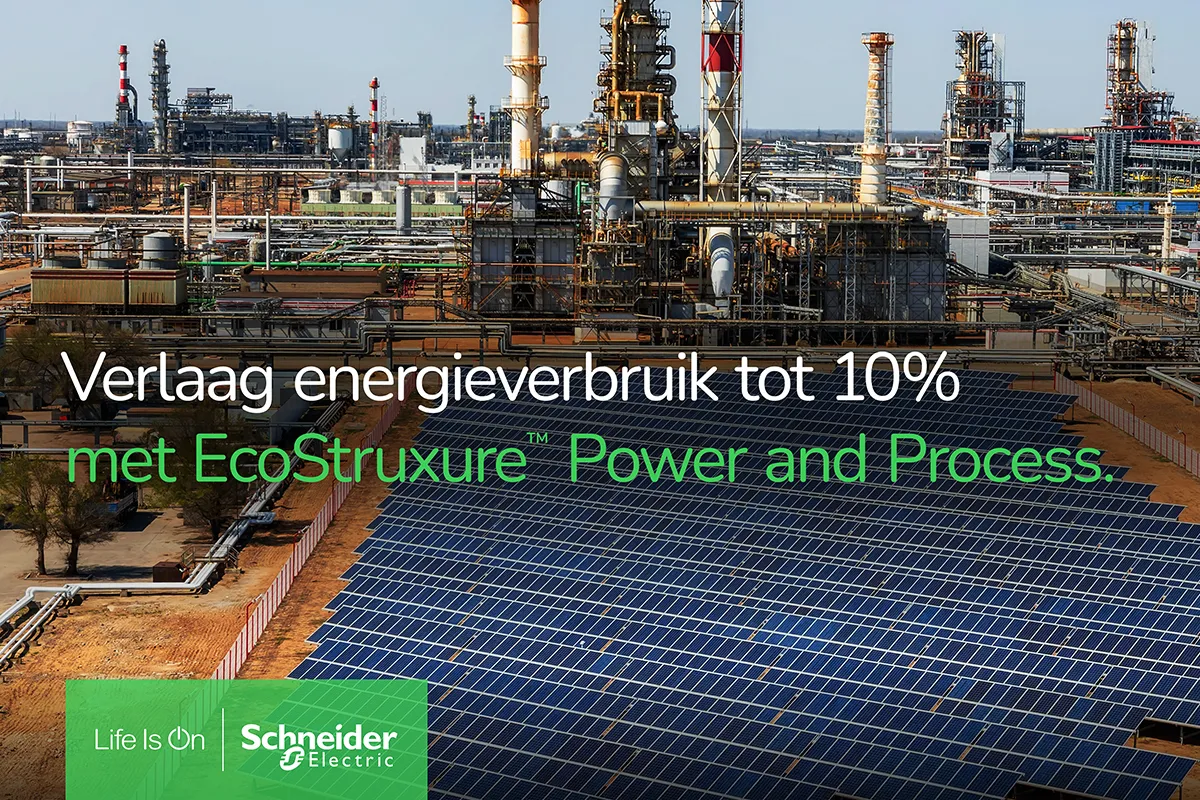
It used to be simple. You plugged into the mains and your production ran at an affordable cost. The situation today is far more complex. “Regulations require decarbonisation, which means electrification. At the same time, however, companies are grappling with higher energy prices and sometimes even the availability of electricity itself. Energy is therefore firmly on the agenda,” says Sander van Reijzen, vice-president at Schneider Electric for Industrial & Proces Automation. “At Schneider Electric, we are in a unique position to develop good solutions.”
Companies need to rethink energy management, particularly now that renewable energy and dynamic tariffs have added new pieces to the chessboard. “When does it make sense to produce energy, and when to consume it? And how can I guarantee availability? Energy management is increasingly becoming part of the bigger picture. It works best when fully integrated into production and across the entire lifecycle of a machine, line or plant. Only then can you really optimise,” says Van Reijzen.
A portfolio spanning both worlds
This increasingly close integration makes Schneider Electric an ideal partner for many customers. “That’s because our portfolio has traditionally covered both worlds: power and process, energy management and automation. There are plenty of software start-ups offering tools for working with renewable energy. But if, for example, you want to produce hydrogen, you also need to understand how an electrolyser works and what impact it will have. We can combine and integrate both sides of the equation perfectly, with hardware and software, but above all with a wealth of expertise.” And that is precisely the barrier preventing many companies from taking the next steps in power and process. With so much more to consider, it is difficult to see the wood for the trees. “There are so many variables to take into account… it’s no longer something you can work out on paper. That’s why we have strong faith in digital twin technology to make the energy challenge manageable.”
Rethinking engineering
So the earlier you can get involved in the discussions, the better. Van Reijzen gives an example to make the point. “You can’t simply replace a gas boiler with an electric one. You need to think carefully about the impact on the rest of your process. Traditional engineering often involves oversizing, just to make sure there is always enough capacity. But perhaps that isn’t necessary for your new business case. Could you choose a smaller boiler, operate it for less than 24/7, or design it to meet different requirements? We look beyond the design to consider the best decisions across the entire lifecycle. The earlier we are involved in these discussions, the more of our expertise we can share. And the more customers can tell us about their process, the more value we can bring to a project. It’s a real two-way exchange.”
Success stories
A Dutch potato processor has already carried out this exercise with Schneider Electric. The aim was to install a new electric boiler, keep consumption below 10 MW and check the electricity bill against the actual values indicated by the relays. By combining Aveva software with EcoStruxure Power and Process technology, the starch and protein producer implemented an integrated solution bringing energy and process control together. It now has all the tools it needs to align production and energy management perfectly: load shedding, overload alarms, network analysis and stability improvements, safe remote switching, and more. The solution is also scalable, ensuring future improvements can be made.
For every customer
Brownfield or greenfield, it makes no difference to Schneider Electric. “Both can deliver significant savings,” says Van Reijzen. “The advantage of a greenfield site is that you can start from scratch and make the best choice for every process step. With a brownfield site, you already have more data available to build your statistical model. Companies can also decide for themselves how far they want to go with modelling and optimisation. Any customer working on electrification or optimisation can therefore benefit from an integrated approach to power and process. You don’t even need to be operating on a huge scale. We help our customers turn their ambitions into concrete investments in hardware and software.”
Question about this story? Ask your question
Keep following this
Get an email when a new story is published. No account needed.
- ThemeFuture-proof production amid scarcity
- SubjectServices & solutions