Integrating components into cobot software
Making life easier for the integrator
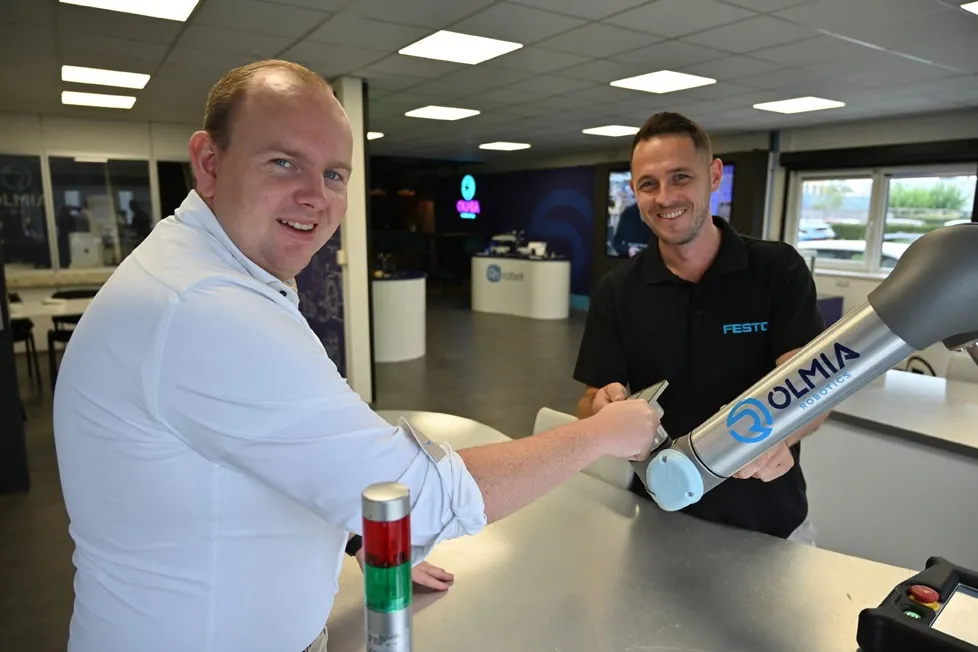
When suppliers want to provide support from A to Z, how useful is it to have an interface that lets products from different manufacturers communicate with each other? In this case, Festo servo solutions work with Universal Robots cobots. Olmia Robotics is the supplier that has made providing this support its primary objective.
When deploying a robot arm, the aim is to automate a specific task. It is often very useful to have an external movement work in conjunction with the robot arm. This could be a linear or rotary movement coordinated with the robot arm’s motion. How useful would it be to control that external movement directly from the robot’s programme? So-called URCaps have been developed for Universal Robots. These Universal Robots Capabilities, or URCaps for short, let you add screens, templates and functionality that are not included as standard in the robot’s control programme. They are made available in the same way as an app on your smartphone. Jan-Willem Addink of Olmia Robotics explains the benefits, as well as the company’s collaboration with Festo.
Customer requirements
“At Olmia Robotics, we always start with the customer’s challenge. That challenge often stems from staff shortages or the desire to automate heavy or tedious work. We are experts in cobots, robots that can work in the same space as people or even collaborate with them without the need for guarding.” A cobot is designed to detect unsafe situations and respond by slowing down or stopping completely. Addink says enquiries often come in with very little detail. “We start with a production scan and provide a proposal with a budget, after which the customer gives us the go-ahead or decides not to proceed. The next step is to develop a proof of concept, because customers naturally want to see whether and how something works before making the investment. Then the real engineering phase begins, when we get in touch with Festo.”
Palletising
Most of the projects come from the packaging industry. Erecting, packing and palletising boxes is often the first step towards automation with robots. “A printing company in Sneek uses as many as a hundred different types of boxes and trays. Some are sealed with tape, while others are folding cartons or open trays without lids, so vacuum grippers are not an option for handling them. The full boxes also vary in weight from three to twenty kilos.”
Engineering, testing and implementation, including assembly and acceptance testing, are carried out at the Tiel site. “We also have training rooms here where we can train operators and maintenance staff. We also get questions about what else the robot arm can do, for example applying labels and inspecting packaging. We can provide programming training too, so users can configure things themselves. This also brings CE marking and risk analysis into the picture, so proper instruction is essential.”
Head start
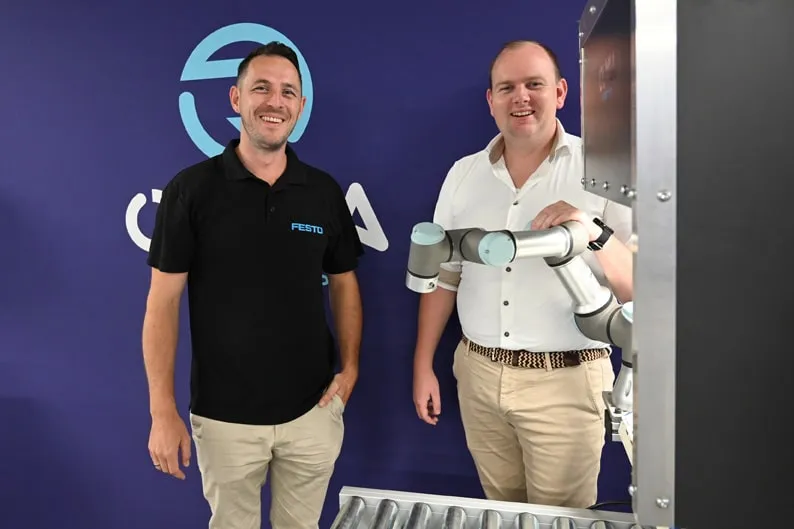
Eight years ago, Olmia was one of the first companies in the Netherlands to focus exclusively on cobots, giving it a significant head start over the competition. “The market has grown enormously in recent years. We are brand-independent. We started with Universal Robots, but over the years we have added two other brands so we can provide the best solution for every requirement. The best solution and the best quality are our priorities. Our experience means we can genuinely take care of everything.”
Addink has noticed a clear shift in demand. “At first, customers bought an arm and a gripper themselves and got to work figuring out how to make the most of them. But these days, they simply don’t have the capacity, so they come to us for the complete solution. That’s when we bring Festo on board.”
Collaboration
The two companies had crossed paths on several projects, and Olmia had always used Festo products, but at the time there was no active collaboration. “Festo is a company that is always showcasing new initiatives and innovations at trade fairs, so we kept a close eye on them, because their innovations are a great source of inspiration. We had previously worked together on a project that involved integrating a gripper developed by Festo. That gave us a reason to get in touch more regularly. Martin de Deyne from Festo spent a long time with us, explaining more about the options and how they work. It was a very good discussion, with plenty of questions on both sides. Then came the project at Koninklijke Drukkerij de Vries in Sneek, where the gripper presented a real challenge.
Consulting an expert
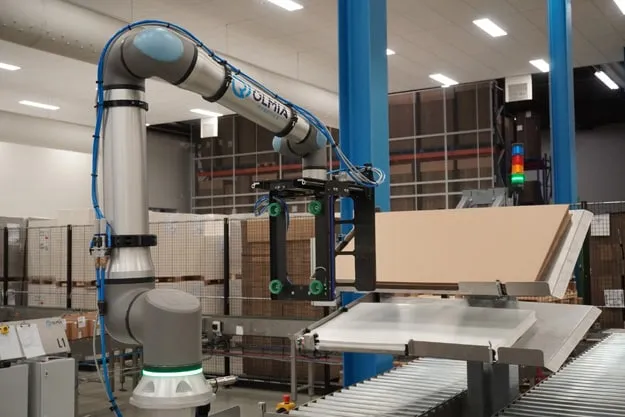
Olmia’s Luuk van Welzen contacted Martin de Deyne to discuss ideas with a Festo expert involved. “The people at Festo know their products inside out, and it was very useful to discuss things with them. The final solution is a lightweight carbon gripper. The motor and drive stayed well within the specifications. The maximum lifting capacity is now twenty-five kilos, which is more than enough for this customer.”
When you can use a vacuum gripper, its weight is not an issue. In this case, however, the best solution was a clamp that also had to open to different widths. That requires technology, which needs to be controlled, and that adds weight. “If you always had to make the same stroke, pneumatics would do the job. But because you need to handle different products here, another solution was needed. We looked for a lightweight gripper with clamping force, because the product must not slip out of the gripper. It was ultimately developed specifically for this project.”
Success
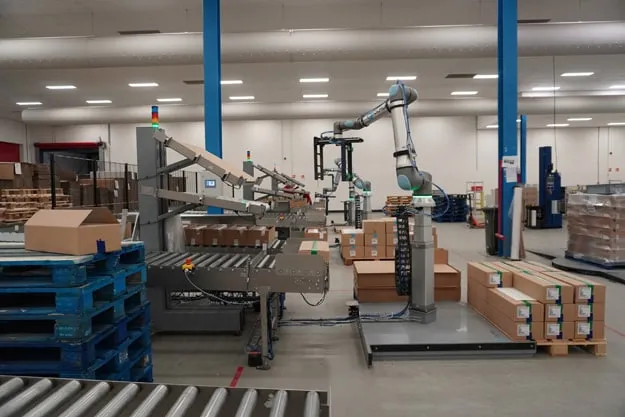
The way the contract was awarded shows that the customer took its time before making a decision. “We received the enquiry through the chat. At that point, the customer was new to us. Several companies were invited to submit ideas. We tested our solution here in Tiel. Our knowledge and experience gave us confidence in a good result, and we delivered. The process manager was very enthusiastic!” The shop-floor staff are on board too. “We often find that people on the shop floor are sceptical about automation at first. But after training on how the system works and what to do, everyone is now enthusiastic. In fact, we’re already looking at the next steps!” The cobot does the work of two FTEs. “That doesn’t mean two people have lost their jobs. It means they can do more rewarding work. There is a staff shortage, after all, so you don’t need to lay people off when you automate tasks. Repetitive work is the easiest to automate, but it is often the least enjoyable too, so employees benefit.” The solution now in place serves six fixed lines in the printworks. The next step is to look at a solution that can be moved around, making it even more flexible.
URCap
The URCap has made a major contribution to this solution. “The gripper is very easy to control. You often need an intermediate step and have to programme or write software, but that isn’t necessary here. You just enter parameters during programming, and the possibilities are endless. It is accurate to the millimetre too. What really sets this apart is how easy it is for the user. This URCap makes it very easy to integrate Festo solutions into programmes. For this customer, we built a separate layer on top of the URCap so that the customer’s input is translated directly into commands for the drive. This layer, a template, lets the customer create new patterns directly and very easily.” According to Addink, it is not only very convenient for the user: the greatest benefit is for the system integrator, who in most cases configures the URCap for the end user.
Expansion
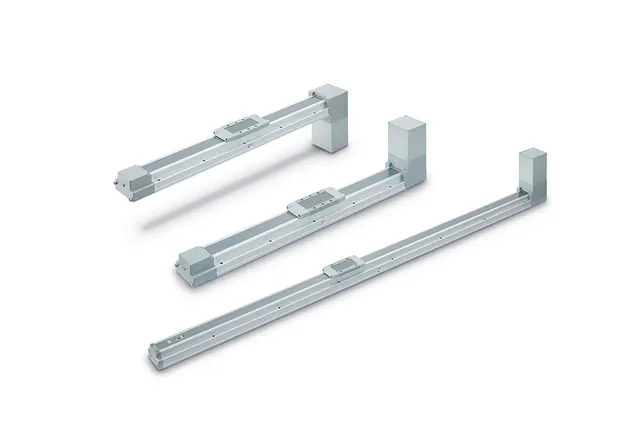
A new project bringing the two companies together involves adapting an existing standard solution for an end user. “The end user had a kit designed here, but it now needed to be a little bigger, with a longer slide to provide greater reach. The cobot needs to serve six stations that are not in a line, so it has to make a movement. That would be a costly modification, so we contacted Martin at Festo straight away to ask about the options. Festo slides can be ordered to size and controlled using the URCap. That makes them very attractive in terms of price, as well as highly flexible to configure. That’s good for the integrator, who still wants to be able to make adjustments themselves,” says Addink with a laugh. Festo slides turned out to be not only cheaper and more flexible, but also much faster than the slide in the existing setup. “The support from Festo is always really quick and excellent too,” he says. “Martin usually gets back to us within a few hours. We’re very satisfied: we get quick, clear answers to our questions. The contact is always very pleasant. We are very positive about the collaboration, and you genuinely feel that they want to be more than a supplier and work together on things. Both our engineers and the engineers at Festo are very positive about the relationship.” He gives the weight of the tooling as an example of a key consideration when working with a cobot. “We often need to look at the weight of the materials used in the solution. They really looked into that.”
Setting it apart
This URCap was developed specifically for Festo drives, making it a truly distinctive tool. The Festo URCap works not only with electric grippers, but can be used with any Festo gripper, motor or actuator. “The advantage of URCaps is that components are very easy to control. Festo is well ahead of the rest in this respect. There is plenty of competition, but they really are an example for others to follow!”
Een zakelijke vraag aan Festo? Get in touch
Companies in this story

Keep following this
Get an email when a new story is published. No account needed.
- ThemeFlexible production with robots
- SubjectMotion, gears & drives
- CompanyFesto