New energy-efficient electric motors are no one-trick ponies
Text Valérie CouplezImage Lenze
Innovative, synchronous and easy to use
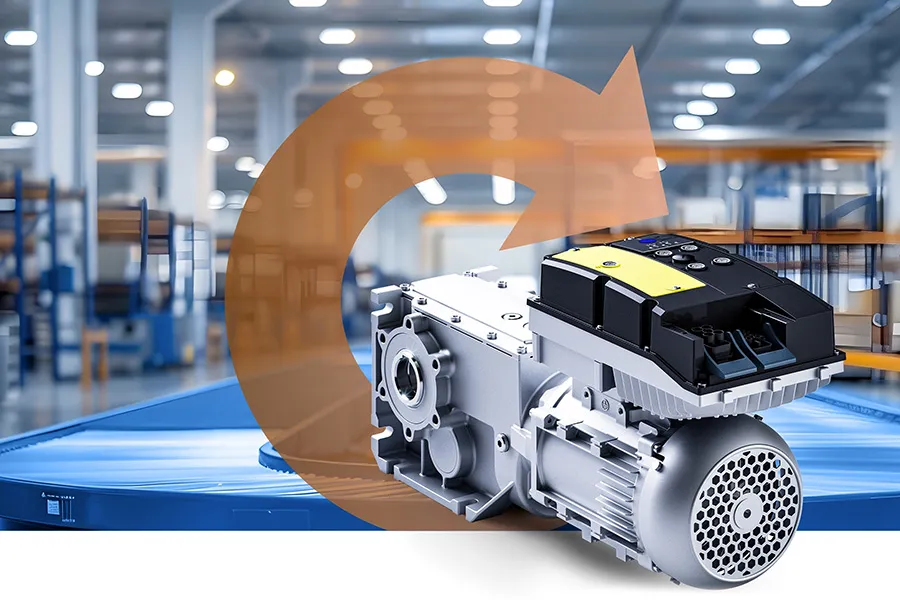
At the recent SPS, visitors had the chance to discover the new standard in efficient motor technology. With its IE5 and IE7 motors, Lenze demonstrated how taking a smart approach to the entire drive train (motor, gearbox and frequency inverter) can deliver the highest energy efficiency. But these new motors are technical marvels in their own right too. In the same frame size as IE2 and IE3 motors, users get a solution that is easy to use and offers servo capabilities. Time to take a closer look.
Lenze has developed a new range of motors. These are not upgrades to existing series. Thanks to a new and innovative motor concept, the m550-U and m650-U achieve energy efficiency class IE5. The m550-V electric motor can even meet IE7 requirements. Francis Denayer, Sales Manager at Lenze Belux, explains: “We have reduced losses by up to 60%. Traditionally, motors get larger as they become more energy-efficient, but this new series turns that around. These motors are no larger than those considered standard today. That means there is no need to redesign the existing drive train. You can replace the motors in your existing application one-for-one with a more energy-efficient model.” Lenze’s m550 motors are available with outputs from 0.25 to 11 kW. The m650 offers a little more, from 0.75 to 22 kW.
Short payback period
Based on the savings achieved by switching to IE5 or IE7, Lenze calculates that the motors pay for themselves in just three years. Denayer gives the example of a warehouse running 800 drives rated at 0.75 kW. “Introducing IE5 or IE7 motors would save 64,050 kWh and 131,500 kWh a year respectively. The higher the output, the greater the savings. That is good for your energy bill, but also reduces your CO2 footprint by 27 or 55 tonnes, respectively. With mandatory CSRD reporting, this is receiving increasing attention.” And this applies even when the motors are not running at full load. “Across the entire range from 30 to 100% load, their efficiency never drops below 85%. They can also handle peak loads of up to 300%, so there is no need to oversize them. Many applications can use a motor two frame sizes smaller, which also brings benefits in terms of cost and available space.”
Virtual encoder
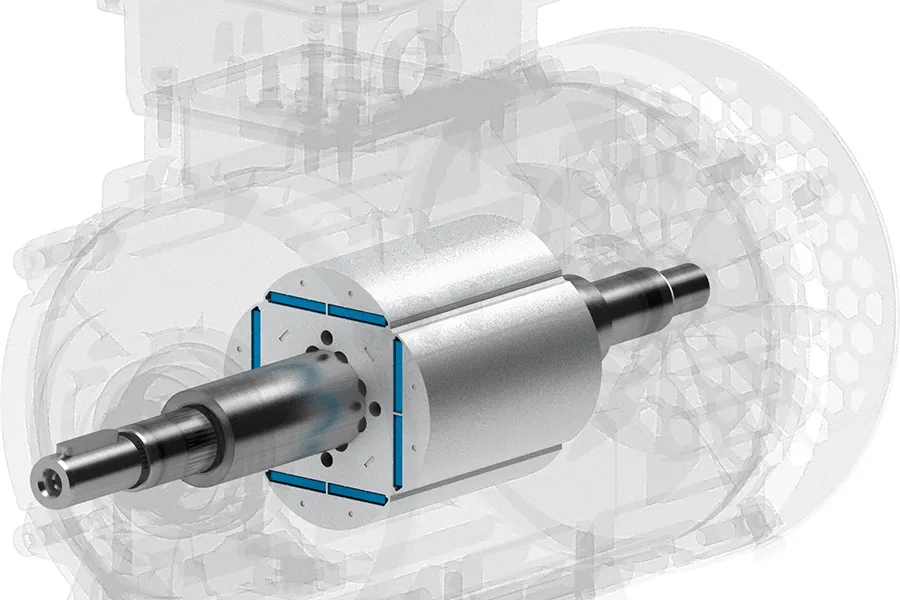
Lenze’s years of experience with drive trains have helped make this possible, and bring benefits beyond energy efficiency. “The motor itself has a permanent-magnet rotor. The innovation lies in the intelligence we have built into it: SLSM, sensorless SM motor control in the inverter,” Denayer explains. “It all starts with the rotor’s position. The trick is knowing that position, which also gives us the exact speed. The rotor position is detected at zero speed and measured continuously during operation. The rotor then effectively acts as a virtual encoder in the motor protocol. This gives us a precise picture of the motor’s speed and position, allowing us to handle positioning applications without a physical encoder. For users, this means a cost-effective alternative to applications using servo motors. The closed loop is comparable to 1024-pulse encoder feedback. These solutions can be used in a wide range of material handling and intralogistics applications.”
A competitive edge
The motors will be available from September. “We can already carry out tests with interested machine builders to see what the motors will ultimately deliver for them and their end users,” Denayer concludes. “We firmly believe our motors give them a competitive edge. Anyone working to make their production leaner will be keen to hear more.”
A business enquiry for Lenze? Get in touch
Companies in this story

Keep following this
Get an email when a new story is published. No account needed.
- ThemeTailored motion and drive systems
- SubjectMotion, gears & drives
- CompanyLenze