Optimise a drive in 60 seconds
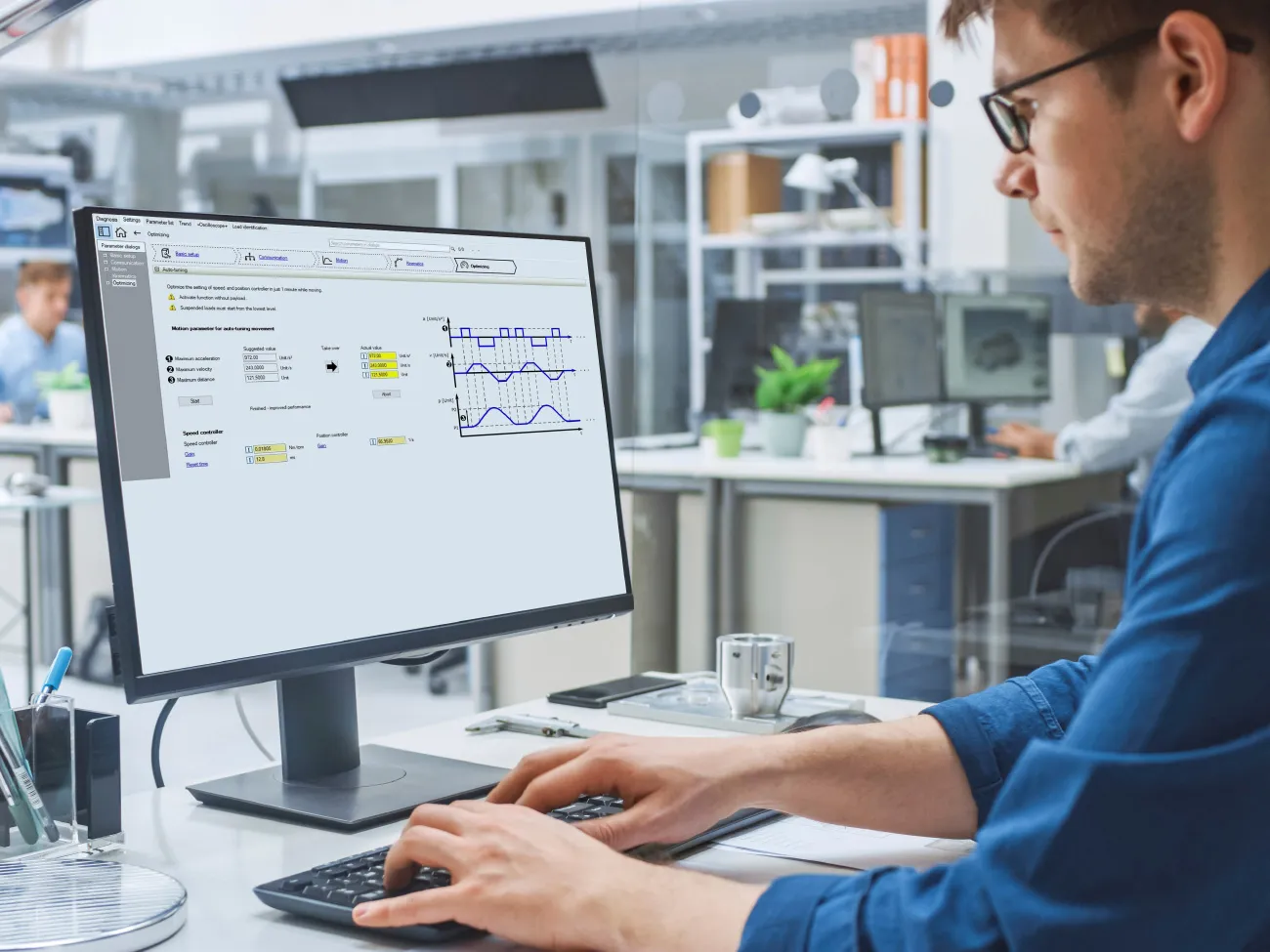
Machines perform at their best when their drives are perfectly matched to the drive train. This ensures that high-quality products are made at the highest machine cycle rate, with the fewest production errors.
To achieve this, the controller’s control loop is configured specifically for the machine. Until now, a drive specialist needed several hours to carry out this task during commissioning. The time required for this manual adjustment depended on the complexity of the motor’s control loop. But now the tuning can be carried out faster, and better.
Highly accurate tuning of the drive’s control loop is essential in many machine applications, for example assembly robots, storage & retrieval machines (SRMs) and packaging machines. This is the only way to achieve competitive machine performance. To achieve this precise tuning, the drive specialist has to spend a great deal of time during commissioning. Using Lenze’s auto-tuning function has significantly reduced commissioning time across a wide range of applications.
The conventional approach
In practical applications, the physical models commonly used to represent a machine’s motor control loop are of limited use when it comes to optimising the drive axis control loop. This is because the behaviour of the physical model differs from that of the real machine. A drive specialist currently optimises the control loop settings by carrying out several tests on the actual machine. The Ziegler/Nichols oscillation method, dating from 1943, is often used to optimise control loops. It is easy to apply, does not rely on a model and delivers robust control performance.
Automating control loop optimisation
Lenze has now automated the measurement of the motor control loop and the setting of control loop parameters for Lenze i-series servo drives, significantly simplifying the process. The method is integrated into Lenze auto-tuning. No additional measurement components are required apart from the servo drive, as during auto-tuning the drive itself acts as a sensor, using the actual values from the position encoder and motor current. Once auto-tuning is complete, the control loop parameter settings are calculated and saved in the controller configuration. The existing physical motor control loop is measured automatically and quickly, then precisely adjusted to the actual machine. Errors previously caused by discrepancies between the model and the machine, or by manual adjustment, are avoided. This procedure saves commissioning time, is robust and delivers repeatable results and optimum machine performance. The auto-tuning function works reliably and safely even with complex control loop challenges, such as gear backlash or variable loads.
Fast, reliable and safe auto-tuning
The Lenze auto-tuning function can be run using the Lenze EASY Starter and PLC Designer tools. Particular attention has been paid to making it easy to operate and providing clear feedback, so that commissioning engineers can use these functions without specialist knowledge. Feedback from Lenze customers who have already used the process in their machines has been consistently positive. They particularly highlighted the simple, robust principle and the exceptional speed of optimisation as major advantages over the previous manual procedure. The fact that not only cycle times but also machine output could be improved also led to a high level of satisfaction. The auto-tuning function has been available since Hannover Messe 2021. Auto-tuning can be used with all i950 and i700 servo drives sold since then. Servo drives supplied before then can be upgraded with the auto-tuning function via a firmware update.
Question about this story? Ask your question
Companies in this story

Keep following this
Get an email when a new story is published. No account needed.
- ThemeTailored motion and drive systems
- SubjectMotion, gears & drives
- CompanyLenze