Platform on production and process automation

Electric motors are becoming increasingly complex and technical, so keeping them running optimally is sometimes a challenge. The causes of problems with electric motors and drives are not limited to a single expertise: both mechanical and electrical problems can lead to motor failures. The right knowledge can mean the difference between costly downtime and improved asset availability.
Defective insulation of windings and wear of bearings are the two most common causes of motor failures, but these conditions are due to very different reasons. This article shows how to identify in advance the most common causes of winding and bearing insulation failure. Factors related to improper installation are not covered.
Transient voltage
Turning on or off adjacent loads, capacitor banks for reactive current compensation, or even weather conditions far away, can cause transient voltages in distribution devices. These transients, which vary in amplitude and frequency, can lead to deterioration or failure of motor winding insulation. Finding the source can be difficult, due to the irregularity of events and the fact that symptoms can manifest themselves in a variety of ways. For example, a transient can occur on control cables and not necessarily cause direct damage to equipment, but potentially interfere with operation.
Voltage imbalance
Three-phase distribution devices often feed single-phase loads. Imbalance in impedance or load distribution can contribute to imbalance in all three phases. There could potentially be faults in the wiring to the motor, the connections to the motor and possibly the windings themselves. This imbalance can lead to internal loads in each of the phase circuits of a three-phase power system. At the most basic level, all three voltage phases should always be of equal magnitude.
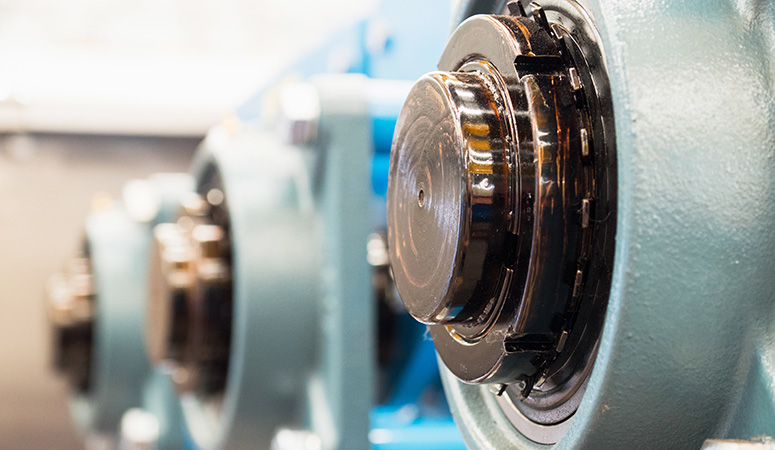
13% of motor failures are due to faulty bearings, and over 60% of mechanical failures in a plant are caused by bearing wear. (Image: Epixx)
Harmonic distortion
Simply put, harmonics are any unwanted extra source of high-frequency alternating voltages or currents that supplies energy to the motor windings. This extra energy is not used to turn the motor's shaft, but circulates in the windings and eventually contributes to internal energy losses. These losses dissipate in the form of heat, which, over time, will deteriorate the insulation capacity of the windings. Some degree of harmonic distortion of the current is normal. Each harmonic has a different allowable distortion level, which is defined in standards such as IEEE 519-1992.
Reflections on pulse width modulated output signals. of the drive
Frequency-controlled drives use pulse-width modulation (PWM) to control the output voltage and frequency for a motor. Reflections are generated when there is a difference in impedance between the source and the load. Impedance differences can occur as a result of improper installation, incorrect choice of components or deterioration of the equipment over time. In a motor drive circuit, the peak of the reflection can be as high as the voltage level of the DC bus.
Sum Current
Sum currents are primarily stray currents circulating in a system. Sum currents occur as a result of signal frequency, voltage level, capacitance and inductance in conductors. These circulating currents can find their way through grounding systems, leading to nuisance tripping or, in some cases, excessive heat in windings. Sum current can be found in motor wiring and is the sum of the current of the three phases at any given time. In a perfect situation, the sum of the three currents would equal zero. Sum current can also be understood as asymmetric signals in multiple conductors that can capacitively couple currents in the grounding conductor.
Business overload
The primary symptoms associated with overloading a motor are excessive current draw, insufficient torque and overheating. Excessive heat from a motor is a leading cause of motor failures. In an overloaded motor, individual components such as bearings, motor windings and other components may be working properly, but the motor keeps getting hotter. Therefore, it makes sense to begin troubleshooting by checking the motor for overload. Because 30% of motor failures are due to overload, it is important to understand how to measure and identify motor overload.
Alignment errors
An alignment misalignment occurs when the motor's drive shaft is not properly aligned with the load, or when the component connecting the motor to the load is misaligned. Many professionals believe that a flexible coupling prevents and compensates for misalignment, but a flexible coupling only protects the coupling itself from misalignment. Even with a flexible coupling, a misaligned shaft will send negative cyclic forces along the shaft and into the motor, leading to excessive wear on the motor and an increase in visible mechanical stress.
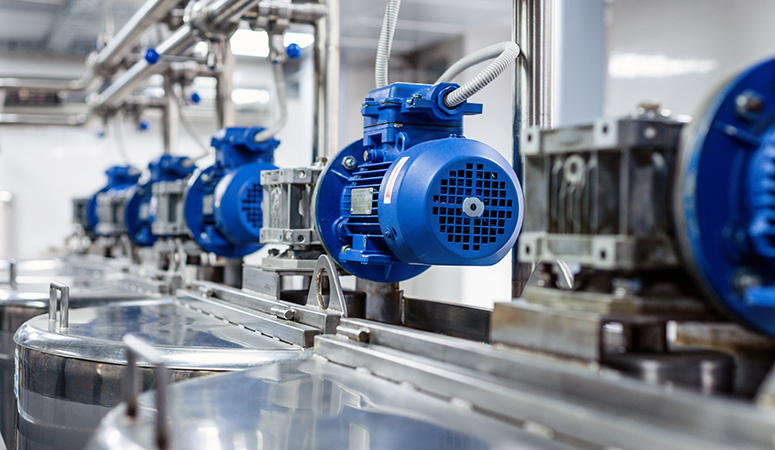
Electric motors are becoming increasingly complex and technical, so keeping them running optimally is sometimes a challenge.
In addition, misalignments can generate vibration in both the load and the engine's drive shaft. Types of misalignments:
- Angular misalignment: the centers of the axes touch but are not parallel
- Parallel deviation: the centers of the axes are parallel but not concentric
- Compound misalignment: a combination of parallel and angular misalignment. (Note: Almost every misalignment is a compound misalignment, but practitioners refer to misalignment as the two separate types because it is easier to correct a misalignment when the angular deviation and parallel deviation are addressed separately.
Axis imbalance
Imbalance is a condition of rotating equipment in which the center of mass is not at the center of rotation. In other words, there is a "heavy spot" somewhere on the rotor. While imbalance in a motor can never be completely eliminated, you can identify when the imbalance is outside the normal range and take action to correct the problem. Imbalance can be caused by numerous factors, including:
- Dirt accumulation
- Missing balance weights
- Manufacturing differences
- Uneven mass in motor windings and other wear-related factors.
Looseness of the shaft
Looseness occurs when there is too much play between parts. Looseness can occur in several places:
- "Rotational looseness" is caused by excessive clearance between rotating and fixed parts of the machine, such as in a bearing.
- "Non-rotational looseness" occurs between two normally fixed parts, such as a base and a foundation, or a bearing housing and a machine. As with any other vibration source, it is important to know how looseness can be identified and the problem corrected to avoid monetary loss.
Bearing wear
A defective bearing runs heavier, gives off more heat and works less efficiently because of a mechanical or lubrication problem or wear. A defective bearing can have several causes:
- A heavier load than the design load
- Insufficient or improper lubrication
- Ineffective bearing seal
- Wrong shaft alignment
- Incorrect fitting
- Normal wear and tear
- Induced axis tensions
Once a bearing begins to fail, it also creates a cascading effect that accelerates the occurrence of motor failures. 13% of motor failures are due to defective bearings, and over 60% of mechanical failures in a plant are caused by bearing wear, so it is important to learn how to detect and fix this potential problem.
To a white paper from Fluke
Text and image Valérie Couplez
Featured image: The causes of problems with electric motors and drives are not limited to a single expertise: both mechanical and electrical problems can lead to motor failures. (Image: Smoczyslaw)