












Curiosity: the quiet engine behind innovation
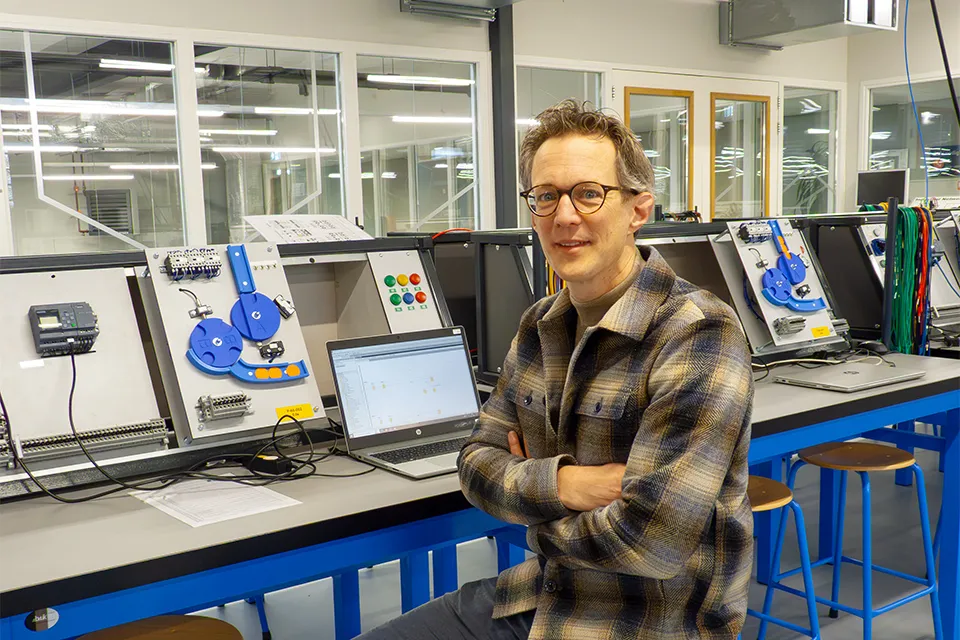
Marcel van Dijk: Project Lead, Customer-Specific Education, ROVC
Today, I work for a technical training provider. I see developments in industrial automation at close quarters. Machines are becoming smarter and more autonomous, with data playing an increasingly important role. But one thing stands out to me: curiosity and a willingness to learn are every bit as important as knowledge. Without these qualities, we will fall behind.
From hobby to vision: what LEGO can teach us
At home, I enjoy experimenting with microprocessors. I connect sensors and power consumers to make our home use energy as efficiently as possible. It is a process of measuring, controlling and optimising, exactly what happens in industry too. The difference? In my living room, it is about comfort and saving energy; in the factory, it is about productivity and quality. But the principles are the same: collecting data, interpreting it and putting it to smart use.
And what about LEGO? That is another of my hobbies. What began with a simple battery box has now become an advanced system. These days, it is more than just a power supply: the box actively measures voltage and current consumption, as well as movement and compass direction in space. And LEGO motors are no longer just actuators: they have encoders that record position, direction of rotation and speed. This evolution shows how far sensor technology and control have come, even in toys. It has taught me that innovation starts with curiosity, and that complexity can be made accessible.
Hands-on training in a world full of smart systems
I see the same trend in industrial automation: systems are becoming smarter, but also more complex. This calls for skilled professionals who not only know how something works, but also understand why it works that way. People with the courage and freedom to experiment, just as I did with LEGO in the past and do with microprocessors today. Because curious people find solutions that others do not see.
This also raises an important question: how do we prepare hands-on training for this reality? How do we ensure that future technicians can interpret data, understand software and get to grips with sensor technology? My message to the industry is: foster that curiosity. Give people room to learn, experiment and make mistakes. Do not just automate machines, automate the learning process too. Technology is developing at breakneck speed, and only those who keep learning will remain relevant.
Let us work together to ensure curiosity remains the engine of innovation. Invest not only in technology, but also in people who dare to explore. That is how we keep industrial automation relevant. And if you would like to discuss the impact of these developments on hands-on training, please get in touch.
Question about this story? Ask your question
Keep following this
Get an email when a new story is published. No account needed.
- SubjectNews







