












Digitalisation enables smarter service delivery
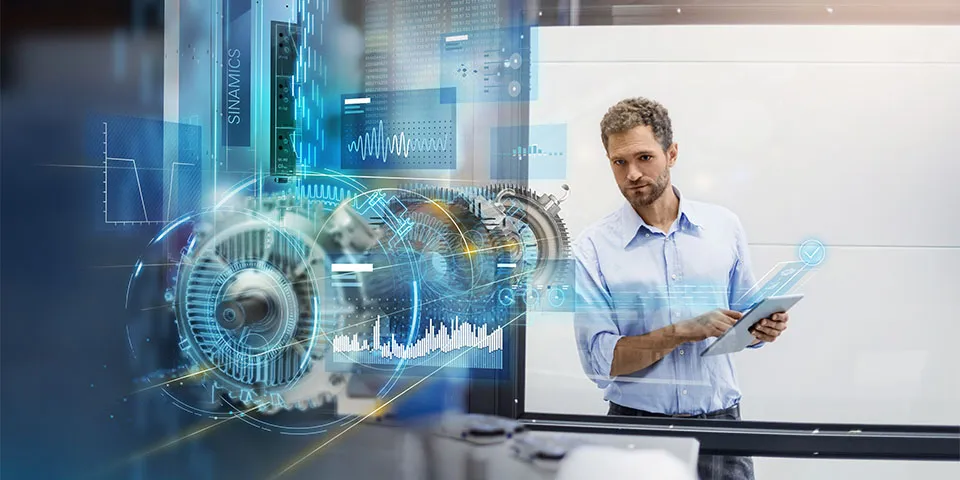
In a knowledge-based industry like ours, it is not easy for companies to have all the technical expertise they need in-house. This is particularly true as we move towards predictive and prescriptive maintenance. That is why there has long been a trend towards outsourcing technical expertise. The advent of Industry 4.0 has only made these technical challenges more complex, increasing the need for expertise. The experts at Siemens Digital Industries Services guide you through the entire value chain and strengthen your own production operations.
Since joining Siemens in 91, Kris Kenis has seen maintenance evolve considerably. “Service is about maximising production output at the lowest possible cost. The playing field is still the same as it was in the early days when I started, but Industry 4.0 allows us to approach it differently and more intelligently,” Kenis says with a wink. He is now responsible for Digital Industries Services. “And that is necessary, because the market demands more flexibility, quality and efficiency than ever before. Digitalisation can deliver on that promise, but you need people with knowledge of IT structures and OT applications. That is not easy for our customers to find. This is why outsourcing high-level maintenance activities and co-creation as part of ‘Proof of Value’ digitalisation projects are on the rise.”

Kris Kenis: “Service is about maximising production output at the lowest possible cost. Digitalisation allows us to approach this more intelligently.”
Continuing to guarantee machine performance and quality
This applies to end users and machine builders alike. They too must not miss the digitalisation train if they want to continue designing and manufacturing competitive machines and installations. What is more, the bar is being raised for machine builders. “The end customer wants more than just a machine. They also want its performance and quality to be guaranteed. We can help achieve this digitally, from the concept and design phase onwards. In addition to traditional support, we can virtually commission automation products using a digital twin. This significantly reduces time to market. Once the machine is operational, we help the machine builder optimise production performance in real time and monitor its ‘health’ using data analytics services (DAS).”
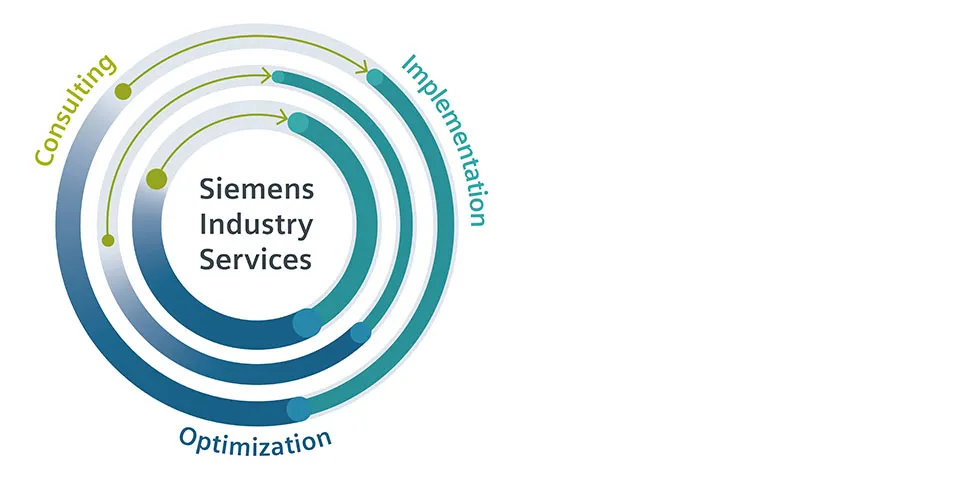
Siemens’ service portfolio covers the entire lifecycle of an industrial automation product, system and installation.
Towards prescriptive maintenance
Services today clearly cover much more. Kenis: “In the past, the traditional approach was corrective maintenance. The customer had a breakdown and we rushed over to fix the problem. New digital capabilities allow us to look further ahead. We can now predict with a fair degree of accuracy when a machine will stop. By applying techniques such as artificial intelligence and machine learning, we can find out not only what will happen and when, but also why. This is the ultimate advice a customer needs: prescriptive maintenance. That is what Industry 4.0 can mean for services.”
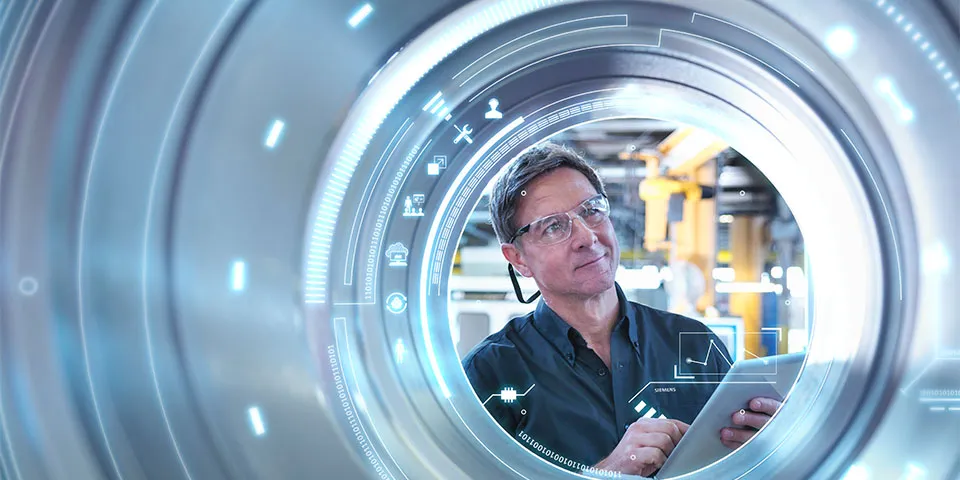
The market demands more flexibility, quality and efficiency than ever before. Digitalisation can deliver on that promise, but you need people with knowledge of IT structures and OT applications.
Tailored training
Siemens divides its industrial services into retrofit & modernization, field & maintenance, repair services, spare parts services, support & consulting, and training & digital services. Together, these cover the entire lifecycle of an industrial automation product, system and installation. Kenis: “The training segment has been undergoing significant change recently. On the one hand, large companies are approaching us for training tailored to their own installations. A good example is our collaboration with Volvo and Hogeschool Odisee. Volvo operators learn to master the processes in detail using a true-to-life digital twin of Volvo’s production environment, increasing efficiency. Hogeschool Odisee provides the facilities, and in return students can also familiarise themselves with the technology.” On the other hand, Siemens is focusing on remote training and remote access, especially during the coronavirus pandemic. This allows customers to stay on site while still receiving instructions on how to do things. Siemens also provides remote platforms such as cRSP (common Remote Service Platform) and Sinema Remote. At BASF in Antwerp, for example, all 350 devices controlled by Simatic PLCs are monitored remotely around the clock via TIA Portal, including cybersecurity and diagnostics.
Building knowledge in modules
As an extension of these remote solutions, Sitrain Acces, an online training platform, was recently launched. “Through this platform, we make knowledge available in modules, through a mix of video tutorials, presentations, webinars … You can explore the modules that are relevant to your role, wherever and whenever you want. This meets the expectations of young people now entering the industry. They want immediate support and to build their knowledge in a flexible, modular way. They can also immediately put that knowledge to the test virtually using digital twins,” says Kenis. “It is important for companies to continue investing in digital transformation. Yet the economic downturn caused by Covid-19 means that many budgets are being put on hold. But this is the time to accelerate ahead of the competition,” Kenis concludes.
Question about this story? Ask your question
Keep following this
Get an email when a new story is published. No account needed.
- ThemeFrom factory data to decisions
- SubjectNews







