












Global logistics would be impossible without micromotors
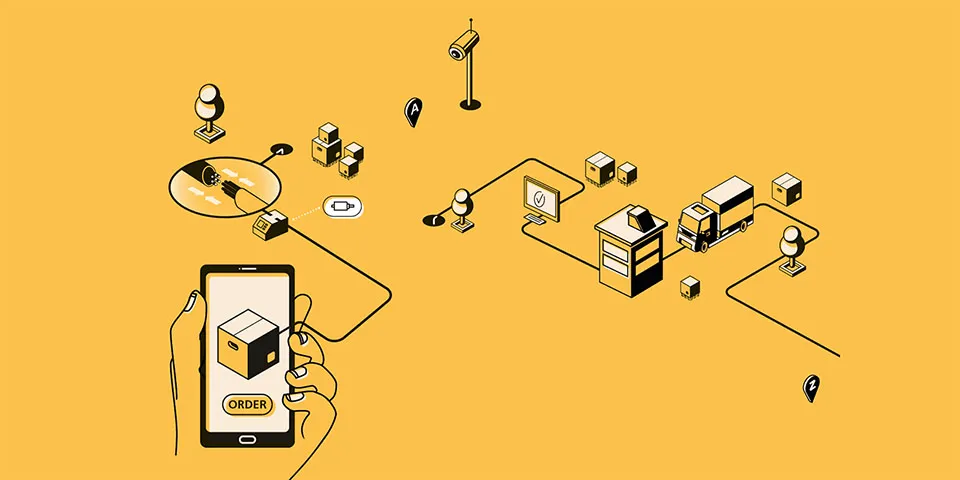
More and more, faster and faster, further and further: everything has to reach the right place at the right time. The global flow of goods keeps the economy moving and poses a challenge for everyone involved. It works only through extensive automation throughout the logistics chain, which would be unthinkable without an armada of high-quality micromotors. These motors often have to deliver considerable force in extremely confined spaces. Above all, they must always operate reliably in continuous-duty applications. That is why FAULHABER drives are often found in these demanding applications.
Although the word “logistics” resembles the root of the Greek word “logic” and is related to it, it is not directly derived from it. Its origins lie in a French military term. Since the late Middle Ages, the “maréchal de logis”, or quartermaster, had been responsible for providing troops with places to sleep and rest during marches and battles. The quartermaster’s remit grew over time and expanded to cover overall supply. What began as providing “logis”, or accommodation, thus developed into the extremely complex military discipline of logistics.
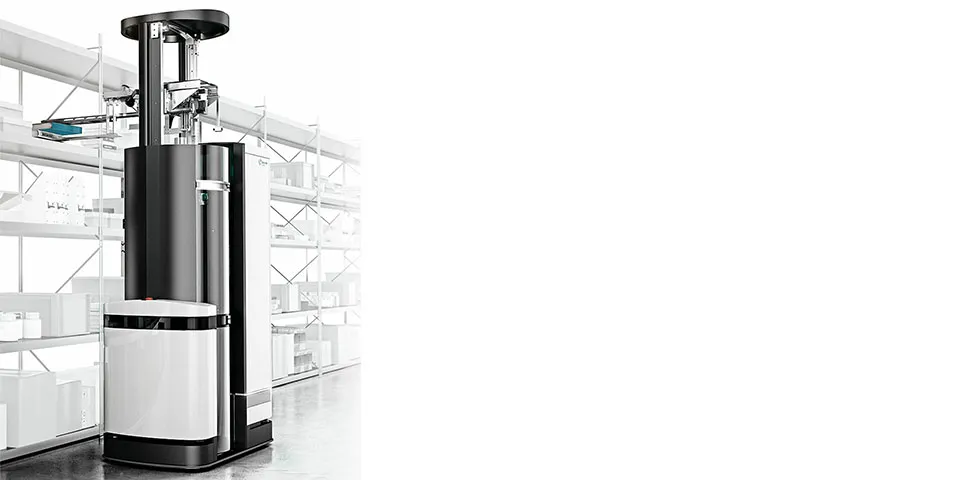
Toru Robot
Quartermasters originally belonged to the cavalry because the transfer of information has always been crucial to logistics. Until well into the 19th century, this required horses. Today, information travels much faster via electromagnetic waves through the air and along cables. The largest volumes of data are now transmitted through fibre-optic cables. These form the backbone of the global logistics network, transmitting the information needed by means of light signals, from an online order through shared just-in-time production in smart factories to express delivery to the consumer.
Connections with nanometre precision
Joining two fibre-optic cables involves connecting the fibres one by one. This is extremely delicate work, as each individual optical fibre is as thin as a human hair. The optical core is even thinner, with a diameter of barely five microns.
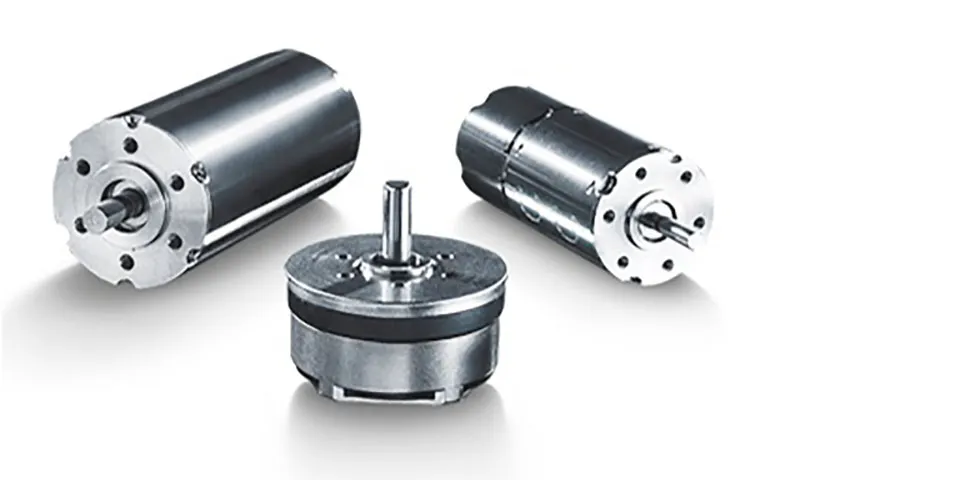
BXT Motors
When two such optical fibres are joined, their ends must be precisely aligned so that the signal can subsequently be transmitted clearly and without obstruction. On construction sites, this alignment is carried out using small mobile machines. First, the individual fibre ends are cut to length at an exact angle of 90 degrees. The protective insulation is then removed, and finally the fibres are inserted into the device. This automatically and precisely aligns the two sections in three dimensions, bringing their flat ends together exactly. They are then fused and insulated again. The fibres are now joined, ensuring that signals can pass through without obstruction. This nanometre-precision alignment is performed using FAULHABER positioning drives, for example DC micromotors from the 1524…SR series, with a gearbox, lead screw and high-resolution encoder. Drives based on highly precise stepper motors are also used.
Extensive automation in warehouse systems
This technology enables fibre-optic cables to transmit the signals for a digital order over long distances without errors and at the speed of light. Orders may be placed by consumers with an online retailer, or by a factory with a supplier. In either case, a series of processes is set in motion. Ultimately, these processes result in products being picked from storage and prepared for dispatch.
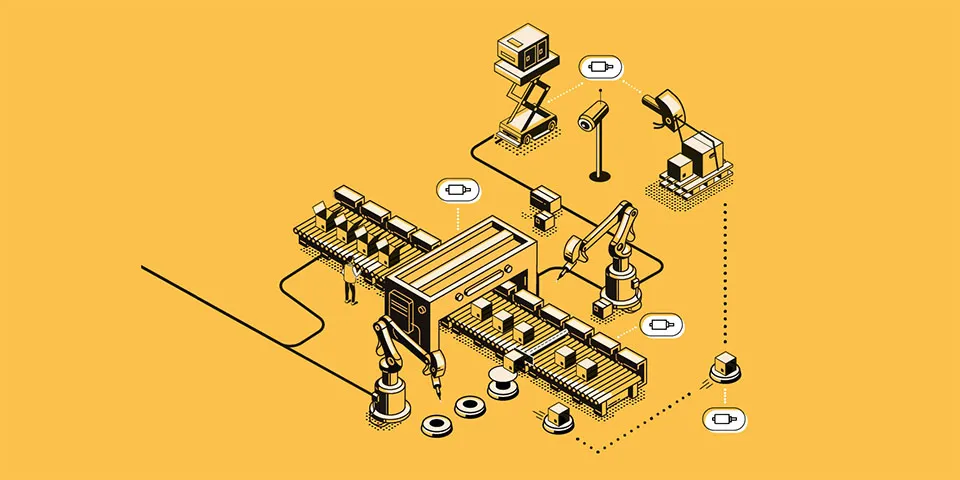
Logistics Robots
More and more warehouse operations, from storing goods to retrieving and preparing them for dispatch, are now handled by automated storage and retrieval systems, driverless transport systems and intelligent logistics robots. The computer-controlled machines receive a work order and then automatically travel to the storage location where they need to put away or retrieve an item. Depending on the type of racking, they are equipped with lifting columns, telescopic arms or grippers to pick up and move packages or trays.
There is usually little room on board these automated devices for the motors that drive them. The motors are often installed directly in the working components. There, despite their small size, they often have to lift considerable weights. Speed is also important: the huge warehouses of e-commerce companies process many thousands of orders every day. This means that each step has to be completed quickly.
Precision, power and speed
FAULHABER BX4 series brushless DC servomotors with Motion Controller and planetary gearbox. When used, for example, in a lifting column, this combination ensures precise positioning, accurate picking and reliable processes during continuous operation with constant changes in load. Camera systems monitor some of the automated processes. FAULHABER motors are also widely used here to drive high-performance moving cameras.
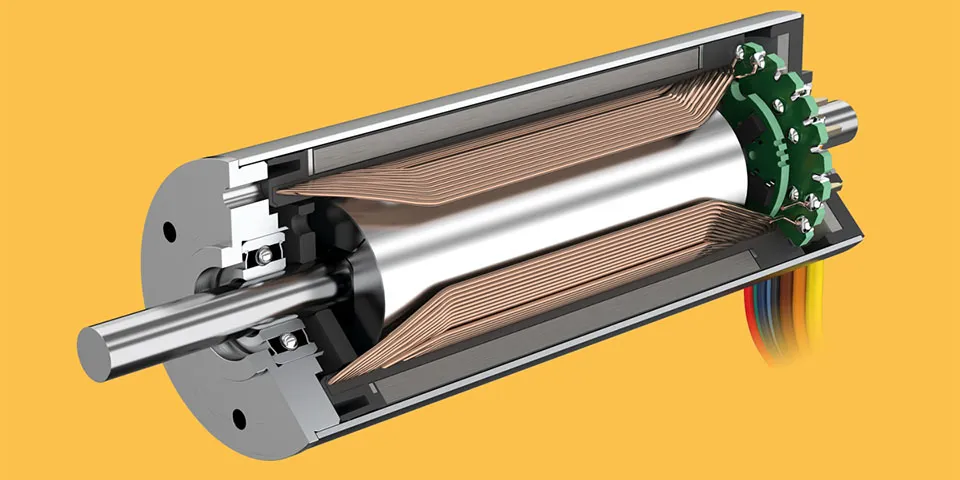
BX4 Motor
After being picked, the item is usually placed on a conveyor belt or roller conveyor. These often feature diverters, paddles or pushers to separate individual packages or flows and direct them along the desired route. In large warehouses where thousands of packages per hour are transported on such systems, the speed of the automated sorting systems is crucial. The diverters must be moved into exactly the right position in a fraction of a second. DC micromotors from the 2237…CXR and 2342…CR series are often used for this purpose, in combination with a gearbox.
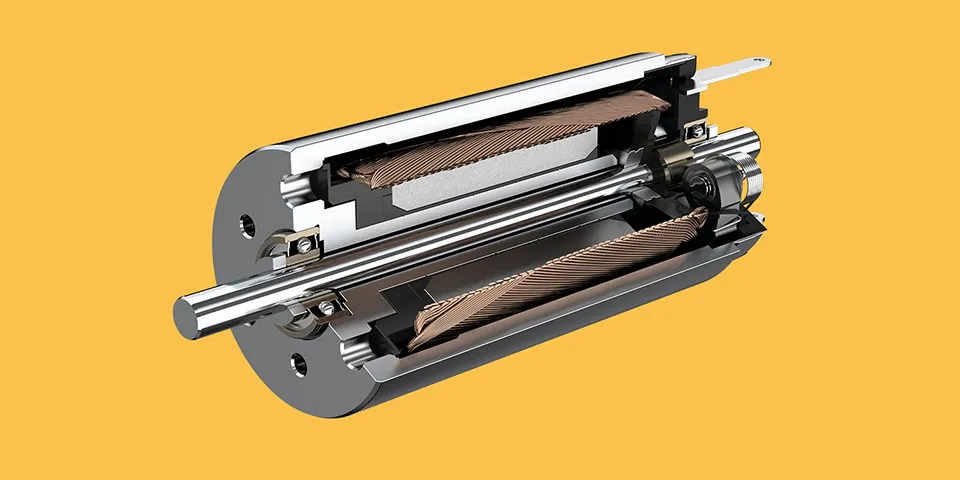
CXR Motor
Automated guided vehicles (AGVs) are also often used for transport tasks. Modules for handling their loads are mounted on them: levers, clamps and pins keep the loads securely in place during transport. The moving parts are fitted with drives.
Cost-effective packaging
The goods are transported to the packaging station, where they are placed in a shipping box. In modern systems, a better description would be “where they are packed in a made-to-measure shipping box”: automated packaging stations use sensors to detect the dimensions of the item to be shipped and fold a box of the right size from a cardboard roll. This saves not only material but also shipping costs, as logistics providers set their prices based on both volume and weight. The actual folding is done by small levers and paddles in the packaging machine. FAULHABER servo drives with an integrated Motion Controller are ideally suited to moving these components.
When packages are stacked on pallets for shipping, they have to be secured firmly. This is usually done with straps made of fibre-reinforced plastic. They are applied using what are known as strapping tools. These tension and seal the strap so that it lies tightly against the stack and holds it securely. Individual packages can also be stabilised in this way. As the tools are hand-held, weight is a particularly important factor: every gram saved helps protect workers’ health. The motors used for tensioning therefore need to be as small as possible, for example the 3274 …BP4 brushless DC servomotor. It weighs just 320 grams, but can deliver a peak torque of more than 1 Nm, securing even heavy loads safely.
“Our motors are used in virtually every area of the logistics chain,” says Rolf Schmideder, Business Development Manager at FAULHABER. “Our drives are a perfect fit for the demands typical of this sector: maximum power, speed and precision in minimum volume and weight. And the number of possible applications will grow further if drones and robots are also used to deliver individual items in the future.”
https://www.faulhaber.com/en/markets/logistics-/-packaging-robot/
https://www.faulhaber.com/en/products/dc-motors/faulhaber-sr/
Question about this story? Ask your question
Keep following this
Get an email when a new story is published. No account needed.
- SubjectNews







