












GPS FOR THE MILKY WAY
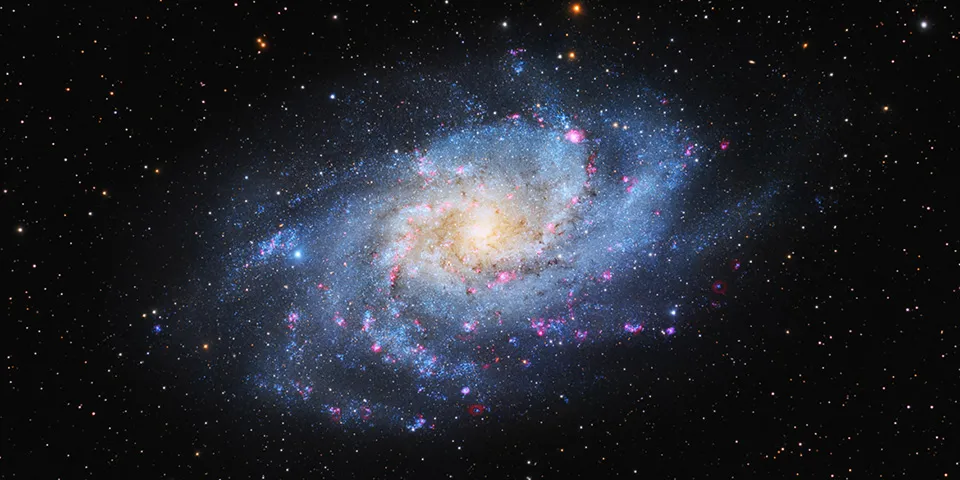
What is happening around us? We all want to know, whether we admit it or not. Ever since humans first appeared on Earth, we have asked ourselves: What is happening in the Milky Way? We know surprisingly little about it, because we literally struggle to see the wood for the trees. But the MOONS project, initiated by British astronomers, aims to change that. FAULHABER technology will play an important role.
A galactic knowledge gap
When it comes to exploring our own disc-shaped spiral galaxy, astronomers face a fundamental problem. Although Earth is not located precisely at the centre, it does lie in the Milky Way’s central disc. So when astronomers look towards the centre from this vantage point, or towards what lies beyond it, their view is blocked by countless stars. From our Earthbound perspective, it is very difficult, or even impossible, to determine where those stars are located within our shared disc. One region we know little about is the dense area at the centre of the galaxy, where countless stars and gas clouds cluster around a presumed black hole. But a major astronomy project could soon fill many gaps in our knowledge. Eight institutes from different countries are involved in the project, which was initiated by the European Southern Observatory (ESO). This scientific organisation operates some of the world’s most powerful telescopes in Chile’s Atacama Desert. These include the Very Large Telescope (VLT) at the Paranal Observatory, with a mirror diameter of 8.2 metres. The project aims to equip the VLT with a new instrument for capturing optical signals from space. It is a spectrograph capable of observing a large number of cosmic objects simultaneously in the visible and infrared parts of the spectrum. The project’s name is an acronym for its English-language description: MOONS, or Multi-Object Optical and Near-infrared Spectrograph. It is coordinated by the United Kingdom Astronomy Technology Centre (UK ATC) in the Scottish capital, Edinburgh.
Spectrum instead of a photograph
“With a good camera, you can replace the lens. With a telescope, it’s exactly the opposite: the VLT has an excellent lens, but we’re replacing the current ‘camera’ with our MOONS,” explains William Taylor, a researcher at the UK ATC. Its new technology gives MOONS entirely new capabilities for observing space, although it does not produce large images in the traditional sense. Instead, it captures minute details. Here’s how it works: the VLT’s enormous lens and mirror are aimed at the region of space to be observed. So far, nothing new. But now the ends of exactly 1001 optical fibres in MOONS are directed at individual objects within this region of space. Rather than capturing the entire field, as a camera would, the new instrument focuses the fibres on specific points in the universe. And these points are not simply photographed either. Prisms split the light into its component parts, the different wavelengths. “Scientifically, this method provides much more information than a photograph,” Taylor explains. “For example, it allows us to learn a great deal about an object’s chemical composition. We can also calculate its dynamics, meaning its speed and direction of motion. Since MOONS is designed for the near-infrared spectrum, we can accurately analyse the redshift that affects light travelling to us from distant objects.” When a star moves away from Earth, the wavelength of its light increases. This shifts some of the visible light into the invisible infrared region, which is still close to the visible spectrum.

Moons at VLT © eso.org
Thousands of objects in focus
With previous technology, a maximum of around a hundred objects could be observed individually, and only in visible light. MOONS not only multiplies that number by ten, it also provides greater depth of information. Within the Milky Way, this will allow us to see between the trees much more clearly and gain a far clearer picture of the entire proverbial forest. “One of the project’s aims is to create a 3D map of the Milky Way, enabling a kind of GPS navigation across our entire galaxy. MOONS technology, with its unprecedented resolution, will also allow us to look a long way into space, and therefore far back in time. We will be able to get within a few hundred million years of the Big Bang.” This will give scientists insight into the early days of the universe. While this is already possible to some extent, MOONS will give us a much clearer and more detailed picture, Taylor says. “We will be able to map the universe to an unprecedented depth.” The astronomers are targeting several million objects over a period of around five years. To achieve this, the spectrograph’s 1001 optical fibres must be aimed quickly, and usually automatically, at their cosmic targets. This is done using an equal number of fibre positioning units (FPUs). Each FPU has two stepper motor drive units mounted on low-backlash gearheads. The rear unit moves the FPU’s central shaft (Alpha). The front motor-gearhead drive unit (Beta), mounted eccentrically on it, moves the end of the fibre at the same time. Combining the two axial movements allows each FPU to cover a circular area within which the fibre can be aligned in any direction. This area partly overlaps with those of neighbouring FPUs. This means that any point within the area to be captured can be accessed. To meet the demanding requirements for positional repeatability, which is essential to prevent the FPU tips from colliding, the drive system solution must be extremely precise. The high-quality stepper motors are supplied by FAULHABER PRECISTEP; FAULHABER Minimotor’s backlash-free gearheads contribute to positioning accuracy. FAULHABER subsidiary mps handles the modules’ mechanical design.
A bespoke positioning instrument
“We have received extremely valuable input from all three participating Swiss companies in the FAULHABER Group,” says Steve Watson, who is responsible for FPU development at the UK ATC. “Without their unique expertise, it would have been impossible for us to develop this core module in this form, and in the quantities we need. In addition to the speed at which the optical fibres are positioned, they also have to be extremely precise. We achieve an accuracy of 0.2± degrees and positional repeatability of up to 20 microns. These are impressive figures, given the length of the FPU and its modular design. The units also remain correctly aligned on the focal plate, on which the modules are arranged in all positions.” The components’ high precision and exceptional reliability make it possible to keep operation simple, another requirement for the spectrograph to work flawlessly. Complex electronics and control logic would seriously hamper the fast, simultaneous operation of 1001 units. Thanks to the high-quality components, precise alignment can be achieved with simple open-loop control. The technology also has to be highly robust and virtually maintenance-free, so that it can perform its tasks without interruption throughout the system’s planned ten-year service life. Project manager Alasdair Fairley is already looking beyond these technical challenges: “We are making good progress with MOONS. We expect to install the spectrograph in the summer of 2021. Commissioning will take around six months, so we will probably be able to start mapping in early 2022. We are confident that the FPU will remain fully operational for ten years without maintenance.”
Question about this story? Ask your question
Keep following this
Get an email when a new story is published. No account needed.
- SubjectNews







