












How can we get back to work safely?
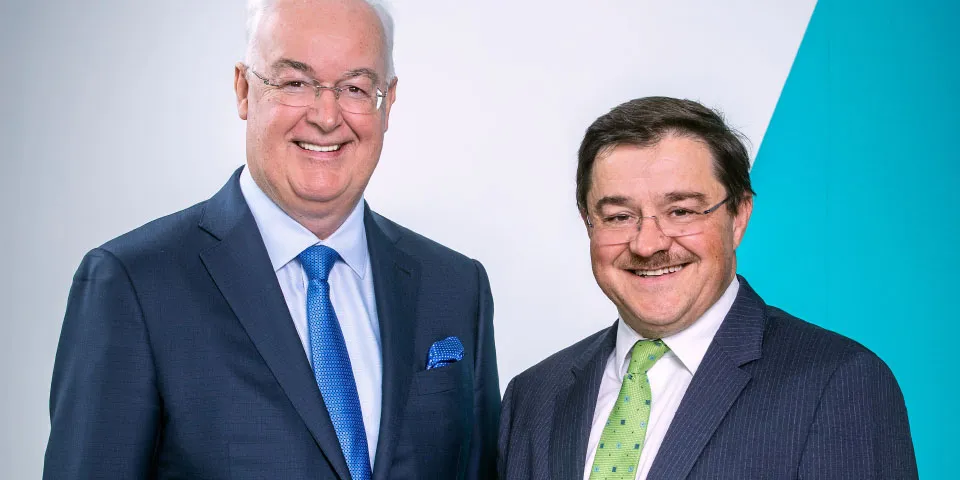
Coronavirus has brought much of Belgian industry to a standstill. Now that the figures are moving in the right direction again, many companies are thinking about restarting operations. Research centre Flanders Make is presenting three new technological solutions to help companies protect their employees and visitors against Covid-19 infection. Weaving machine manufacturer Picanol was involved from an early stage and tested one of the social distancing systems at its factory in Ieper.
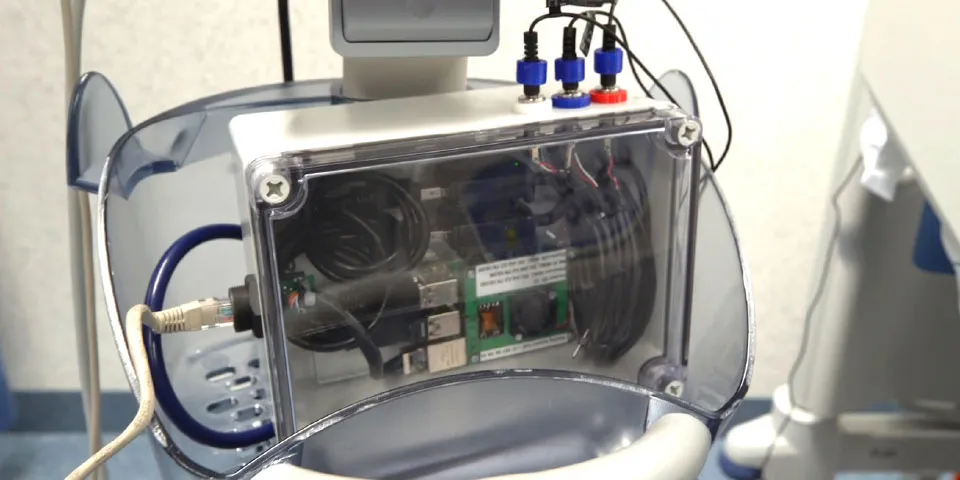
A team of fifteen Flanders Make engineers set to work supporting the VUB-FabLab with the development and improvement of a ventilator, and with preparations for possible production.
Flanders Make has been far from idle in recent weeks and months. Work has been going on behind the scenes on technological solutions. Ubrain Vandeurzen, Chairman of Flanders Make, explains: “Following distressing reports of acute shortages of life-saving ventilators in Italy, we immediately decided to deploy our top engineers on a number of urgent projects to prevent such dramatic scenarios here. A team of 15 Flanders Make engineers set to work supporting the VUB-FabLab with the development and improvement of a ventilator, and with preparations for possible production. Audi Brussels then produced the first fifty pre-production units, which the VUB-FabLab is now testing and finishing. We do not want to let our people suffocate, literally or figuratively, and we are very pleased with the support we have received from companies in Flanders’ manufacturing industry, such as Audi Brussels.”
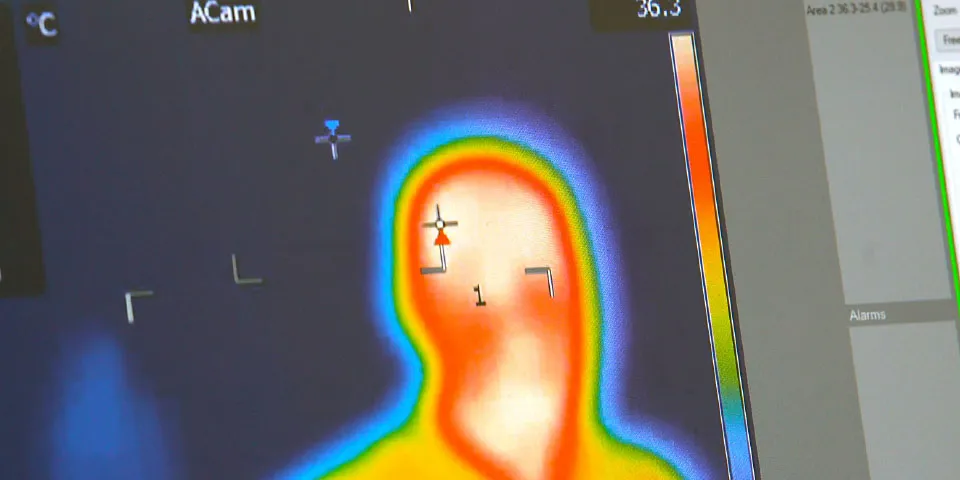
First, everyone entering the premises is immediately screened for body temperature using a system based on infrared measurements.
Fast, simple screening
Now that many companies are considering restarting operations, Flanders Make is also offering the necessary support in this area. Specifically, this means one device that screens body temperature and two systems that help people keep at least 1.5 m apart. These solutions can be used together or separately, depending on the company’s needs. Flanders Make has already been using them for some time and is now offering them to companies too. Dirk Torfs, CEO of Flanders Make, says: “First, everyone entering the premises is immediately screened for body temperature using our system based on infrared measurements. If there is any doubt, you use a thermometer and only let people with a healthy body temperature in. This makes it possible to screen large groups quickly while respecting social distancing. This reduces the likelihood of sick people being present in your company.
Keeping social distancing in mind
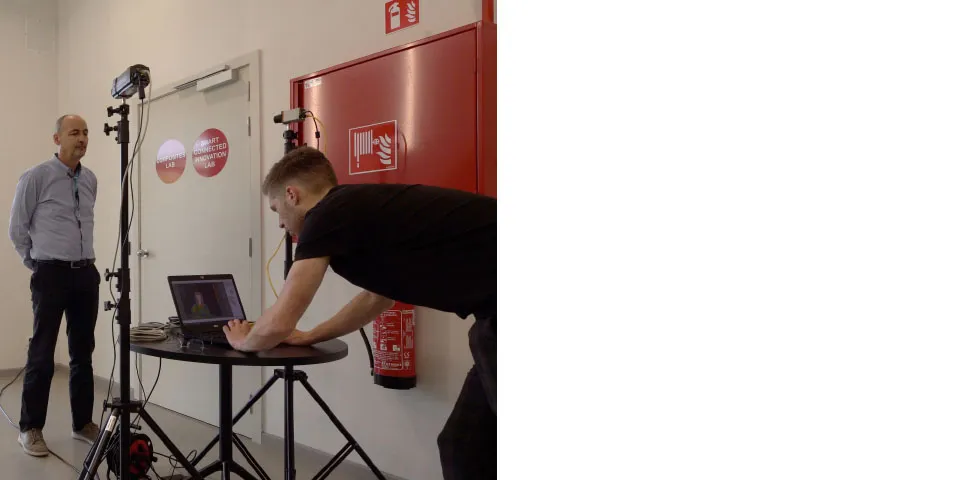
Once inside, every employee whose job requires particular attention to social distancing wears a small device around their neck. It sounds an alarm as soon as someone gets too close. “This new device is therefore close to the mouth, making it the ideal point from which to measure distance. This also means production operators can work safely. The device helps employees correct their behaviour immediately and remain alert. In places where many people gather, such as an entrance hall or canteen, you can install our camera-based system, which also sounds an alarm when people get too close to one another. The camera footage is not recorded and people cannot be recognised in the images, so privacy legislation is fully respected. The system can therefore also be used more widely, for example in the hospitality sector.”
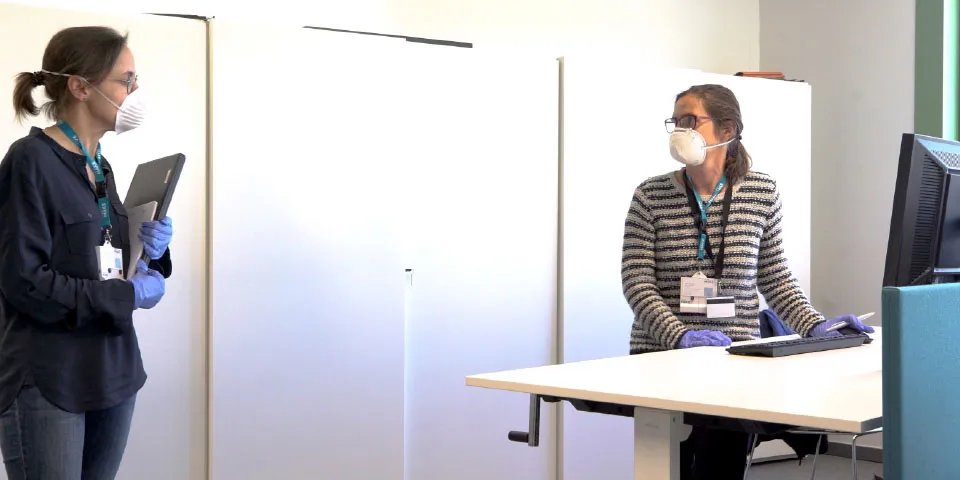
Once inside, every employee whose job requires particular attention to social distancing wears a small device around their neck. It sounds an alarm as soon as someone gets too close.
Successful initial production tests at Picanol
Geert Ostyn, VP Weaving Machines at Picanol and Vice-Chairman of Flanders Make, says: “Picanol was quickly involved in developing the social distancing devices and evaluating the technology on the shop floor. We first tested the system in Ieper with eight operators wearing the device around their necks. If they get too close to one another, they immediately hear a signal telling them to move apart. It has since been extended to eighty employees. The easy-to-install system requires no fixed infrastructure, operates entirely locally and respects employees’ privacy. This is a good example of a research centre developing a solution quickly so it can be deployed in companies at short notice.” Flanders Make is currently mapping the specific needs of interested companies and consulting potential manufacturers of the various systems, with a view to introducing them and supporting our industry as quickly as possible.
Question about this story? Ask your question
Companies in this story

Keep following this
Get an email when a new story is published. No account needed.
- SubjectNews
- CompanyFlanders Make







