












Motors need to become more energy-efficient again
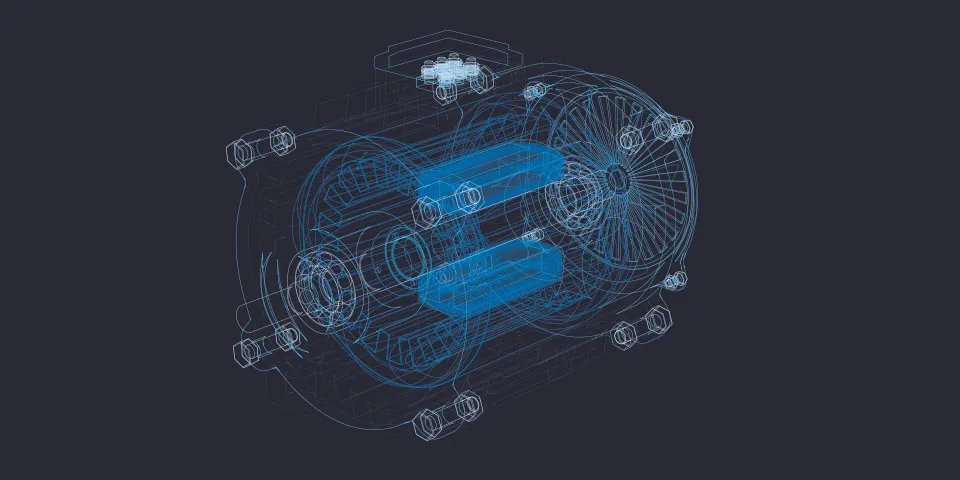
Since 2009, Europe has used its Ecodesign Directive to encourage manufacturers to bring more energy-efficient products to market. On 1 January 2021, the rules will be extended. From then on, electric motors will have to meet new, more ambitious energy requirements. All electric motors with an output of between 0.75 and 1,000 kW will have to meet at least energy efficiency class IE3. Implementation will take place in three phases, starting on 1 July 2021, 1 July 2022 and 1 July 2023.
Electric motors are major energy consumers. It is therefore no surprise that Europe is also targeting motors in its efforts to reduce energy consumption and CO2 emissions, bringing them within the scope of its Ecodesign Directive (ErP). The requirements are being progressively tightened. A new phase begins on 1 January next year. The new directive applies to all induction motors designed for continuous operation, with two, four, six or eight poles and an output of between 0.12 kW and 1,000 kW. This represents a significant expansion of the current scope, which covers motors from 0.75 kW to 375 kW. For the first time, eight-pole motors are included, along with motors fitted with an industrial brake, single-phase motors and ATEX safety motors (Ex eb). The exemption for motors used with frequency converters is also changing.
What changes on 1 July 2021
As usual, the new rules will be implemented in several phases. From 1 July 2021, all electric motors with an output of between 0.12 and 0.75 kW will have to meet at least energy efficiency class IE2. For outputs between 0.75 kW and 1,000 kW, the requirement will be raised to IE3. For machine builders, this means considering how the new motors and their revised dimensions will fit into machine designs. Those looking to future-proof their designs should take this into account now. It may mean additional work at the drawing board, but these costs are often quickly recouped by the end user. The key is to consider the relationship between the purchase price and the cost of use. Take a pump, for example: the investment in the motor is likely to account for just 5% of the total cost over its entire service life. Energy consumption, by contrast, will make up the lion’s share. The carbon footprint will be reduced, and total cost of ownership (TCO) can fall too.
What changes on 1 July 2022
From 1 July 2022, motor manufacturers will be required to test all electric motors at different speeds and under different loads. At present, testing is carried out only at full speed, but under varying loads. This change reflects the growing popularity of motors used with variable frequency drives, which operate precisely under these conditions. These updated test requirements will inevitably affect motor manufacturers’ designs. Integrating variable frequency drives into machines will therefore become even more attractive to machine builders.
What changes on 1 July 2023
The final phase begins on 1 July 2023. From then on, ATEX safety motors with an output of between 0.12 kW and 1,000 kW, and single-phase motors rated at 0.12 kW or more, will also have to meet at least IE2. The bar for electric motors will also be raised once again. All standard motors with two, four or six poles and an output of between 75 kW and 200 kW will have to meet IE4. Efficiency will then range from 66.5% (0.12 kW) to 95.6% (200 kW) for two-pole motors, from 69.8% to 96% for four-pole motors, and from 64.9% to 95.8% for six-pole motors.
Question about this story? Ask your question
Keep following this
Get an email when a new story is published. No account needed.
- SubjectNews







