












Researchers at Flanders Make @ UAntwerpen develop new remote lung examination system to help doctors worldwide in the fight against the COVID-19 pandemic
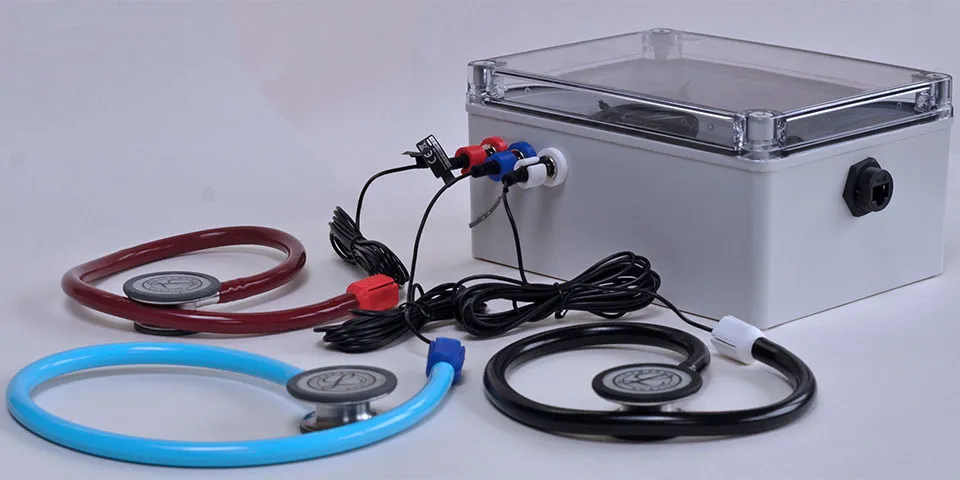
Tests under way in intensive care setting at Antwerp University Hospital
Regular lung examinations are essential for monitoring COVID-19 patients and pose a major challenge for medical staff. Doctors must enter patients’ rooms wearing sterile clothing, then change completely and wash their hands before examining the next patient. To improve safety and reduce their workload, a team of researchers from Flanders Make @ UAntwerpen has developed a remote stethoscope system that makes it possible to examine the lungs without direct contact with the patient. Tests are currently under way at Antwerp University Hospital. The system will be made available as an open-source solution to support doctors worldwide.
“To combat this pandemic, it is essential that research institutions fulfil their societal role and work together to develop the necessary technical solutions quickly. Flanders Make is making €1 million in operating funds available to develop technological solutions for both our hospitals and our companies. This brand-new system for remote lung examinations is a fantastic result of that collaboration and will help make lung examinations safer and more efficient worldwide,” says Urbain Vandeurzen, Chairman of Flanders Make.
COVID-19 infections often cause severe acute respiratory syndromes, which is why one of the most frequently performed examinations is listening to the lungs with a stethoscope. “There are several types of lung sounds that can be assessed with a stethoscope, and all of them contribute to the clinical monitoring of a patient’s condition. These examinations are very time-consuming, especially when large numbers of patients need to be examined. That is the case in virtually all hospitals during this COVID-19 crisis,” says Dr Stijn Verhulst of Antwerp University Hospital.
Digitised stethoscopes
Direct contact with patients and the use of a stethoscope also carry a risk of infection. Many healthcare workers around the world have already been infected while treating their patients.
This is precisely where the newly developed system can help. It consists of several digitised stethoscopes that can remain on the patient’s body, all connected to a computer in the medical staff’s consulting room. On 15 April, a pilot project involving several intensive care beds was launched at Antwerp University Hospital. “The system also makes remote monitoring possible in locations other than intensive care units, such as residential care centres,” says Rudy Mattheus, board member of Antwerp University Hospital and chairman of Voka Health Community, who believes the system will play an important role as a medical device in the near future.
“One major advantage of the system is that a team of doctors can listen together and work collaboratively to assess a patient. They can even compare results over a given period and assess patients’ progress more objectively, all without direct contact with the patient,” says Prof. Jan Steckel, principal investigator on this project from CoSys-lab, a Flanders Make @ Antwerp University research team specialising in audio signal processing. “It is easy to build and uses inexpensive, readily available commercial equipment such as microphones, small computers and sound cards. People with experience in technology and computer networks can easily replicate the system and assist hospitals with its installation. The system has the potential not only to help during the current COVID-19 pandemic, but also to improve the diagnostic quality of this type of lung examination and help patients with respiratory conditions.”
Open-source solution
“This project builds on our research group at UAntwerpen’s many years of expertise in audio processing and was developed in just a few weeks,” explains Marc Engels, COO of Flanders Make. “Once the tests currently under way at Antwerp University Hospital have been successfully completed, we will make the system available as an open-source solution to help doctors around the world.”
Hilde Crevits, Flemish Minister for Innovation, concludes: “Our Flemish researchers and scientists are world-class, as this coronavirus crisis has once again demonstrated. In Flanders, we have not only considerable expertise in developing vaccines or antiviral agents against COVID-19, but our manufacturing industry is also highly innovative. This example of ‘remote auscultation’ clearly shows how technology can make patient care easier and better. As Minister for Science and Innovation, I can only be especially proud of our researchers in the fight against coronavirus.”
Question about this story? Ask your question
Companies in this story

Keep following this
Get an email when a new story is published. No account needed.
- SubjectNews
- CompanyFlanders Make







