












Reverse engineering: how do you recreate a part that can no longer be sourced?
How can you get hold of a part that is no longer in production? This is a problem you may encounter if you have an old pump system. Our spare parts experts at KSB have answered a series of questions to tell you all about reverse engineering, the process of reproducing a part from the original.
Reverse engineering is a method of making a part that is identical to the original. It makes it possible to overcome product obsolescence while retaining the manufacturer’s quality assurance. The newly manufactured part is fitted in place of the old one. It is a solution when you have run out of options!
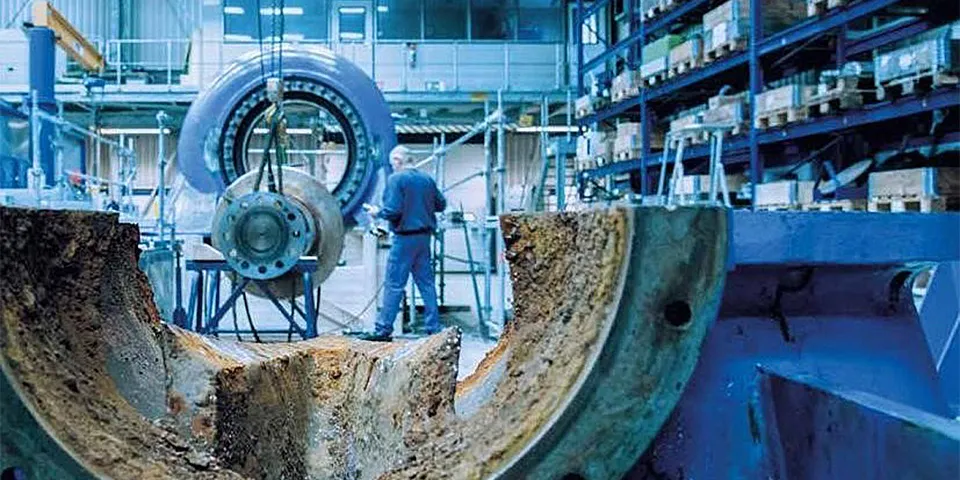
How is the reverse engineering process organised?
To manufacture a part using reverse engineering, various types of information need to be gathered. First, information about the materials, but also about the fluid being transported and the environment in which the part is used. Reverse engineering starts with a 3D scan. This makes it possible to determine the exact dimensions of the damaged part or the model part to be reproduced. A scan can also be used to create a point cloud. In this way, KSB ensures the highest possible accuracy when reproducing the part. All the information gathered enables the pump specialist to create a CAD model. This model provides an overview of the finished part and is needed to create the mould that enables the part to be machined identically. This method can be used to make all parts, even the most complex. Parts can also be 3D-printed in a wide range of materials, such as bronze, cast iron, stainless steel or any other steel!

What types of parts are involved?
These include all kinds of parts, such as pump components, valves and other parts for rotating machinery. Reverse engineering applies to both KSB products and third-party products. In addition to components for valves and rotating machinery, KSB can also produce other parts or prototypes to meet your requirements. The possibilities for replication are unlimited. This means you can have any number of custom-made parts produced to suit your needs. This is not a one-off production run, which can make the process even more ingenious and necessary in some cases.
When do we use reverse engineering?
Reverse engineering is used when the original part can no longer be made because the process has evolved, drawings are missing, the casting pattern has been lost, or optimisation is required. In other words, the original part is modified to improve its efficiency by changing the materials or design. This approach ensures that an exact, ready-to-use replica of the product in question is produced quickly, without compromising KSB’s uncompromising quality.
Question about this story? Ask your question
Keep following this
Get an email when a new story is published. No account needed.
- SubjectNews







