












The growing importance of track and trace
Track-and-trace technology is not new. Yet it is being adopted by more businesses than ever. There are two reasons for this. On the one hand, the cost of this technology has fallen dramatically, putting it within reach of more businesses. On the other, the timing is right. The digitalisation set in motion by Industry 4.0 has opened up more possibilities and applications for track-and-trace technology. This prompted Agoria to organise an interesting afternoon seminar on the subject. We take a closer look at Johannes Cottyn’s presentation.
Track and trace: three words that are now commonly used as a single term. But the concept covers more than that. As well as tracking and tracing, it involves monitoring, planning and controlling. This gives users a complete picture of where a product has been (trace), where it is now (track), where it is going (control), what the process looks like (monitor) and what the future will look like (plan). The same source of information is needed for each of these steps. Initially, this information came mainly from the product itself, which was also the main focus. Today, track and trace is also used to track assets and resources. As businesses’ need for flexibility grows, the number of movements will only increase in the future, even for machines. Examples include the introduction of carriers on the production floor and tools that need to be tracked throughout production. Things become even more complex when this mobility is combined and orders, tasks and quality control are all linked.
Greater visibility needed
The growing use of track and trace is closely linked to businesses’ need for greater visibility into their production. This is not only to meet legal requirements, but also, and perhaps more importantly, to enable real-time optimisation. But where should a business start when introducing track and trace? It is important to know the answers to a number of questions. What level of detail do you need? Do you want manual or (semi-)automatic identification? Is the process discrete or continuous? Is additional information needed, for example about location, distance, temperature or the conditions under which identification takes place? Only once these questions have been answered can you choose the right technology.
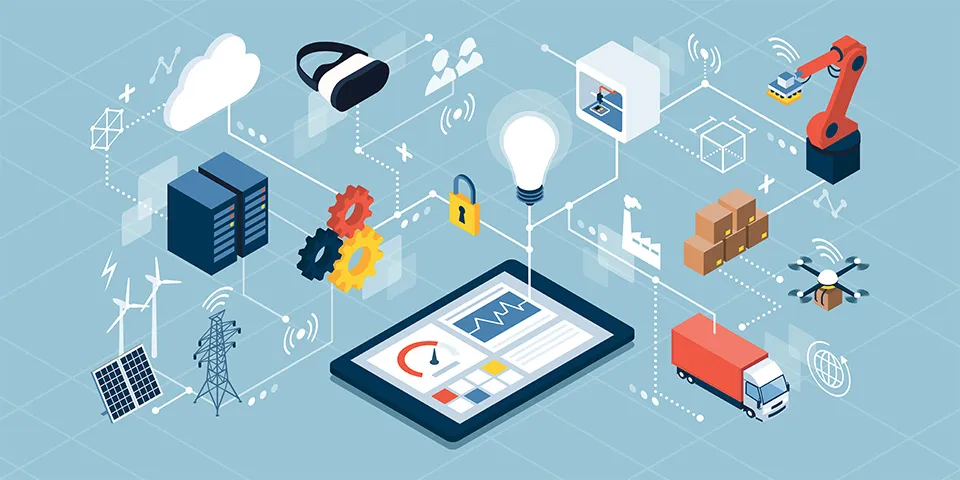
By combining all the individual signals into a single picture, you create an information flow throughout
your production, particularly if you choose technology that can provide additional data.
A wide range of technologies
Users have a wide range of options. RFID is now well established. A tag (transponder), an antenna, a reader, a controller and a network: that is all you need to track products, assets or resources. Another option is indoor positioning. This can use RFID, but also Wi-Fi, BLE (Bluetooth Low Energy) or UWB (Ultra Wide Band). It can be server-based or client-based. For those looking to operate on a larger scale, however, industrial 5G communications will become crucial. Real-time location tracking is another option. Various sensors on the production floor pick up signals and use their orientation, the distance between them and the time difference between signals to locate products. The more sensors there are on the production floor, the greater the accuracy. A good internet connection ensures that all signals are synchronised. Bluetooth can also be used for proximity-based localisation. Passive sensors, meanwhile, are an excellent way to combine information. Rather than being generated continuously, the information is only generated when a tag comes within range of the reader. The final option discussed was 3D vision. Its advantage is that no additional material, such as a tag or barcode, is needed. Identification is based on geometry.
Added value in bringing data together
This hardware is used to collect raw data. Software is of course still needed to gather it and convert it into useful information. The value of track and trace lies precisely in bringing data together. By combining all the individual signals into a single picture, you create an information flow throughout your production, particularly if you choose technology that can provide additional data. This also opens the door to extensive product individualisation.
Question about this story? Ask your question
Keep following this
Get an email when a new story is published. No account needed.
- SubjectNews







