












Trends in direct-drive motors
Despite the technological maturity of certain industrial segments, the capabilities of a machine are still limited by what its builder can implement. One of the key decisions they need to make is which type of motor to choose. Direct-drive motors are regarded as a technological evolution of standard drive systems. Although their basic design has remained unchanged for years, motor manufacturers are working hard to optimise various aspects and improve overall performance and quality. Here, we look at six developments they are focusing on.
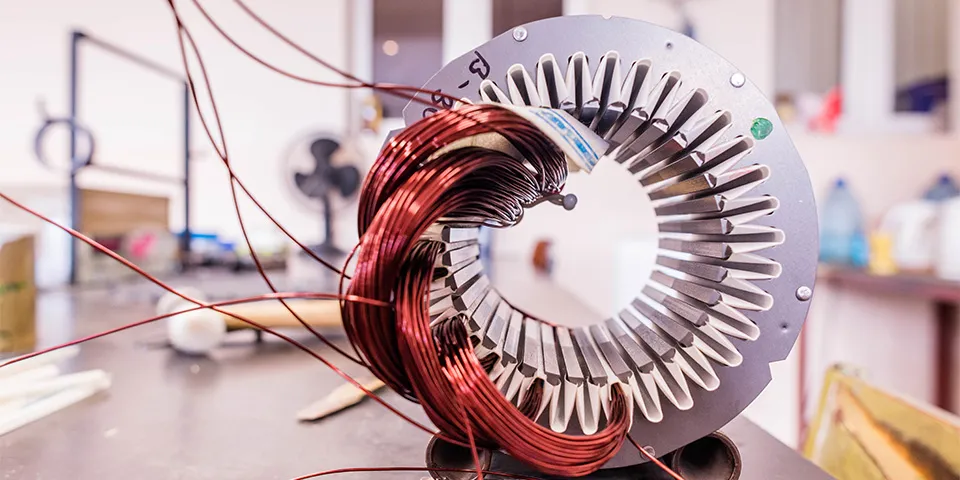
One of the main advantages of direct-drive motors is the high performance they deliver from a relatively small footprint. Their torque and power mean that a machine takes up less space without compromising on power. Machine builders are therefore keen to increase power density within a limited volume. One common approach is to fit more copper windings into the same volume. This can be achieved, for example, by creating unique shapes or using different manufacturing methods. The more tightly packed they are, the stronger the magnetic flux. A second way to improve performance is to optimise heat distribution. After all, the better the motor is cooled, the better it will perform. The answer lies in state-of-the-art designs and materials.
The wide range of sizes allows machine builders to maximise space and efficiency,
to the point where they can feel as though the motor was built specifically for their application.
More size options
While direct-drive motors are designed to optimise power within a given volume, geometric variations are needed to tailor them to specific applications. This gives machine builders greater flexibility when selecting the optimum motor for the space available. Torque motors come in a range of diameters, lengths and power ratings, making it much easier to find the ideal combination. If the motor’s outer diameter is limited, manufacturers often offer several height options to maximise torque. This variety of sizes also allows for greater flexibility in terms of cost. If a linear motor can be made longer, it requires less width and fewer expensive magnets. The wide range of sizes allows machine builders to maximise space and efficiency, to the point where they can feel as though the motor was built specifically for their application.
Simpler integration
Many machine tools have internal cooling. Good heat distribution is an effective way to double a motor’s torque capacity and fit it into a smaller package. However, using liquids can be a deterrent in some applications. Motor manufacturers therefore sometimes offer the option of self-contained, built-in cooling jackets. These eliminate the risk of leaks and the challenge of designing optimum cooling channels. Responsibility for effective cooling is thus shifting increasingly from the machine builder to the motor manufacturer. Integration of linear motors can also be simplified by keeping the magnetic paths consistent. If the magnetic path is similar across the different motor models used in a machine, modifications are easier to make. The benefits are even greater if the next generation of machines builds on the same approach. This allows customers to upgrade their machines with minimal effort.
More windings
Although a motor may have a certain torque or force rating, its full capacity is not necessarily available at every speed. The faster a motor runs, the lower its torque capacity becomes, partly due to eddy currents. These effects can be reduced by adjusting the winding of the copper coils. This raises the speed threshold, but requires more current. To minimise the impact, it is best to offer a range of torque versus speed profiles for each motor footprint, meeting as many requirements as possible.
Machine builders are therefore keen to increase power density within a limited volume.
One common approach is to fit more copper windings into the same volume.
New ways to integrate
For a long time, direct-drive motors were reserved for a limited number of standard applications. As machine builders have become more familiar with the technology, more ways of harnessing the benefits of direct drive have emerged. One example is the configuration of a linear motor. Normally, the motor moves along a magnetic track, but what if the magnetic section itself were to move? This configuration enables short, fast strokes. It allows a lighter load that does not need to be constrained by a cable, giving it greater freedom of movement. A linear motor can also be adapted so that the track is curved rather than straight, allowing the load to travel in a circular or racetrack configuration. It takes up less space than a torque motor and offers a cost advantage, as users do not have to pay for unnecessarily high torque. Combine this with the modular nature of a separate linear motor that can be connected in parallel, and you also get a solution that is easier to integrate and maintain.
Greater efficiency
Growing attention to climate issues is prompting companies to seek greener, more energy-efficient technologies. To meet these demands, motor manufacturers need to develop new ideas for minimising power losses. They are examining every aspect of the materials and how they are assembled, with the aim of achieving the most efficient performance within the same basic design developed for direct-drive technology.
Question about this story? Ask your question
Keep following this
Get an email when a new story is published. No account needed.
- SubjectNews







