












Vertical instead of horizontal: how motion plastics are making agriculture more sustainable
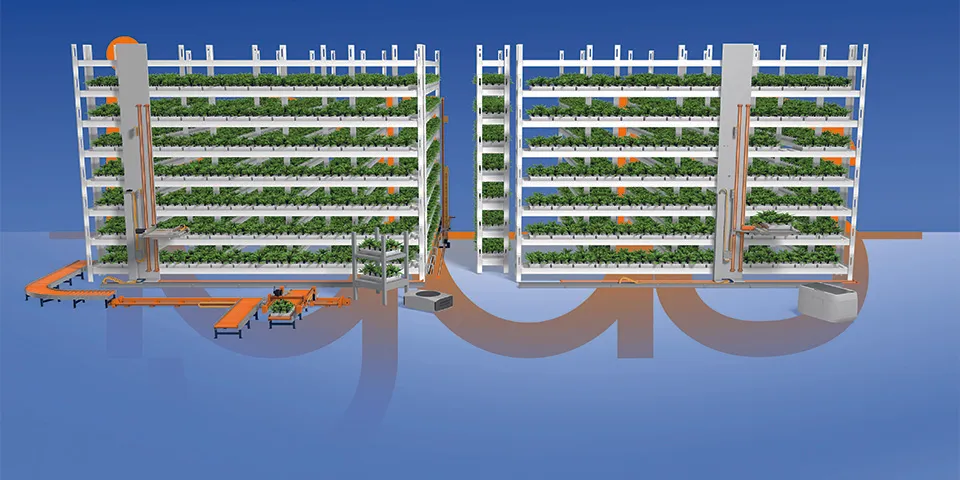
According to the United Nations, the global population will grow to 9.7 billion by 2050. In particular, the populations of cities will increase significantly. Vertical farming is seen as a promising alternative to conventional food production methods, offering a reliable and affordable way to feed the growing number of city dwellers. igus motion plastics already play an important role on these vertical farms, delivering cost-effective and reliable operation.
Lubricant-free tribo-polymers ensure the reliable operation of vertical farming systems
With 7.7 billion people currently living on Earth and the global population continuing to grow, food production has become an increasing challenge. Adding to this is increasing urbanisation: more than half of the world's population already lives in cities and metropolitan regions. However, conventional farming is only possible to a limited extent, as agricultural land has become scarce. Food therefore has to be transported from remote regions to urban centres. One solution is so-called vertical farming. Multiple levels in enclosed buildings are used to produce food. The aim is to reduce production and transport costs, along with the resulting CO2 emissions. At the same time, vertical farming makes use of small production sites in urban areas, which are ideal for generating the greatest possible agricultural yield in a small space.
High-performance polymers demonstrate their strengths
The machines used in vertical farming operate in an extremely sensitive environment. igus motion plastics are ideal for use in this type of food production. This eliminates the need for maintenance and ensures trouble-free operation in vertical farming. As the polymers are lubricant-free, they comply with FDA requirements and meet the highest hygiene standards, without contaminating plants, vegetables, salad or fruit. The tribo-polymers are also corrosion-free and low-maintenance, as well as resistant to dirt, dust and mud. There is also considerable potential for autonomous, fully automated vertical farms. Low-cost automation systems make it possible to plant, harvest and package vertically all year round, cost-effectively and with a rapid return on investment (ROI).
Vertical farming is no longer a dream of the future
Living Greens Farm is known for its vertical farms. The American company's idea is to transform vacant high-rise buildings into vertically oriented farms. These cultivation techniques require specialist machines to supply nutrients and irrigate plants. A patented traversing system fitted with igus cable carriers delivers nutrient-enriched water directly to the plant roots. In an empty warehouse in Minneapolis, around 4,000 square metres are used in this way to harvest the same quality of food as is produced on more than 40 hectares of conventional farmland. Intelligent Growth Solutions (IGS) also uses igus motion plastics to automate vertical farming. One of Growth Towers' aims is to make vertical farming more economical by improving productivity, yield, quality and consistency while drastically reducing electricity and labour costs. The vertically arranged IGS systems need to be reliable, have low friction and be easy to maintain. igus drylin linear guide systems meet all these requirements and ensure trouble-free system operation. One year after the lubricant-free components were installed, an inspection found no discernible wear on the bearing liner.
Question about this story? Ask your question
Companies in this story

Keep following this
Get an email when a new story is published. No account needed.
- ThemeTailored motion and drive systems
- SubjectNews
- Companyigus B.V.







