4Bar Factory: how to save up to 20% energy with compressed air
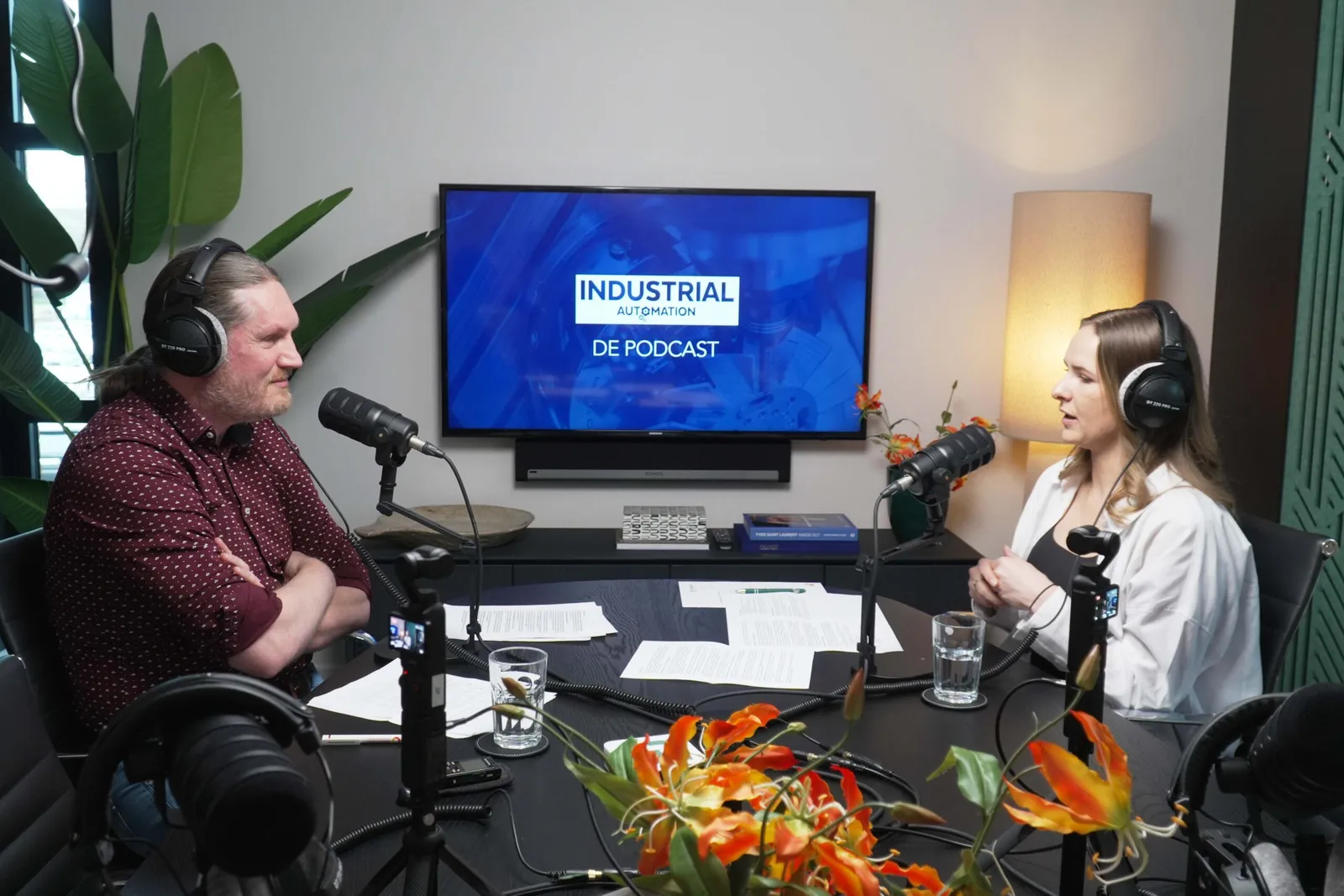
Host: Alexander Pil
In conversation with Dorien van Twisk
In this episode of the Industrial Automation Podcast, Alexander Pil talks to Dorien van Twisk (SMC) about the role of compressed air in industrial automation and how the 4Bar Factory concept helps companies save energy, cut costs and produce more sustainably. They discuss the difference between pneumatics and electric drives, the impact of energy costs, and how data, sensors and smart design choices can be used to optimise existing factories. With practical examples from companies including FG ROBOSYS B.V., as well as applications in the food industry, you’ll discover how to achieve energy savings of up to 20%.
Have a business enquiry for SMC? Get in touch
Full transcript
Alle hoofdstukken (17)
- Podcast introduction
- Energy costs and customer demand
- Perceptions of pneumatics
- Pneumatic versus electric
- Choosing the right technology for the application
- Introducing 4Bar Factory
- Energy savings per bar
- Implementation challenges
- Components for 4 bar
- Brewery example and local pressure boosting
- Targeted pressure boosting
- The role of engineering in design decisions
- Working with machine builders
- Example: FG Robosys
- Example: Lekkerkerker
- A strategic decision
- Conclusion and advice
Podcast introduction
Alexander Pil Welcome to the Industrial Automation Podcast, where technology, innovation and industry come together. We talk about everything happening in the world of manufacturing and process automation, from robotics and smart software to connected machines and digitalisation on the shop floor. Industrial automation is the driving force behind more efficient, smarter and more sustainable production processes. On this podcast, we talk to the experts, engineers and entrepreneurs working every day to build the factory of the future. No theory, just practical insights, real-world case studies and ideas you can put to use straight away. Whether you work in motion control, IT/OT integration, AI or smart production lines, you’ll find out what’s changing, what’s possible and how to keep moving forward. My name is Alexander Pil, and I’m here with Dorien van Twisk. She is Project Lead for Sustainability and Digitalisation at SMC. To start with, Dorien, for anyone who doesn’t know SMC, what do you do?
Dorien van Twisk We are SMC Nederland, part of the corporation based in Japan, SMC Corporation, which is a Japanese company. We operate from the Netherlands and supply components for industrial automation. We specialise in compressed air, which is where we started: compressed air components. These include air preparation equipment, valves and cylinders, as well as temperature control and sensors. Essentially, everything you need for automation.
Alexander Pil So, a very broad range of products.
Dorien van Twisk Very broad, yes.
Alexander Pil Your role is about sustainability. That’s not necessarily what comes to mind when I think of compressed air. Can you explain what’s involved and why it matters to you?
Dorien van Twisk We’re seeing a major transformation in industry. We’ve had Industry 1.0, 2.0 and now, officially, Industry 4.0. Some even say 5.0. So industry is changing, particularly in terms of digitalisation and automation. We’re seeing a lot of demand for this from industry. Sustainability is part of that too: using compressed air more efficiently, but also improving the efficiency of your machines, so you can take the next step towards a future-ready machine or production site.
Read the full transcriptCollapse transcriptnog 16 hoofdstukken
Energy costs and customer demand
Alexander Pil Energy costs have been a challenge lately, especially given everything that’s happening in the world. Are you seeing companies and your customers focus more on this?
Dorien van Twisk Yes, very much so. It depends a little on the market you’re in. You hear more about it in some markets than others. It also depends on how significant a part compressed air plays in a machine, as that can determine whether it’s worth looking at. But we’re hearing more and more about it now: efficiency, sustainability, CO2 savings and cost savings. That’s coming up a lot with customers.
Alexander Pil Right. So it’s also a financial issue, not necessarily an environmental one.
Dorien van Twisk No, there are several different aspects to it. They look at it from all angles. And of course, it’s an added bonus if you can also save costs or reduce CO2 emissions, ideally both.
Alexander Pil Exactly, a win-win, you could say.
Perceptions of pneumatics
Alexander Pil So you mainly work in pneumatics. This might be a bit of a loaded question, but to me, pneumatics also seems a little old-fashioned. What’s your take on that?
Dorien van Twisk It’s a difficult question to ask me, of course. I hear that every day. I often hear people say that compressed air is expensive. Compressed air isn’t expensive. It’s inefficient, mainly in the way it’s generated. So compressed air can sometimes seem cheap, because air is cheap or even free, but compressed air isn’t. What you see is that 80% of the energy is lost when the air is compressed. So only 20% reaches the end users, the machines. There is always an 80% loss. So if you don’t use it efficiently or intelligently, it can indeed be expensive. But if you use it well and give real thought to how you design your compressed air systems, you can make significant improvements.
Pneumatic versus electric
Alexander Pil What are the advantages of pneumatics compared with electric drives or even hydraulic drives?
Dorien van Twisk We’re seeing a lot of demand from companies for electrification at the moment. It feels like a more sustainable and environmentally friendly option, and therefore a better choice. And in some ways, it is a good choice. For example, you have more control over movement with an electric actuator than with a pneumatic cylinder. But compressed air systems are very robust. And choosing a pneumatic cylinder can sometimes be a very good option, including in terms of purchase cost. So it depends more on the application whether you choose electric or pneumatic, and above all, on setting it up correctly. One option isn’t automatically right and the other wrong.
Alexander Pil And you offer both.
Dorien van Twisk Yes, we offer both.
Alexander Pil So you can help customers make the right choice.
Dorien van Twisk Yes, you really need to look at the application and the movement you want to create, how much control you need over it, and how much force you need to be able to deliver. It’s a design question.
Choosing the right technology for the application
Alexander Pil How do you make that choice? When is pneumatics suitable, and when is electric the better option?
Dorien van Twisk It really depends on the customer’s requirements and the application. We support customers with this. What kind of machine are they using? What force needs to be applied, and how quickly? Speed is often a factor too. And if it’s, for example, an application in the food industry, you need to consider food safety. We take all those kinds of questions into account.
Alexander Pil So pneumatics can be used in the food industry?
Dorien van Twisk Absolutely.
Alexander Pil Or perhaps even preferred?
Dorien van Twisk Yes, either can be used. It simply depends on which option you choose. You look at the IP rating of the components, whether they’re electric or pneumatic. It doesn’t really matter.
Alexander Pil There aren’t any rules of thumb you can give us, saying that you should use pneumatics in one case and electric in another?
Dorien van Twisk No, that’s very difficult to say. Either option works well if it’s designed properly.
Alexander Pil Exactly. And that’s the choice you help customers make.
Dorien van Twisk Yes, that’s right.
Introducing 4Bar Factory
Alexander Pil In our briefing, you said that the team at SMC is very busy with 4Bar Factory. It sounds exciting. What is it?
Dorien van Twisk It’s really our overall vision for the new industry. Historically, machines have operated at 6 or 7 bar. In extreme cases, they go up to 8 or 9 bar, sometimes 10. But standard machines generally run at 6 or 7 bar. As I just mentioned, the biggest losses occur when compressed air is generated. That’s where the 80% loss comes in. At SMC, we’re asking: why not tackle the problem there? We’re looking at the root cause, which is the compression of the air. That’s where we want to address the problem. So we’re moving to 4 bar. You can then run your compressors at a lower load, saving a lot on energy costs.
Energy savings per bar
Alexander Pil How much difference does lowering the pressure make?
Dorien van Twisk On average, each 1 bar reduction in pressure saves 7% in energy. So, if you go from 7 to 4 bar, you save more than 20%.
Implementation challenges
Alexander Pil Why don’t people do that? Why is it complicated?
Dorien van Twisk I’m making it sound very simple, but it is a complex step to take, particularly in a brownfield site. You already have a factory operating at 6 or 7 bar. Everything has been designed for that. It works. And production is the top priority, so making a change is often very difficult and complex. It also costs money and takes time. That’s why the step is bigger than I’ve made it sound.
Alexander Pil Because all the machines would need to be adapted, all the pipework, everything would need replacing.
Dorien van Twisk Yes, and some machines are simply very old and still work well. They’re producing, and for companies that’s actually much more important than energy costs. That’s why we focus on new developments. If you’re designing a new machine, you can look at whether you can apply this concept, because you have to redesign it anyway. The engineering costs are already there, so taking this step is easier.
Components for 4 bar
Alexander Pil And you have components designed specifically to operate at 4 bar.
Dorien van Twisk Yes, that’s right. SMC is now designing everything around the 4Bar Factory concept. I say factory because it really is viewed from a factory perspective. It’s obviously very interesting for machine builders, but factories are the ones that will actually save those costs. So everything is now being designed in Japan around this concept. Every component will work perfectly at the lower pressure and deliver the resulting efficiency gains. So you can use the components to implement the 4 Bar concept. It’s not just a marketing claim. It’s technically feasible.
Alexander Pil And it saves money in the end.
Dorien van Twisk And it saves money. You’re also keeping pace with the future, which is very important. What we’re seeing now is that some end users are already insisting that equipment can operate at 4 or 5 bar. With the 4bar concept, we’re talking about compressors at 5 bar and end users and machines at 4, leaving a little room for pressure drop. End users are now starting to demand this.
Brewery example and local pressure boosting
Alexander Pil It’s really almost a little nudge to customers: you need to do this, otherwise we won’t meet our own rules.
Dorien van Twisk Fortunately, that’s not much of an issue in the Netherlands. We don’t have a production site, so we can easily manage our own processes ourselves. And with scope 3, which is a large category, the emissions from our components are generated at customers’ sites, inside the machines, during actual use. We can support them in reducing those emissions, and of course help ourselves to make the entire supply chain more sustainable. That’s something we’re trying to put into practice ourselves, too. For example, we have a production hall in Japan that runs entirely at 4 bar, with all our new products and components in it, so we can show that it really works.
Alexander Pil To show that it’s technically possible.
Dorien van Twisk Yes, to show that it’s technically possible. A good example from a customer is a brewery, for instance. The entire brewery operates at 5 bar in this case, and the compressors are set to 6 bar. Then a new filling line arrived. They had already ordered it, and it was being delivered. The filling line operated at 6 bar, which was actually too high for their setup. In many applications, you often find that you do need the higher pressure, because you have to operate, say, 16 heads at once. Those applications often run at a higher pressure, so the brewery’s existing settings wouldn’t be enough. What they did was use a booster. In this case, it was SMC’s VBHE booster. It’s a mechanical component that runs solely on compressed air, using the flow to build up the pressure.
Targeted pressure boosting
Alexander Pil From 5 to 6 bar.
Dorien van Twisk From 5 to 6 bar in this case. Was that for the whole factory? No, it was specifically for the filling line. They decided to boost the pressure for that filling line only, from 5 to 6 bar. The filling line still gets the pressure it needs, but they don’t have to raise the pressure throughout the whole brewery to 6 bar.
Alexander Pil So it’s boosted locally to 6 bar for that one machine, and you can keep the rest at 5.
Dorien van Twisk Yes, exactly. Sometimes applications really do need that high pressure. Take vertical cylinders, for example. A cylinder is often used to apply force, to lift something, for instance. If it has to lift a heavy load, 4 bar sometimes really isn’t enough. So you can boost the pressure specifically for that application. You can do that with a booster, for example, with a tank underneath, so that you always have enough flow at the higher pressure. That means you don’t have to worry about speed either. At the brewery, they had three boosters connected in parallel, so they could be sure there was enough flow at all times. They saved almost €48,000 a year because they didn’t have to raise the pressure throughout the whole brewery to 6 bar, only in that one location.
The role of engineering in design decisions
Alexander Pil Some applications require higher pressure. Isn’t it also up to engineers to come up with alternative solutions so that higher pressure isn’t needed?
Dorien van Twisk Yes, absolutely. That can of course be a solution too: redesigning the machine. When I explain the 4Bar concept to customers, whether machine builders or manufacturers, they often say, “Yes, but we don’t want a machine that’s one and a half or twice as big because we have to fit larger cylinders.” It’s simply physics: if we lower the pressure, the force also decreases. So we have to increase the cylinder’s surface area a little to achieve the required force. When designing a new machine, you therefore need to design it differently. That’s one reason why, for example, SMC offers compact cylinders. Many ISO cylinders are still used. They’re a great solution, interchangeable like for like and available everywhere. But they’re very robust, and it takes a lot of air to generate the same force as, for example, a compact cylinder, which has a much smaller installation footprint. In that case, you can simply go up one or two bore sizes and still achieve the required force.
Working with machine builders
Alexander Pil Do you also work with machine builders to encourage them to set their systems to 4 bar?
Dorien van Twisk Yes, we take two approaches. We work with machine builders and manufacturers. We want to show manufacturers the benefits: they can save a lot of CO2 and money, and work much more efficiently. But in the end, it’s the machine builder who has to design the machine. So we also encourage them to take that step now. That way, they’ll be ahead of the curve when a customer comes to them with that requirement, rather than having to think, “Oh, we need to get started on this now.” They’ll already be able to say, “Yes, we can do that.” Or, “The total cost of ownership of our machines is now much lower than it used to be.”
Alexander Pil That sounds like a difficult sell, though, because the savings are ultimately made in the factory.
Dorien van Twisk A 4 bar machine isn’t necessarily more expensive than a standard machine, because the applications are the same. All you’re doing is designing it differently, from a different perspective and for a different pressure. Sometimes the machine already has such a large safety factor that the cylinders barely need to be made any bigger, because they can already handle it. And a different cylinder isn’t necessarily more expensive than the standard cylinder currently fitted. So it’s not an extra option on the machine. It still does exactly what it did before, it’s just been designed slightly differently.
Example: FG Robosys
Alexander Pil Are there any other concrete examples?
Dorien van Twisk Yes, a machine builder is a good example of how it can be done and of a company taking that step. That’s FG Robosys in Veenendaal. The example is a specific machine, a bottle filling line. The company was intrinsically motivated to design the most future-proof machine, so they approached SMC and asked us to help. We then worked together from start to finish, examining the previous version of the machine: what was in it, how it worked and how we could improve it. One major part of that was going from 6 to 4 bar. We looked closely at whether we could adapt the components to work at 4 bar. The first thing you do is measure the machine. We had the previous version and were able to measure it fully, see exactly what was happening and determine precisely what force was needed. In the end, we only had to make changes at a few points.
Example: Lekkerkerker
Alexander Pil Do you have an example of a company that has done it for its own operations?
Dorien van Twisk Yes, Lekkerkerker is a good example. It’s a Dutch company that mainly makes machines for dairy products. In this case, we looked at a cheese line and a butter line, for packaging butter. They also take in old machines, refurbish them and then send them back out. So they already reuse a lot of their products, keeping emissions and material use as low as possible. That’s a great step in itself. We first spoke about food safety, which led us to sustainability. We explained the 4Bar concept to them internally. They’re also a machine builder, so at first we weren’t sure how they would respond. But they’re so motivated that they were keen to apply it themselves at their own production site. They have a large hall where they build the machines, and we measured everything there. They were previously running at 7.5 bar. We found that only two machines needed that high pressure, yet everything was being supplied at that pressure. So we tested a booster, and now their own production site runs at 4 bar.
A strategic decision
Alexander Pil So that really came from management.
Dorien van Twisk Yes, that ultimately made the difference. It was a management decision, based on the many benefits they could see.
Conclusion and advice
Alexander Pil What advice would you give companies?
Dorien van Twisk What you see is that moving to 4 bar isn’t just a technical issue, it’s also a strategic step towards the future. The first steps we’ve discussed are to understand your machines and measure your flow, temperature and pressure. You can then look at your biggest consumers and work more efficiently. A 4 bar machine is a step towards the future. It means machine builders and manufacturers can stay ahead of the curve and achieve real efficiency gains. The key point is that SMC can support you. We can help you, so you don’t have to do it alone. We have the components, the expertise and the engineers.
Alexander Pil And it really starts with recognising that compressed air can be sustainable.
Dorien van Twisk Yes, that you can use it sustainably and efficiently, and that it’s still a good energy source. You need to ask yourself how you can make better use of it, so that we can help the entire industry.
Alexander Pil Thank you, Dorien. Thanks for listening, and see you in the next podcast.
Companies in this story
Keep following this
Get an email when a new story is published. No account needed.
- SubjectProcess & instrumentation
- CompanySMC