Intralogistics is becoming a control discipline
Text Christobal van LeeuwenImage Wikimedia Commons en Pexels
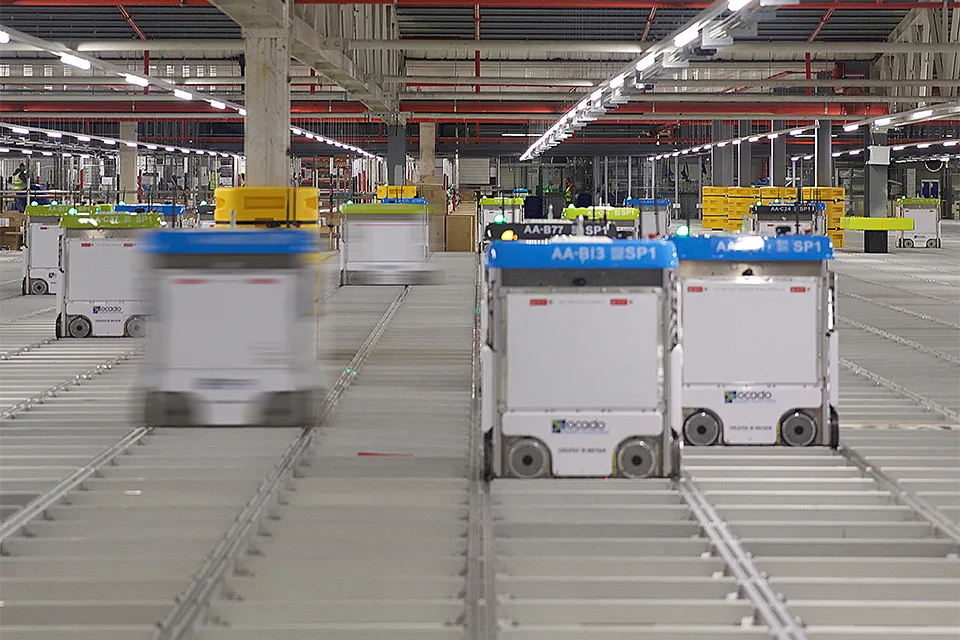
How predictability, safety and orchestration determine the real ROI of intralogistics automation
In many manufacturing companies, intralogistics is the silent bottleneck: materials are left waiting too often, routes cross and a minor disruption (a late pallet, the wrong tote, an unavailable forklift) immediately affects OEE (Overall Equipment Effectiveness). At the same time, pressure is mounting due to greater SKU variety, smaller batches, labour shortages and higher expectations around traceability and safety. As a result, automation is shifting from ‘a single island’, such as an automated storage and retrieval crane or an AGV route, to end-to-end control of material flows. With software as its backbone.
Not just speed, but above all predictability
Many projects begin with the promise of faster picking or fewer handling steps, but the real gains often lie in stability and predictability: fewer ad hoc interventions, less time spent searching and fewer disruptions between inbound, storage, production supply and outbound. The business case remains a stumbling block, however: in MHI’s (Material Handling Industry) annual industry surveys, ‘no clear business case’ has been cited for several years as one of the biggest barriers to technology adoption. This argues for an approach that goes beyond capex versus labour hours: include in the TCO the time planners, team leaders and technicians currently lose fighting fires.
Safety is (finally) covered by mature standards
The rise of AMRs and AGVs is clear to see, but they are increasingly operating in mixed zones with pedestrians, forklifts and temporary obstacles. This calls for mature safety measures. ISO 3691-4:2023 specifies safety requirements and verification methods for driverless industrial trucks and their systems. It is an important framework for manufacturers and integrators to follow when conducting risk assessments and developing safety concepts.
In practice, safety is about more than a laser scanner. It also involves zone concepts, interactions with people, speed and distance, fail-safe behaviour, and what the software allows when the environment is dynamic.
VDA 5050 as an answer to ‘fleet lock-in’
When deploying several mobile robots, companies soon run into a familiar frustration: every supplier has its own fleet manager and interface. VDA 5050, the (German) recommendation/standard for the communication interface between a central control system and AGVs/AMRs in intralogistics, defines an interface for exchanging order and status data between a central master control and AGV/AMR systems in intralogistics. The specification is also evolving: v2.1.0 was published in January 2025. Why does this matter? It makes multi-vendor scenarios more realistic and shifts the question from ‘which robot?’ to ‘which workflow and orchestration layer?’. Note that VDA 5050 does not guarantee that everything will be plug and play, but it does provide a shared language that can speed up integration and reduce dependency. Now it just needs to reach the Benelux…
Throughput without additional floor space
When space is at a premium, automation in storage and retrieval often becomes more attractive than expansion. Rail-mounted storage and retrieval equipment (stacker cranes/S/R machines) remains a workhorse in this area. EN 528:2021 + A1:2022 defines safety requirements for rail-dependent storage and retrieval equipment (S/R machines). In practice, it is not just about safety, but also ease of maintenance: condition monitoring of drives, sensors and rails, predictive maintenance and ‘degradation modes’ that you want to detect before they bring operations to a standstill.
Picking, palletising and mixed-case handling
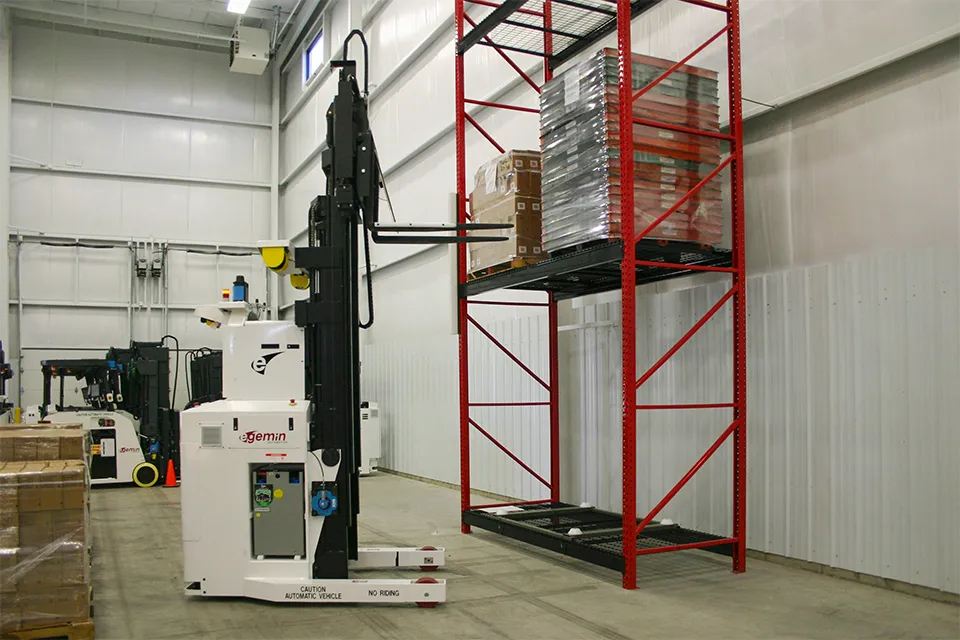
Industrial robots are appearing in warehouses and production areas for palletising, depalletising, case handling and, sometimes, picking. The safety frameworks are evolving too: ISO 10218-1:2025 covers safety requirements for industrial robots as ‘partly completed machinery’, before they are integrated into complete systems. For engineers, this means the robot is rarely the hardest part. The challenge lies in grippers, product variation, vision and, above all, the surrounding process: where do totes arrive, how are exceptions handled, and how do you prevent an automated cell from still needing to be manually reset every day?
WMS/WCS/WES and the ‘last metre’
Automation only delivers a return when work orders, inventory and transport orders are synchronised. That is why attention is shifting to the orchestration layer (WMS/WCS/WES): it determines which pallet goes where, in what order, and how disruptions are handled. The broader trend picture comes into play here too: DHL’s Logistics Trend Radar highlights, among other things, the impact of AI and robotics on logistics processes and the need to integrate technologies pragmatically into end-to-end flows. The hard lesson from many plants is that the last metre, the connection to the production line, operator interaction and exceptions, makes or breaks the project. An AMR that drives perfectly but regularly fails to get a drop-off location because of poor data quality is a source of frustration, nothing more.
Intralogistics is becoming IT-like
As internal logistics becomes more software-intensive (APIs, Wi-Fi/5G, cloud dashboards, remote support), cybersecurity becomes a factor in production. The ISA/IEC 62443 series defines requirements and processes for securing industrial automation & control systems throughout their lifecycle. A shift in European compliance requirements is also on the way: the Machinery Regulation (EU) 2023/1230 will apply from 20 January 2027. This matters for intralogistics because many solutions (mobile robots, conveyors, robot cells, AS/RS) fall under machinery safety regulations, and because digital components (interfaces, software updates and connectivity) are becoming increasingly prominent in safety and compliance discussions.
Question about this story? Ask your question
Keep following this
Get an email when a new story is published. No account needed.
- ThemeFlexible production with robots
- SubjectProcess & instrumentation