Eliminating jitter in angle measurement
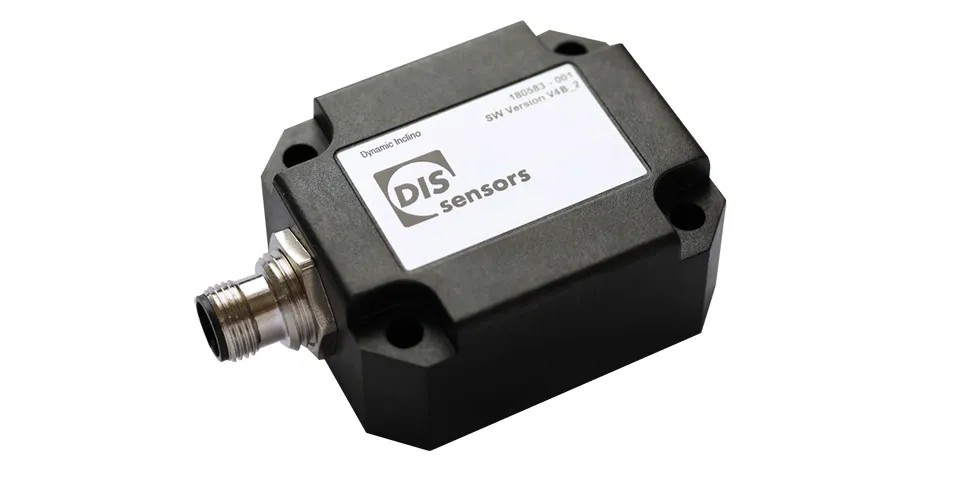
An inclinometer measures the angle relative to a horizontal position, using the imaginary line to the centre of the Earth as its reference. So much for the theory. In practice, vibration and shock ‘contaminate’ the angle measurement with irrelevant peaks. The usual solution is to add filtering algorithms and/or extra sensors, but this increases complexity and cost. A newly developed dynamic inclinometer based on MEMS technology offers a much more cost-effective option for controlling and monitoring machines and structures in dynamic conditions.
Inclinometers are indispensable in many industrial applications. They are used in situations where accurate position determination and/or continuous monitoring of the angle relative to gravity is required. Inclinometers have a wide range of applications, from aviation and shipping to mobile equipment in agriculture, mining, ports, logistics and civil engineering. Robotics and mobile automation are also making increasing use of inclinometers.
The right angle
The geometry of a working machine, whether it is a crane, forklift, excavator or cherry picker, is not static. All parts of the machine are constantly moving as a result of operator commands or external factors. Ideally, the control system receives perfectly clean and reliable angle information in real time, enabling it to determine the exact geometry at any moment. This information allows the control system to interpret the operator’s commands and ensure safe operation. For this purpose, an inclinometer with one, two or three axes is preferably used in combination with an accelerometer, which measures G-force acceleration relative to gravity as a universal directional reference, both while the sensor is moving and when it is stationary.
Eliminating ‘jitter’
When used on an object subject to sudden, intermittent shocks or vibration, such as the arm of a mobile excavator, these non-functional accelerations generate numerous peaks in the angle signal sent to the control system. To compensate for this ‘jitter’, filtering algorithms and/or additional sensors, such as gyroscopes, are used. Unfortunately, every additional sensor and filter makes the system slower and more expensive. The advent of affordable MEMS (Micro-Electro-Mechanical Systems) technology and smart software algorithms now makes it possible to solve these problems with a single sensor module: the dynamic inclinometer. MEMS are miniaturised systems containing various electronic and mechanical components, embedded in a device such as an accelerometer, gyroscope or inclinometer. They are manufactured using the same techniques as those used to produce chips.
Dynamic inclinometer
The new dynamic inclinometer is a hardware platform based on an advanced MEMS chip that combines a three-axis accelerometer with three-axis inertial angle measurement. Its powerful integrated controller can be configured externally and processes all input and output signals. The angle, transmitted to the control system as a separate CANopen / J1939 object for each axis, is already gyro-compensated and therefore clean and free from the effects of false acceleration and shock. Predefined application profiles and a user-friendly configuration tool are available to make configuration easier.
With thanks to DIS Sensors and Rotero
Question about this story? Ask your question
Keep following this
Get an email when a new story is published. No account needed.
- SubjectSensors & vision