Does battery production in Europe make sense?
Text Valérie CouplezImage iStock
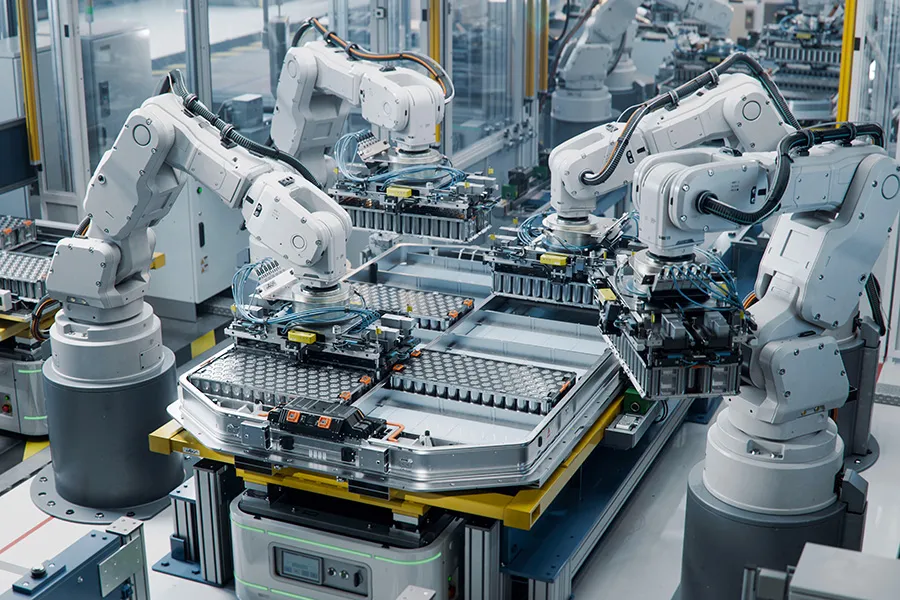
A local battery value chain is crucial to strengthening Europe’s strategic independence. Batteries are a key component in vital sectors such as the automotive industry, energy and defence. But Europe’s battery industry is threatened by cheap, subsidised imports, putting its viability at risk. Although demand is expected to reach 1.5 TWh in 2035, structural cost disadvantages and regulatory uncertainty threaten to shift value creation permanently to China. Decisive action is needed to prevent our region from missing the opportunity to create hundreds of thousands of jobs and billions in economic value in one of this century’s most strategic industries.
Europe’s battery industry faces a fundamental test: can it turn expected demand growth into domestic value creation, or will production remain concentrated in China and other non-European markets? Europe is expected to become one of the world’s largest markets for lithium-ion batteries, with demand forecast to reach around 1.5 TWh and a market value of 130 to 150 billion euros in 2035, despite the recent slowdown in expected demand for electric vehicles. A significant number of manufacturing facilities are already operational, with installed production capacity of around 200 GWh and approximately 80,000 direct and indirect jobs created to date. These facilities will help meet most of the demand with locally produced battery cells.
Is production viable in Europe?
Despite this potential, the industry faces significant challenges. Structural cost disadvantages compared with Chinese imports, higher than expected start-up costs even for experienced players, and ongoing market uncertainty, including slower demand for electric vehicles and mixed political signals about the path to zero emissions, are putting pressure on the competitiveness and viability of European production. In addition, a significant proportion of the many projects announced in recent years have failed, been halted or delayed.
The cost challenge
Locally produced battery cells are expected to face a significant cost disadvantage, estimated at around 9 to 11 euros/kWh compared with cells produced in China and imported. This gap stems from structural disadvantages in capital and operating costs, affecting both new domestic players and established Asian players manufacturing in Europe. Start-up costs for new entrants to the EU market are expected to be around 1.5 billion euros higher for a 20 GWh factory in Europe than for new factories built by established Asian players. In addition, China’s substantial overcapacity in cell production has intensified price competition, bringing prices close to marginal costs.
Regulatory uncertainty and fragmented policy
Regulation in Europe threatens investment certainty, hinders rapid scaling and drives up costs. The core problem is a regulatory environment that is repeatedly called into question, alongside the absence of a clear long-term industrial strategy. There are insufficient policy signals and detailed guidelines that endure beyond election cycles, unlike China’s more consistent, centrally coordinated approach. Measures such as the Net Zero Industries Act (NZIA) and Critical Raw Materials Act (CRMA) lack local-content incentives and binding requirements. The current instruments are relevant, but their impact is diluted by slow implementation, non-binding requirements and difficulties in securing or allocating resources efficiently. A further challenge is that current regulations are often not tailored to battery factories. Hundreds of regulations, combined with the need to negotiate with dozens of authorities to obtain the permits required for a single factory, significantly hinder project delivery and increase costs.
Why a local battery industry matters
Establishing a local battery value chain is crucial to strengthening Europe’s strategic independence. The battery industry has the potential to make a significant contribution to the European economy. Roland Berger’s analysis shows that successfully addressing the challenges ahead could create 310,000 jobs and add around 75 billion euros to the European economy by 2035, but only with decisive regulatory action and a coordinated strategy involving all stakeholders.
Based on a report by consultancy Roland Berger.
Question about this story? Ask your question
Keep following this
Get an email when a new story is published. No account needed.
- SubjectServices & solutions