Industrial safety: a new perspective for heavy industry
Text Jerry Huang, Getac Technology CorporationImage Getac Technology Corporation
Ensuring safety in increasingly complex work environments
Heavy industry has made clear progress on occupational safety in recent years. However, recent figures show that some sectors still account for a significant proportion of workplace accidents, and progress is beginning to stall in some cases. This shows that prevention needs to go beyond traditional tools such as training, procedures and personal protective equipment.
Persistent risks
Data from Eurostat show that sectors such as construction, manufacturing, transport and mining continue to face elevated safety risks. In the oil and gas industry, figures from the International Association of Oil & Gas Producers (IOGP) confirm that workplace accidents continue to occur, despite safety standards that rank among the strictest internationally. This underlines the need to complement existing safety measures with technologies that provide better support for risk assessment and early warning.

Work situations with increased exposure to risk
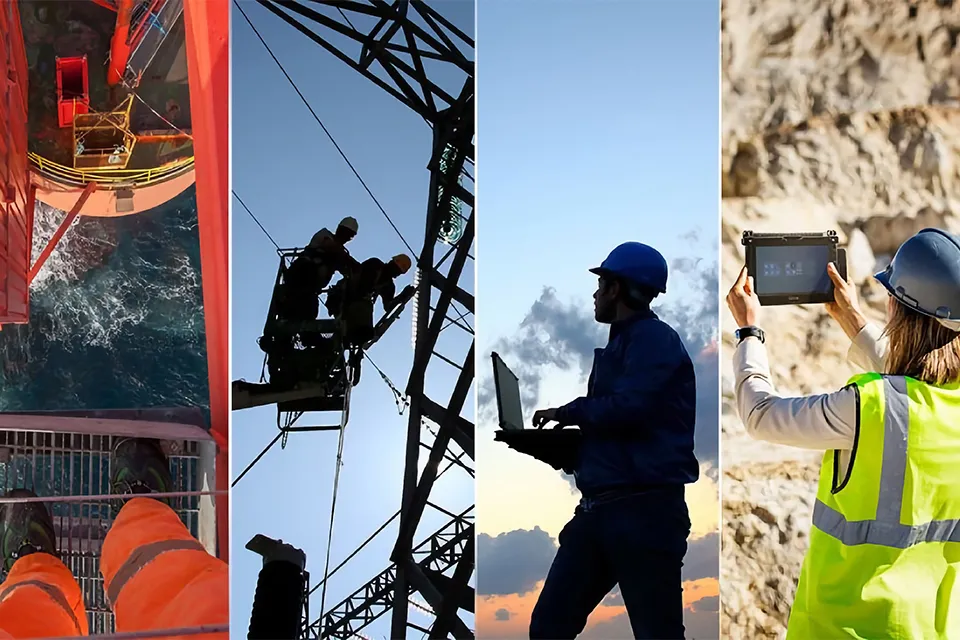
Research and practical experience consistently point to several particularly high-risk activities, including working at height, electrical work, operating machinery and heavy equipment, and working in confined spaces. Human and organisational factors also play an important role, including fatigue, high workloads, complex environments and rapidly changing operating conditions. Effective prevention therefore requires a broader approach that systematically takes these factors into account.
A survey of around 32 professionals working in fields such as environmental health and safety found that 50% consider working at height and electrical work to be the most hazardous activities. Next came the use of machinery and heavy equipment, followed by work in confined spaces. Other frequently mentioned risks include vehicle use, handling hazardous substances, loading and unloading, and working at high temperatures.
Digital technology to support prevention
Digital technologies are increasingly being used to manage safety risks more effectively. Artificial intelligence makes it possible to analyse data from installations, machinery and work environments, identifying anomalies or potential failures at an early stage. Augmented reality provides on-site workers with contextual information in real time, while robotics, drones and semi-autonomous vehicles help reduce human exposure during hazardous tasks. Virtual reality is also playing an increasingly important role in training and education, by simulating complex scenarios realistically without operational risks.
Targeted use of safety solutions
Research shows that solutions which physically keep workers away from the most hazardous situations generally deliver the greatest safety benefits. Monitoring and warning systems, such as smart sensors and connected equipment, are a valuable addition, provided they fit well with day-to-day work and are widely adopted by the teams involved.
According to the study Industrial robots, Workers’ safety, and health, published in Labour Economics (Gihleb, Giuntella, Stella & Wang, 2022), a one-standard-deviation increase in exposure to industrial robots leads to a reduction of around 1.2 workplace accidents per 100 workers. This highlights the potential of robotics as a long-term safety tool.
Designed for the realities of the workplace
To make a real impact, technological solutions must suit the specific conditions of heavy industry. This means being robust and easy to use, complying with regulations, and operating reliably in harsh conditions such as dust, vibration, extreme temperatures or poor visibility. The success of these solutions depends not only on their technical performance, but above all on how well they work in day-to-day operations. Ergonomics and practical usability are also crucial. Solutions must be easy to operate, even when wearing gloves or in low light, and must not hinder workers or restrict their freedom of movement. Compliance with regulations also remains essential, including certifications for use in potentially explosive or otherwise hazardous environments.
Safety requires technology and organisational change
Technology alone is not enough to deliver lasting improvements in industrial safety. A real impact can only be achieved when technology becomes part of broader organisational development, supported by ongoing training, employee involvement and a safety policy embraced at every level. Solutions from manufacturers such as Getac illustrate this approach, which focuses not only on the technology itself but, above all, on its effective use on the shop floor.
A future-proof safety strategy for heavy industry therefore requires the considered use of technologies that fit the realities of the workplace and are embedded in a proactive safety culture. Only then can workplace accidents be reduced sustainably and workers better protected in an industrial environment that is constantly evolving.
Question about this story? Ask your question
Keep following this
Get an email when a new story is published. No account needed.
- SubjectServices & solutions