New generation of thermochillers addresses stricter F-gas regulations
Text Roberto Martínez de Lafuente, SMC SpanjeImage SMC

All traditional refrigerants used in industrial chillers have their drawbacks, whether it is their high Global Warming Potential (GWP), flammability or toxicity. Regulatory bodies have been focusing closely on this issue and seeking to protect the environment by making it more difficult to continue using traditional refrigerants. But there is good news: after years of intensive work on this challenge, SMC will soon introduce a solution.
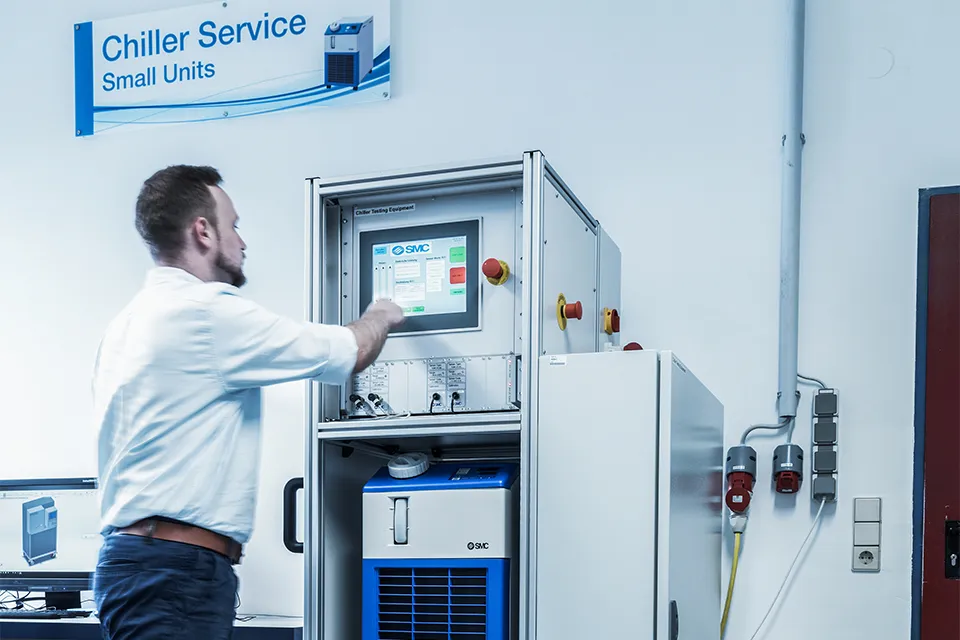
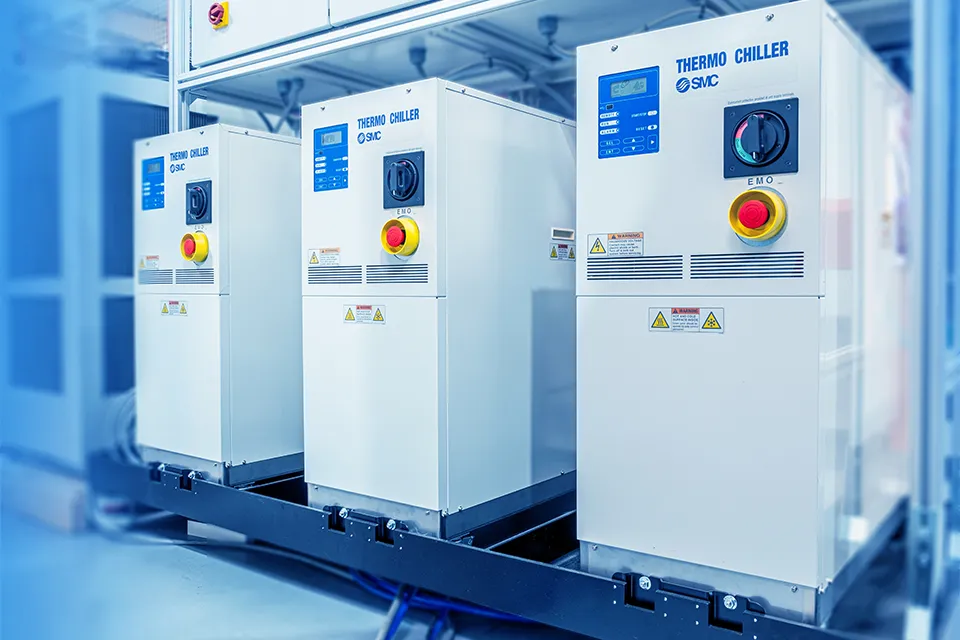
A refrigerant enables the cooling circuit in chillers to operate and, when managed correctly, ensures performance. Its job is to cool the process medium by using its specific properties, while other chiller components dissipate the heat. Refrigerant-based chillers are popular in industry thanks to their proven technology, rapid cooling and ability to deliver very low temperatures. The only drawback? The refrigerant itself.
Step on the gas
The main reference for the use of industrial refrigerants is the F-gas Regulation. With this regulation, the EU aims to reach a milestone in its European Green Deal and bring the continent closer to its targets of reducing emissions by 55% by 2030 and becoming climate-neutral by 2050. The F-gas Regulation bans refrigerants with a GWP above 150 in chillers with a cooling capacity of 12 kW or less. This limit is much stricter than comparable regulations in the US, where the GWP limit is 750. More concerning still, the F-gas Regulation comes into force on 1 January 2027, so now is the time to consider a new chiller strategy.
Fortunately, the experts at SMC have already studied this issue in depth. A few years ago, SMC began introducing refrigerant solutions using R454C, which has a GWP of 148. This makes R454C a legal refrigerant after 1 January 2027. SMC already offers a chiller solution that takes advantage of this refrigerant, and a rack-type chiller will follow soon. But development does not stop there. R454C is flammable, albeit in a low-flammability category. Future regulations must also be taken into account, as GWP limits may be tightened further. In addition, many companies are already aiming for zero impact and non-polluting operations, and need suitable solutions.
Breakthrough with CO2
Alongside its R454C chiller solutions, SMC set itself the challenge of developing a non-flammable refrigerant solution with a GWP of 1 or less. The result? Chillers that use CO2 as a refrigerant!
CO2 has a GWP of 1. It is also non-flammable and non-toxic. However, using CO2 as a refrigerant requires a completely new chiller design, incorporating several technological innovations. SMC offers a range of chillers that use CO2 and its ultra-low GWP, starting with the HRZC series, introduced in September 2024. This means SMC continues to cover its entire range and ensures future-proof options are available well before the F-gas Regulation comes into force.
The F-gas Regulation is a reality and is fast approaching. If you need advice on what this means for your existing and new chillers, SMC is happy to provide the support you need. SMC is fully up to speed on this issue and has been investing for years in research and development of solutions that comply with the F-gas Regulation taking effect in January 2027, as well as future regulatory changes. SMC’s experts feel a strong responsibility to help customers tackle industrial challenges. You can trust SMC not to let you down, and neither will the planet.
Have a business enquiry for SMC? Get in touch
Companies in this story
Keep following this
Get an email when a new story is published. No account needed.
- SubjectServices & solutions
- CompanySMC