Standardisation at every level of the installation: an illusion? Certainly not!
Once the euphoria of ‘it works’ has passed, a long period of optimisation begins on many fronts. How can it be made more efficient, cheaper, easier...? The same applies to developments in fieldbus technology. After a brilliant idea had been translated into working technology, a proliferation of fieldbuses, associated protocols, interfaces, connectors and so on emerged. Every company hoped to gain a monopoly, creating a world in which everyone would have to buy only its products simply because it had the best fieldbus.
Standard bus protocols were the beginning
This dream scenario (of course) never materialised, and it became clear that standardisation would be crucial to creating a world in which everyone could survive, where components from the many suppliers and developers could exchange data at every level. The first steps in this direction came with the adoption of the PROFINET, EtherNet/IP and EtherCAT protocols worldwide. A start, but still a long way from realising the dream...
IO-Link also brings standardisation to the sensor-actuator level
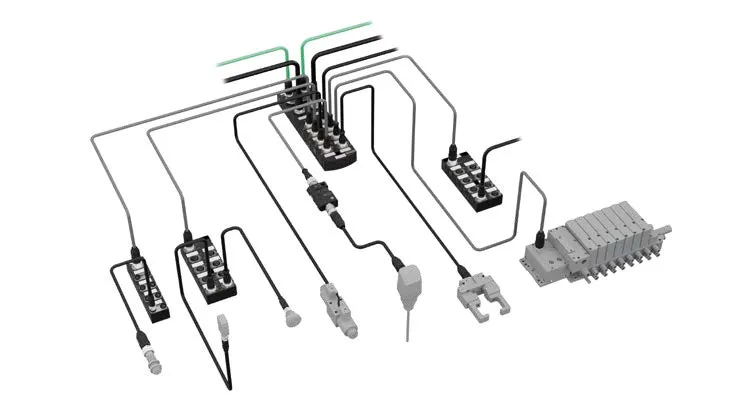
The next step has already been taken: standardisation at the sensor-actuator level. For this final stretch, right at the bottom of the control pyramid, IO-Link is a widely accepted solution. IO-Link is a bidirectional point-to-point communication protocol that can be used in virtually all systems. An IO-Link master gateway connects the relevant fieldbus, whichever one it may be, to the lowest level.
Connecting to higher-level systems
So far, we are moving in the right direction. Things become more difficult when connections have to be established to higher-level systems such as cloud applications. Standardisation is still insufficient to enable a universal connection to a master. Solutions are currently being developed using interfaces written by master manufacturers themselves or via IO-Link stacks. In every case, establishing the desired connection and creating a working application takes considerable time and effort.
A good solution to this problem is the SMI: Standardizes Master Interface (SMI), introduced in 2019. It harmonises the connection of IO masters across all access points, whether for control systems, fieldbus protocols, master/device tools (PDCT) or new IT or IIoT protocols such as JSON or OPC UA. It gives users and machine builders full access rights, regardless of the device manufacturer, resources or installation location.
SMI paves the way for decentralisation
As well as making control systems much easier to implement, from engineering through to commissioning, SMI also makes it possible to retrieve data from all components that could be relevant to maintenance, troubleshooting, optimisation, regulatory compliance, energy consumption and more. This means that SMI directly paves the way for decentralisation and all its associated benefits.
Would you like to learn more about the underlying technologies that make this possible? Download our white paper, ‘Declaration of Independence with SMI’, or contact us. We have launched a new range of IO-Link devices with SMI integrated as standard. I would be happy to show you what this could mean for the installation in your machines.

Question about this story? Ask your question
Keep following this
Get an email when a new story is published. No account needed.
- ThemeReliable industrial network connectivity
- SubjectServices & solutions