The rise of Raman spectroscopy
Text Evi HussonImage Hellma
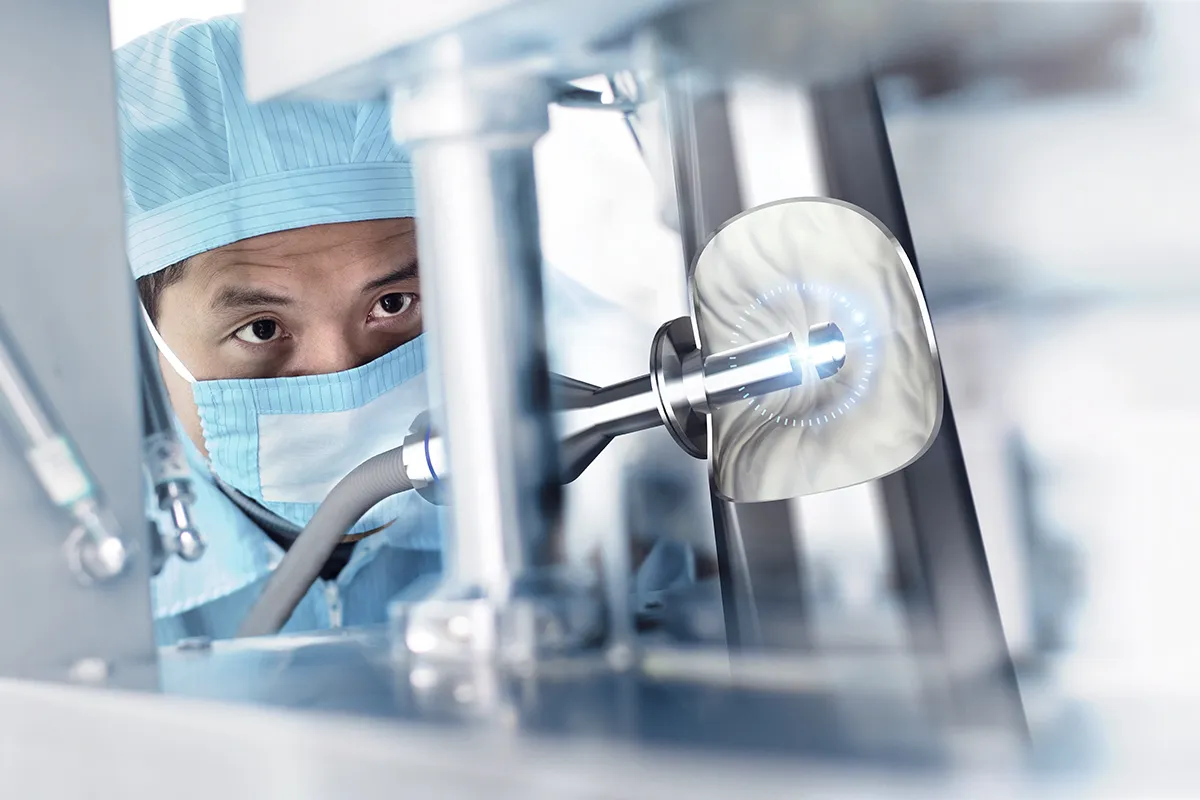
Raman spectroscopy is an analytical technique used to determine the chemical composition of substances and materials, or to assess quality in production processes. It is increasingly being used in a range of production environments. Oliver Mandal, who works at Hellma, takes a closer look at this promising technique and its potential across various sectors.
“Process analytical technology (PAT) is now an integral part of production environments. It is particularly valuable in the chemical, pharmaceutical and food industries. PAT allows you to monitor production and quality control, and then improve process or plant performance,” explains Oliver Mandal. He is Senior Product Manager at Hellma. The company has many years’ experience in integrated solutions for optical analysis and absorption spectroscopy.

Raman spectroscopy
One promising technique is Raman spectroscopy. “Raman spectroscopy uses light scattering to obtain information about molecular vibrations. When a monochromatic beam of light, often from a laser, hits a sample, most of the light is scattered elastically, or reflected back without any change. This is known as Rayleigh scattering. A very small proportion of the light interacts with molecular vibrations, causing the energy of the laser photons to increase or decrease. This inelastic scattering is called the Raman effect. The shift provides unique information about the nature of the samples being analysed, allowing their molecular structure to be determined precisely.”
Benefits
“Raman’s major advantage is that it works very well with aqueous samples compared with other PAT technologies such as NIR (near-infrared) or mid-IR (mid-infrared), because water barely interferes with the signal,” Mandal continues. “This is a major benefit in fermentation processes, which are typical in biotechnology. The technology is also well suited to inline analysis in the chemical industry, monitoring in the pharmaceutical industry and gas analysis of liquefied natural gas (down to -196°C). With the advent of portable, more affordable Raman instruments, Raman spectroscopy is now even more accessible to industry as a whole.”

A wide range of applications
Hellma offers probes and measurement cells for a wide range of conditions. “The right choice depends on the application. For example, Tidus Flex is well suited to upstream processing, such as the formation of chemical or biochemical compounds in reactors or fermenters. It can also be used for downstream processing, including filtration, ultrafiltration, crystallisation and drying.”
ATEX environments
For demanding industrial process conditions, Hellma designed the Tidus Lumio. “This probe has an integrated laser source and ATEX certification. This allows companies to take inline measurements in hazardous areas without the risk of explosions. Not only does this improve safety, it also makes analysis much more efficient, as companies gain immediate insight into process quality. This enables them to optimise production and meet the strictest industry standards.” The Tidus Lumio is also available in a non-ATEX version.

The right product for the right application
With so many measurement techniques and products on the market, companies can sometimes find it difficult to make the right choice. “That is why Hellma offers an online configurator with a wide product selection to support online measurements from UV to IR. Customers can use it to quickly and easily find the right measurement interface or configure individual immersion probes or measurement cells.” The configurator is one option. “Our applications team supports customers throughout the process of making the right choice, from selecting modules through to implementation and training. We start by analysing the customer’s process. What needs to be measured, where, under what conditions and for what purpose? On that basis, we select the most suitable technology (UV/VIS, IR, Raman, fluorescence). Our broad product range allows us to provide a tailored solution every time, so we can offer the right product for the application.”
Een zakelijke vraag aan HELLMA BENELUX? Get in touch
Companies in this story
Keep following this
Get an email when a new story is published. No account needed.
- SubjectServices & solutions
- CompanyHELLMA BENELUX