Software, IT, OT & cybersecurity
Carbon reduction starts with data

It’s five minutes to midnight for the climate, a warning the industry is taking to heart too. After all, it can be considered responsible for around a third of global emissions. More and more companies are therefore asking their suppliers for data on the carbon footprint of their products. But how do you map an entire supply chain? That’s exactly what Siemens’ SiGREEN platform does, without compromising data ownership. Time to take a closer look.
The idea behind SiGREEN emerged three years ago at one of Siemens’ production sites. Siemens was looking for a way to prepare itself for customer enquiries and future legislation on CO2 emissions. Johannes Thul is leading the project: “The starting point is that products consist of different components. If you want to know a product’s carbon footprint, you need to add up the emissions for each of those components. In other words, you need to obtain actual data from every step in the supply chain. Estimates and averages based on a bill of materials alone won’t get you there.”

The idea was further developed within next 47, Siemens’ ecosystem for start-ups, into a practical tool. “Although the idea stemmed from a challenge we had identified internally, we immediately saw its potential for everyone in the industry. That’s what I’m most proud of: that we’re tackling a problem with which Siemens isn’t necessarily associated by bringing together the expertise of all the specialists we have in-house as a technology company.”
Securely sharing data on CO2 emissions
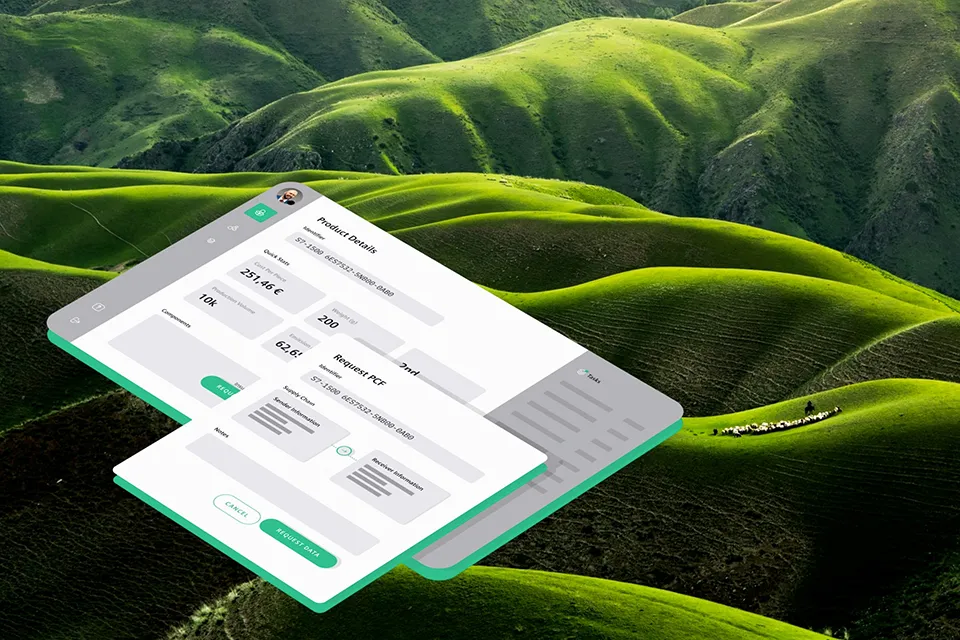
SiGREEN was officially launched last summer. “Anyone wanting to calculate their carbon footprint today either has to rely on secondary data and averages or request all the data from each supplier individually. It takes time and software to bring all that information together. Working with the SiGREEN platform makes the process much more accessible. All suppliers contributing to a PCF (Product Carbon Footprint) are invited to enter their data on a secure webpage, using one of the available standards. Communication is peer-to-peer and cryptographically secured. The data are not available to everyone: they remain the property of the user. But the platform can use them to calculate the actual value at every step in the supply chain,” explains Geert De Coninck, business unit manager factory automation. Everything is taken into account: both the materials and the energy needed to produce them. Audit partners can also be brought in to double-check the accuracy of the data.
Identifying potential for CO2 reduction
A wide range of customers have since signed up to the platform, where most features are free to use. “You can see that the industries most in the public eye and closest to consumers are the quickest to come on board. Customer and supplier enquiries are also our top priority as we transform our own portfolio,” De Coninck adds. Calculating the carbon footprint is only the first step. “It all starts with creating transparency and making the data ever more accurate. The more data we bring together, the greater the potential to identify opportunities for optimisation. Companies gain a useful tool for assessing which raw materials or components could offer a sustainable alternative and help achieve the ultimate goal of carbon neutrality,” says Thul.
Transparency for making the right choices
Although SiGREEN initially focuses on CO2, there is nothing to prevent further development to cover other valuable elements in the bill of materials. “I’m already looking ahead to other topics,” says Thul. “Anything that can promote sustainability could be included here, such as the presence of recycled content or the extent to which products meet Cradle-to-Cradle certification requirements. The challenges of recent years, such as the pandemic and the energy crisis, have shown that the way forward inevitably involves more resilient supply chains and green investment. With SiGREEN, we want to give industrial companies the transparency they need to make the right choices, based on actual data.”
Question about this story? Ask your question
Keep following this
Get an email when a new story is published. No account needed.
- SubjectSoftware, IT, OT & cybersecurity