Software, IT, OT & cybersecurity
Detecting and locating pallets in warehouses: working 50% faster
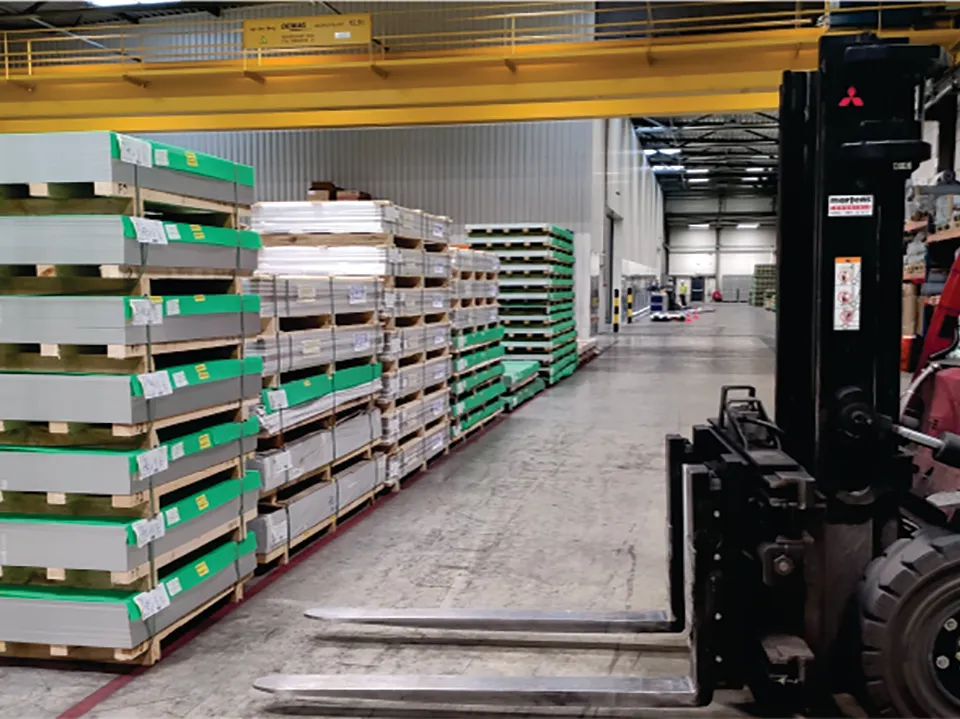
The Dutch company Roba Metals supplies steel, stainless steel, aluminium and other non-ferrous semi-finished products to customers around the world.
Keeping track of everything is no easy task. But thanks to the ATLAS Forklift Track&Trace solution supplied by Aucxis, every step in the journey of each pallet is monitored throughout the logistics flow, from storage after production to loading onto lorries for transport. The solution has increased working speed by 50% and improved picking accuracy. Operators, warehouse staff and transport planners can also now work with less pressure and frustration.
Words and images Aucxis
Roba Metals’ various European sites employ more than 600 people between them. Aucxis was commissioned to roll out an RFID pilot project at the Roba Metals service centre and sales office in Genk. Across an area of 20,000 m² divided into four halls, coils of stainless steel are processed into made-to-measure sheets and then packaged. The pallets are dispatched from stock or on demand to customers, who in turn process the stainless steel sheets into finished products, such as industrial kitchen and shop fittings, machine parts and drums. Roba Metals Genk holds an average of 7,000 pallets in stock, of which more than 1,000 are delivered each week. A total of 35 employees are involved in the production and logistics flow.

Gert Machon, Roba Metals
Automated location and load tracking
To locate and retrieve the correct pallets for shipment to customers, Roba Metals used a traditional barcode scanner and an Excel file. As more and more storage space was being added, and pallet locations were not always recorded, search times increased considerably. Meanwhile, delivery times were becoming ever tighter: customers often expected delivery just one day after placing an order. Roba Metals therefore looked for a real-time detection and localisation system that could be linked to its WMS. Aucxis proposed implementing the ATLAS Forklift Track&Trace solution. This provides an accurate, up-to-date overview of internal logistics movements through automated location and load tracking. RFID UHF technology was chosen because it enables bulk scanning. Unlike barcodes, it also does not require line of sight to read the tags.
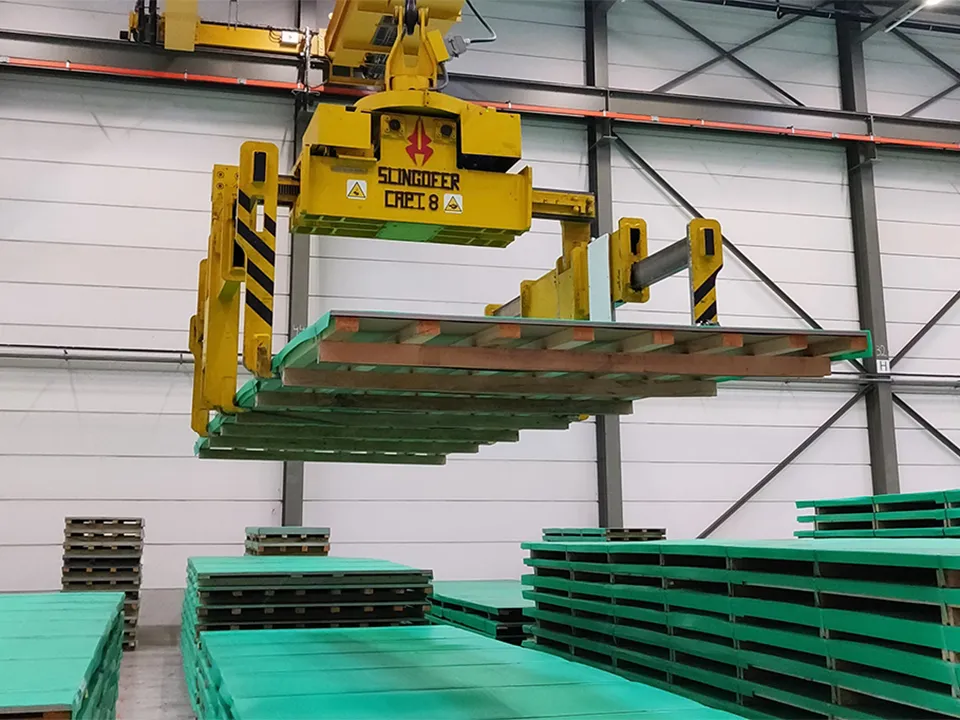
Antennas on the overhead crane and lifting clamp scan the load of sheets.
Tagging pallets
Once the made-to-measure stainless steel sheets have been placed on a pallet, they are covered with protective paper or plastic film. A barcode label bearing the customer details and a unique number is always attached to it. Based on this number, which is read by a PC with a barcode scanner, we print two RFID tags, which are programmed simultaneously with the product ID. These two RFID tags are also attached to the protective film. Each pallet needs two tags because it can be lifted in different ways during loading: either by forklift or by overhead crane. Roba Metals Genk estimates that around 100,000 pallets will be tagged this year. Once tagged, the pallet is placed in a drop-off zone by a forklift. The overhead crane then moves it to its designated storage location. Picking pallets for transport follows the reverse process.
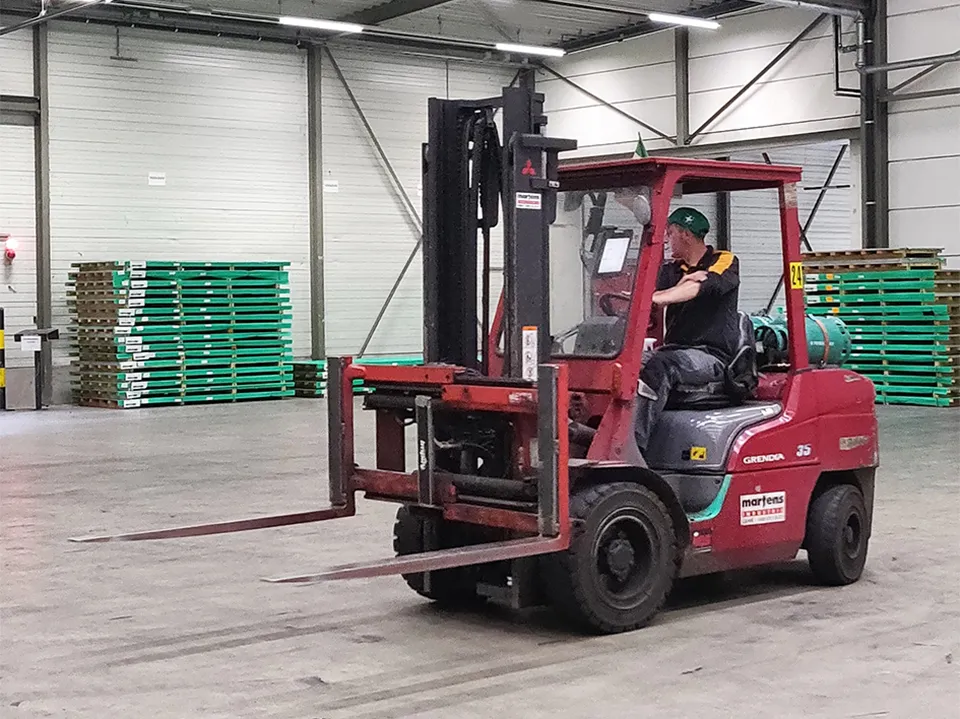
Antennas at the front and underneath the forklifts scan the floor tags and transmit the forklifts’ locations.
Detection equipment for overhead cranes and forklifts
An overhead crane travels along a rail from front to back at the top of each hall. Its associated lifting clamp moves from left to right to load the pallet. Each hall is divided into a grid, with each cell representing either a drop-off location or an aisle. The five overhead cranes were equipped with an antenna to scan the load and two distance sensors to determine their exact position in the hall based on X&Y coordinates. Six forklifts were fitted with an antenna at the front to scan the load and another underneath to scan the floor tags, enabling their position in the hall to be determined. This equipment allows the forklifts to read several pallets at once. Since the forklifts travel over the grids of floor tags at 12km/u, tag read speed was an important factor in selecting the tags.
Data processing
The overhead crane or forklift operator carries out the same tasks as before, but can now also see on a screen which pallet to pick up at each drop-off location. The operator then confirms this on the touchscreen. Once the user has confirmed, the data is automatically sent to Roba Metals’ WMS. An advantage of the system is that the same hardware and technology (HERTZ middleware) can be used for both identification and localisation.
For more information
Aucxis RFID Solutions
Zavelstraat 40-9190 Stekene
Tel. +32 (0)3 790 17, [email protected], www.aucxis.com/nl/rfid
Question about this story? Ask your question
Keep following this
Get an email when a new story is published. No account needed.
- ThemeSmarter measurement and inspection
- SubjectSoftware, IT, OT & cybersecurity