Software, IT, OT & cybersecurity
Digital automation and artificial intelligence in manufacturing
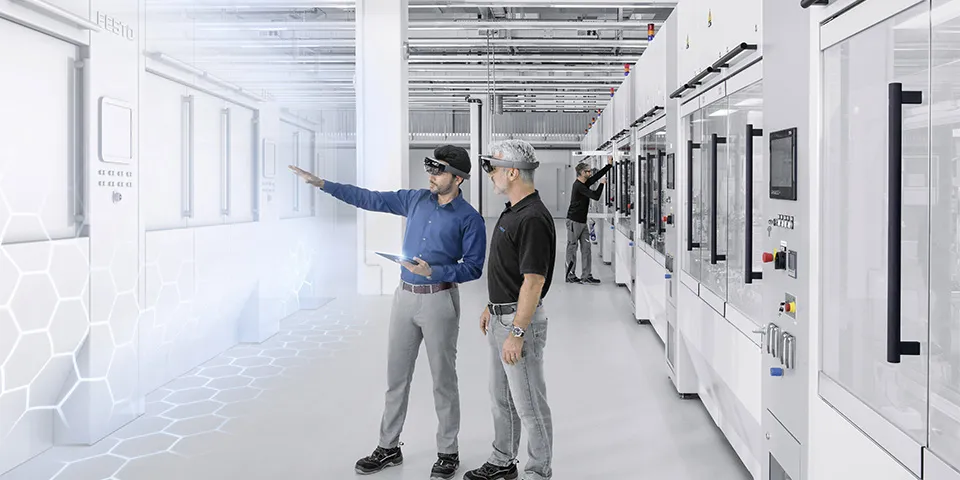
Manufacturing is under pressure: the accelerating pace of technological change, less optimistic prospects for the global economy, political debate over trade relations, Brexit … If manufacturers are to succeed, they can no longer simply go with the flow. They need to take an active role. That is what Festo wants to do too: lead the way in digitalisation and artificial intelligence.
As a new decade approaches, Festo is already looking ten years ahead. How will digitalisation shape industry in 2030, and how can a producer of automation technology help its customers develop and operate their machines and factories in a way that ensures they remain successful and competitive? Getting started could not be easier. Festo offers a range of digital solutions that you can already use. “Smartenance, dashboards, Projects … we are constantly expanding our digital offering to make it easy for machine builders, end users and operators to enter the digital world,” explains Dr. Michael Hoffmeister, Digital Business Executive at Festo. The sooner machine builders and end users opt for digital products, the greater the benefits. For example, with the Handling Guide Online or other product configurators, time to market for integrated handling systems can be reduced by 70%.
Making complexity manageable
With its smart digital solutions, automation specialist Festo combines its extensive expertise in industrial applications with the latest developments in information technology. The possibilities offered by artificial intelligence further complement and enhance this. Sensors enable us to capture data directly from machines and industrial production systems. We can then evaluate this data in real time and deepen our understanding of the relationships and interactions within the production process. Digitalisation and AI make process complexity entirely manageable. Dipl.-Ing. Dr. h.c. Oliver Jung, Chairman of the Management Board of Festo, says: “We are focused on transferring our core competencies in factory automation to the AI-supported, digitalised production of tomorrow. Today, algorithms analyse machine data to predict downtime or help prevent it. Tomorrow, algorithms will monitor, control, navigate, supervise and regulate product flows in a complex network. They will support people in making the right decisions.”
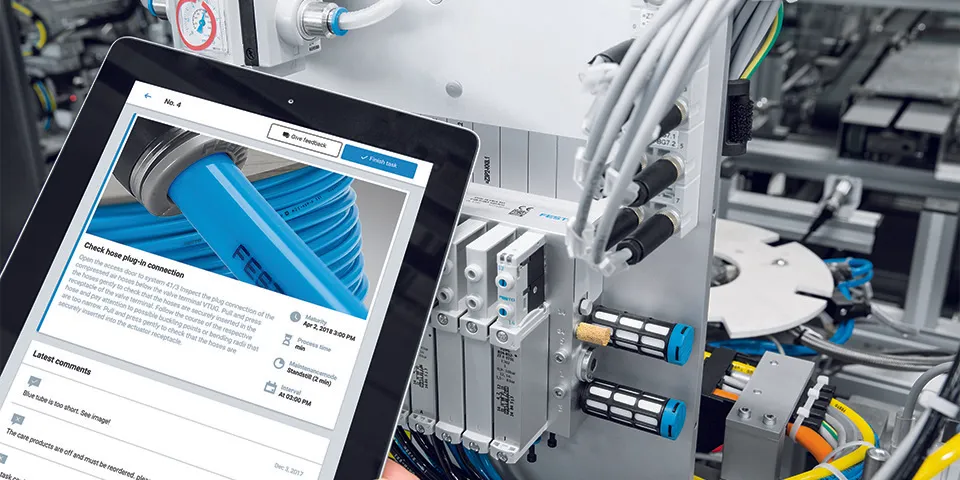
Smartenance is Festo's software programme, which serves as a digital maintenance manager to support production and operators.
From mechanical to smart products
With the Festo Motion Terminal VTEM, Festo has already paved the way for digitalised pneumatics. The functions of the valve terminal can be controlled via an app, allowing different tasks to be performed using the same hardware. This significantly increases the potential level of automation. Another example is Smartenance, Festo's software programme, which serves as a digital maintenance manager to support production and operators. The app enables end users to plan, monitor and evaluate maintenance. It is also a useful tool for machine builders. They can turn maintenance tasks for any factory into digital solutions that deliver added value to customers. Instructions and documentation of fault patterns can be enhanced with images, videos and PDFs.
Pneumatic robot meets artificial intelligence
Another example of how Festo integrates digitalisation and AI into its products is the
BionicSoftHand. This pneumatically actuated gripper has much in common with a human hand. Its fingers consist of flexible bellows structures with air chambers, surrounded by special 3D textile made from elastic and high-strength threads. This textile makes it possible to determine exactly where the structure expands and generates force, and where it does not. The result is a lightweight, flexible, adaptive and sensitive gripper that can nevertheless exert high forces. The BionicSoftHand uses reinforcement learning to learn movements. Rather than copying a specific action, the hand is given a goal. It reaches that goal through trial and error. Using the feedback it receives, it then optimises its actions until the task is completed successfully. This takes place in a virtual environment using a digital twin and artificial intelligence algorithms.
Added value through additive manufacturing
Additive manufacturing techniques will be at the heart of the fourth industrial revolution. They make it possible to create lighter, more complex designs that would otherwise be impossible. They also shorten lead times, reduce material waste and enable more efficient inventory management. 3D printers are now more than just a passing fad and are already being used in series production, particularly for plastics. One of the leading manufacturers of 3D printers is HP, which can introduce customers to the technology at its European headquarters in Barcelona. Fabio Annunziata, Head of Strategic Alliances, 3D Printing & Digital Manufacturing at HP Inc., says: “The main barriers to a major breakthrough in 3D printing are still the materials, automation of the entire process and designers’ mindsets. Over the coming months and years, HP will focus on automation to optimise post-processing, which still involves a lot of manual work. We look forward to working with Festo on this and facilitating the transformation to a smart digital factory.” Festo’s reliable products for flow and pressure control are critical components in a stable additive manufacturing process. The ability to network these solutions throughout the entire hierarchy, from mechanics to the cloud, will enable HP to develop flexible, automated 3D printers that deliver superior productivity and impeccable quality.
Bringing artificial intelligence directly to the machine
The reason industrial applications of artificial intelligence have so far failed to impress is the latency and the large volumes of data that had to be sent to the cloud. AI will only become truly impressive when we bring it directly to the machine and interpret the data there, at source, in real time. That is exactly what AI specialist Resolto does with its Scraitec platform. The company has been part of the Festo Group since 2018. “The Scraitec platform continuously learns from actual production. It also integrates the knowledge of engineers and customers’ technical experts. We call this the ‘human-in-the-loop’ principle,” explains Tanja Maaß, Managing Director of Resolto. “The machine learning and AI products use predictive analysis to interpret information, enabling them to optimise factory parameters autonomously and send concrete instructions for specific actions to ‘their’ people. Production lines and machines are thus transformed into digital tools for new business models for machine builders and end users. These are new service concepts that deliver added value through the automated, timely coordination of in-house maintenance teams. The platform also improves all parameters to meet specified requirements and boosts productivity.”
Question about this story? Ask your question
Companies in this story

Keep following this
Get an email when a new story is published. No account needed.
- ThemeFrom factory data to decisions
- SubjectSoftware, IT, OT & cybersecurity
- CompanyFesto