Software, IT, OT & cybersecurity
Learn from your machines: what if certain machine components never fail?
Have you ever considered that your machine components might be too good? There’s a good chance they are. Take advantage of this new business model and learn from your machines in the field to make significant savings.
You’ve probably heard that data-driven decision-making, including AI-based machine learning, neural networks and self-learning machines, is essential for businesses that want to keep up with the competition. But you may be thinking: machine learning is difficult, and my automation platform doesn’t support it without significant investment. What’s more, some machines and equipment simply aren’t capable of benefiting from these kinds of methods anyway.
How about learning from your machines to create new revenue streams?

Learning from your machines vs machine learning
As mentioned earlier, AI-based self-optimising algorithms and neural networks are simply not yet suitable for every machine builder. This is not a reality for smaller machine builders, and for many it is, at best, a plan for the future. Most machine builders (and customers) focus on creating a machine that runs smoothly and quickly, with high OEE. What’s more, modifying the PLC software on optimised equipment and machines is considered a no-go by most, in line with the motto: ‘never touch a running system‘.
However, learning from your machines is a realistic step for every machine builder. New machines are like new cars: they experience faults at first and need to be optimised. By learning from your machines in the field, you can ultimately prevent components from failing or discover other useful insights. Most machine builders have highly effective quality assurance systems, and use root cause analysis to identify and correct faults and weaknesses in their equipment.
What you can gain from learning from existing machines
Machine builders have systems in place to improve the quality of their machines throughout their service life, based on faults and corrective actions. These are also passed on to their R&D department so that similar faults can be avoided in future equipment. But what if you collect and analyse data from your machines, benchmark several machines against one another and discover that some components never fail or perform well below the expected design criteria?
It’s common for your design criteria and safety margins to be too high, because you’re trying to prevent faults in the field. But you’ll never get this feedback unless you look at your machine data, true to the motto: ‘If it works well, don’t fix it.’
With this insight, you can downgrade machine components that are ‘too’ good and reduce the design criteria or safety margins in your redesign. This can lead to significant savings without any loss of quality. What would happen if you didn’t adapt, but your competitor did? This is certainly a business model worth considering for every machine builder.
Use case: redesigning your conveyor belt
When designing a conveyor belt, your calculations indicated that you needed a drive package capable of delivering 4 Nm @ 200 RPM for correct operation, based on load, friction, etc. You set your safety margins at 20% and design components to be sized for up to 4.8 Nm @ 200 RPM. Once they are up and running, you can start collecting data on specific components and processes over a longer period.
Look at all your machines around the world, monitor the PLCs and perform advanced analyses using the data collected in the cloud. Suppose you find that the load is actually 3.8 Nm RMS across all machines and never exceeds 4 Nm. You can then reduce the requirements for the drive package, save costs and use what you’ve learned to reconsider the safety margins for your conveyor belt design.
Are you ready to find out whether you can save on certain components?
How to develop your own ‘machine learning’ strategy
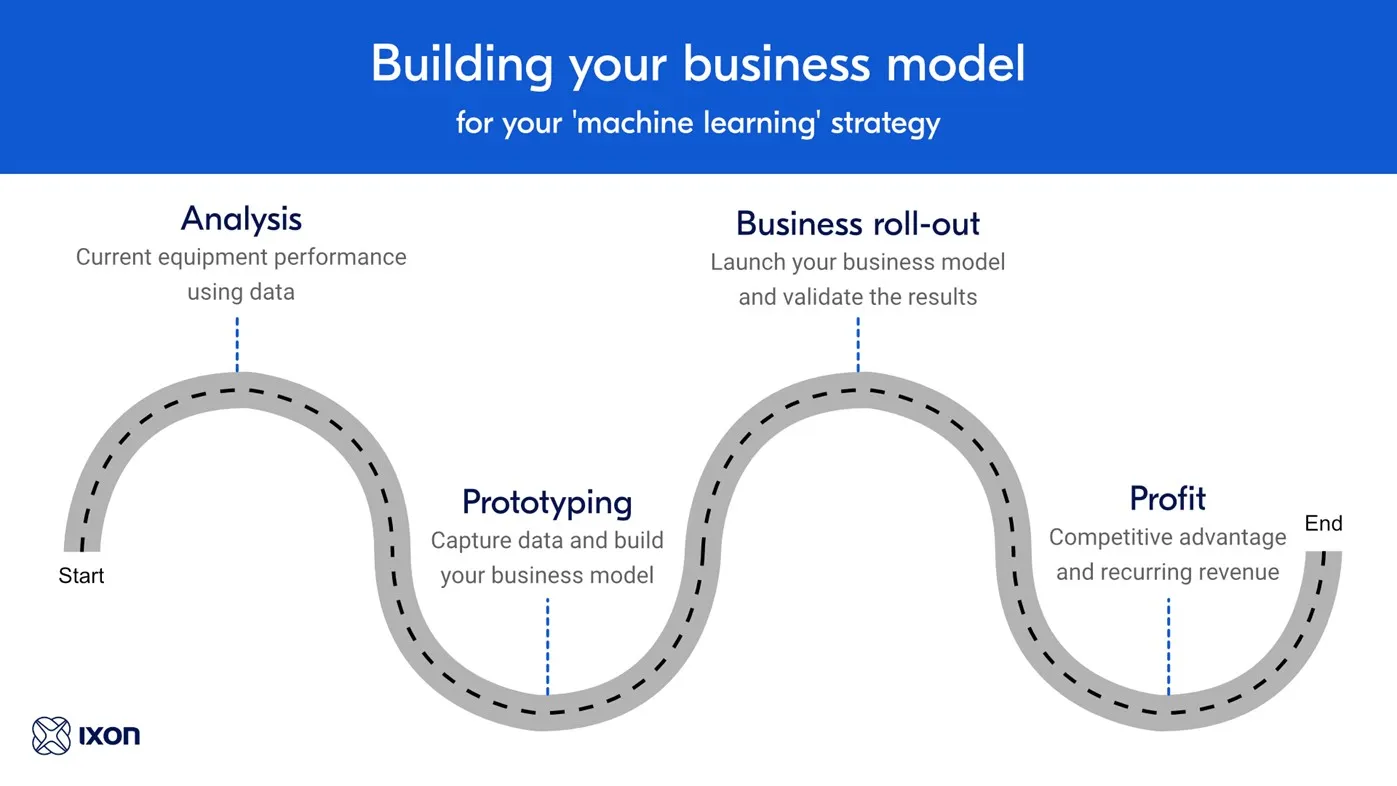
Learn from historical data from machines in the field in a practical and effective way, with very limited investment and a fast ROI, and build your own strategy around this new business opportunity. The list below may provide some inspiration:
1) Starting point: current equipment performance and data required
The first phase is to analyse the current methods for replacing components across your machine fleet. Identify which components are replaced regularly and which are not. Establish whether data are being recorded that have a clear statistical relationship with the value of a data point and the condition of the component in question.
Some data will show a clear correlation between standard PLC variables and components, while other cases may require additional variables to be defined and collected, or even additional sensors to be used. An edge gateway can be used to send PLC data in bulk from machines in the field to the cloud.
2) Prototyping: testing
The next step is to determine the minimum and maximum values for your safety margins. Analyse the performance of your machine components and identify which ones need improvement and which can be scaled back.
Carry out internal tests on the components in question to support or disprove the hypothesis. Use these insights when designing your next machine.
3) Rolling out the business model
Determine how you can reduce your safety margins and implement this in your next redesign to achieve significant savings.
Save costs on machine components that are ‘too’ good
Looking to save costs on your machine design? By learning from your machines in the field and redesigning components with excessive safety margins, you can increase profits and gain a competitive advantage.
If you need advice on how to start learning from your machines, feel free to contact one of our industry experts.
Question about this story? Ask your question
Keep following this
Get an email when a new story is published. No account needed.
- SubjectSoftware, IT, OT & cybersecurity