Software, IT, OT & cybersecurity
New logistics system creates an efficient flow across multiple floors
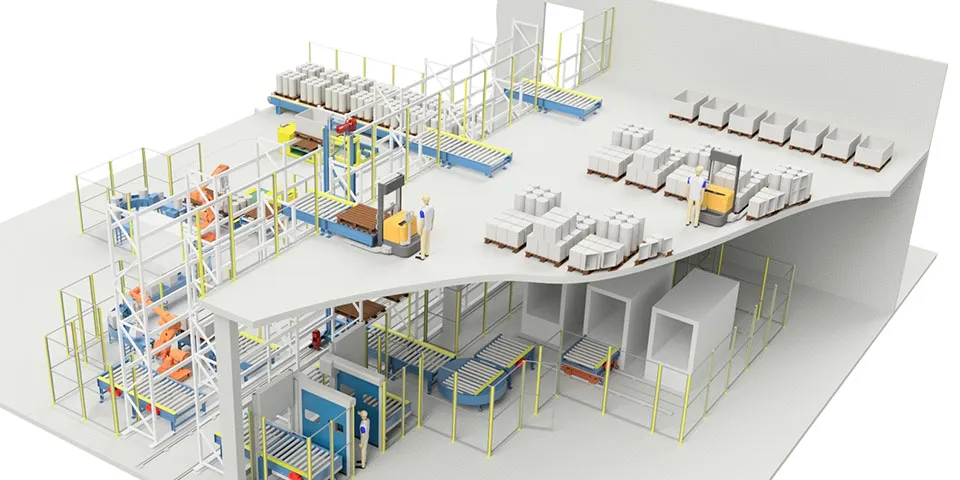
Space is in short supply in production. But have you considered making full use of the cubic metres beneath the roof of your factory building? After all, there may be room for an extra floor. Provided, of course, that you can establish an efficient logistics flow. That is the idea behind RDL Engineering’s Backbone. It enables companies to connect their logistics processes seamlessly across several floors. With this concept, RDL Engineering brings together its experience in horizontal and vertical movement to make your production run more smoothly than ever.
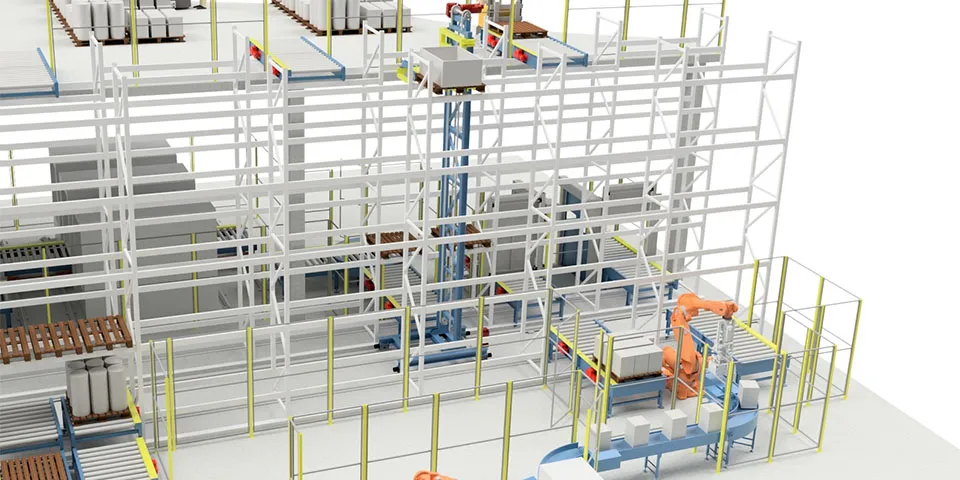
As its name suggests, the Backbone can become the backbone of your production, with every step required to make your product connecting seamlessly to it.
As a company grows, its production floor becomes increasingly crowded with machines, stock and employees. Those looking to expand or optimise further will have to search for every square centimetre of floor space. That is why more and more business owners are looking upwards. The cubic metres beneath the ceiling often remain unused. “For businesses, an extra floor or mezzanine can be an excellent solution for order picking or preparing the pre-production of semi-finished products …,” says managing director Dominiek De Leersnijder. He runs the Izegem-based company alongside his brothers Vincent and Xavier. But how can they organise their logistics processes as efficiently as possible across several floors? That is the question RDL Engineering set out to answer, because large, fully automated warehouses are not always designed with SMEs in mind. The answer: the Backbone!
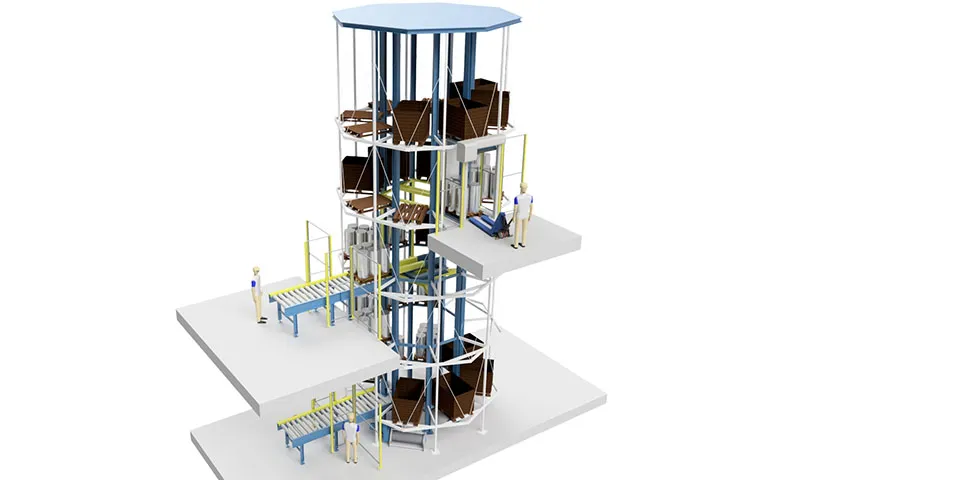
The 3D-Backbone excels at making efficient use of space. For around forty pallets, it performs 50 to 60% better than a manual solution.
Three versions of the Backbone
With the Backbone, RDL Engineering has developed a logistics concept that brings together its expertise in handling, roller conveyors (horizontal) and lift systems (vertical). De Leersnijder: “We clearly felt this need in the market, so we started thinking about how we could help our customers save space while also creating buffers to absorb production imbalances. This resulted in three versions, each of which we can adapt to the customer’s specific situation.” The 1D-Backbone is the simplest version and consists simply of a lift system seamlessly connected to roller conveyors. RDL Engineering already has hundreds of references for this solution. It can be expanded modularly into the 2D-BackBone. The lift then becomes mobile, enabling it to serve multiple cells. Supplying raw materials, collecting finished orders and buffering semi-finished products: it can all be handled by one system. Finally, in the 3D-Backbone, the lift rotates within a shaft system. This version excels at making efficient use of space. For around forty pallets, it performs 50 to 60% better than a manual solution.
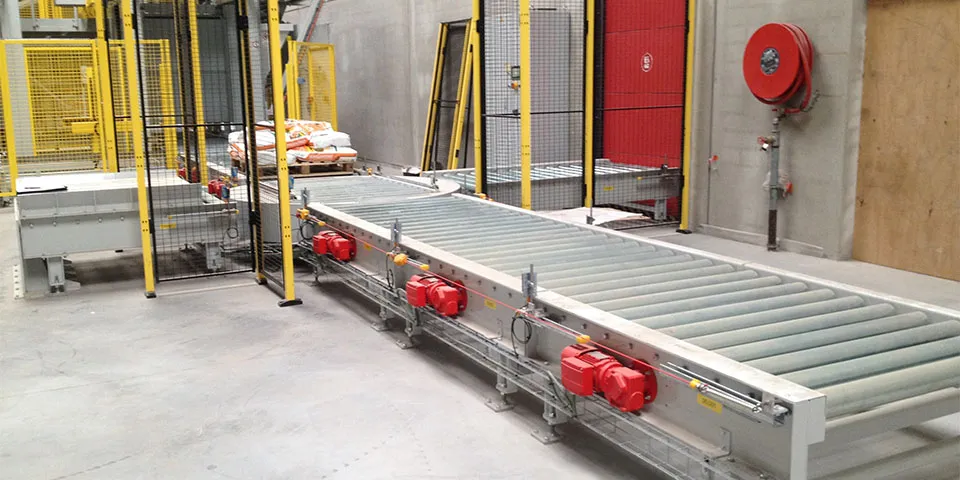
RDL Engineering has more than thirty years’ experience in automating internal transport systems and lifts. It can also seamlessly integrate all the equipment around the Backbone.
Every pallet accessible
For RDL Engineering, the priority was to ensure that every individual pallet remained fully accessible, in addition to delivering space savings. De Leersnijder: “As its name suggests, the Backbone can become the backbone of your production, with every step required to make your product connecting seamlessly to it. Because every pallet or box is accessible, and customers have plenty of options in this respect, all materials (raw materials, semi-finished products, finished products, order-picked orders …) can also be stored in one and the same warehouse, enabling an efficient flow throughout your entire production process. And the system can grow with your success. All that is needed is to add extra inlets and outlets.” The Backbone’s strength as a newcomer in logistics also lies in the mind and hands of its creator. RDL Engineering has more than thirty years of experience and expertise in automating internal transport systems and lifts. It can also seamlessly integrate all the equipment around the Backbone, such as software for keeping a clear overview of stock or lift systems, or a robot to automate part of your logistics.
Conclusion
“The Backbone is designed to take the logistical burden off customers, so their production runs more smoothly than ever. It is a solution for anyone who wants to work across multiple levels. And that certainly does not have to involve a spectacular logistics operation. The costs and space the Backbone helps save, together with the gains in time and efficiency, make it an attractive option for any SME,” concludes De Leersnijder.
Question about this story? Ask your question
Keep following this
Get an email when a new story is published. No account needed.
- SubjectSoftware, IT, OT & cybersecurity