Software, IT, OT & cybersecurity
Powerful CAE software streamlines the entire production process for electrical engineering projects
Every electrical circuit starts out as a concept. This is followed by a detailed design, with the final design only completed at a later stage. Today, professional CAE software makes this a straightforward task, efficiently turning even the most complex electrical circuits into a finished 3D design. And it does even more.
Despite the clear benefits of this software, a large part of the market is still relatively unfamiliar with it. Industrial Automation therefore felt it was high time to bring these applications out of undeserved obscurity, and spoke to Wiellie Cörvers, Account Manager Benelux at software developer IGE+XAO. “Fast, easy to use and versatile,” is how Cörvers sums up the capabilities of their SEE-ELECTRICAL application when we ask him to describe it in a nutshell. “The versatility of our software received a major boost in 2018, when IGE+XAO became part of the Schneider Electric group,” Cörvers adds. Schneider’s arrival brought the application the added support of a robust package of proven hardware, giving it greater depth as well.
A powerful end-to-end solution
This type of CAE software is clearly much more than an overgrown drawing programme. This was demonstrated in a recent video case study that Industrial Automation produced for IGE+XAO at its customer Applitech. The case study set out to show SEE-ELECTRICAL’s capabilities in practice, and did so with flying colours. The software proved to be a powerful end-to-end solution for building even the most complex control cabinets, in Applitech’s case, cabinets for controlling generators.
How it works
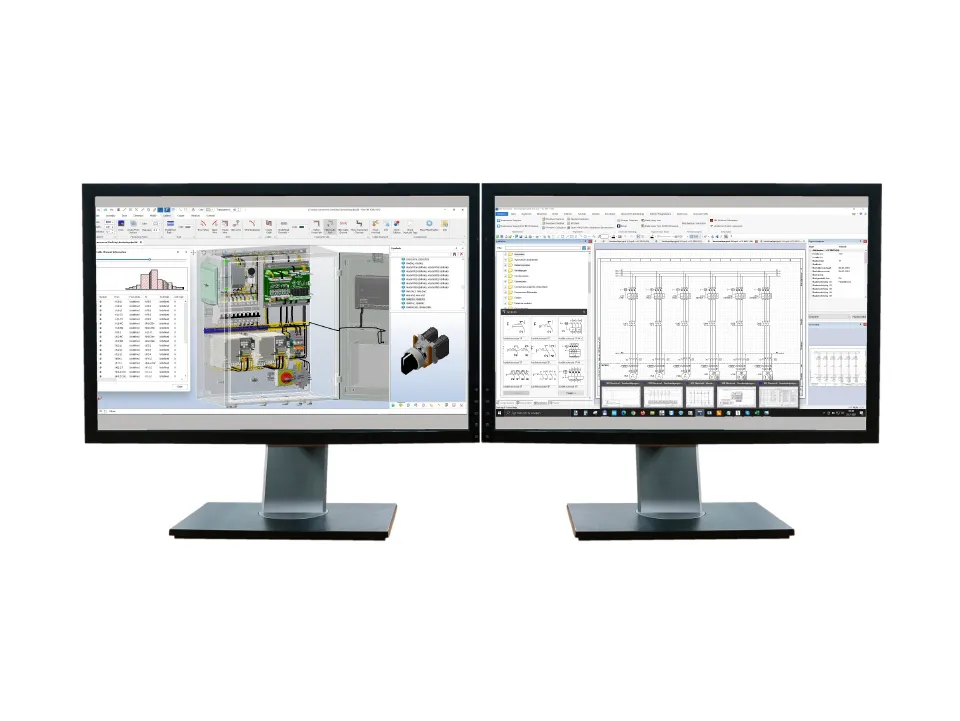
Once the design has been drawn up schematically, the software knows which components will be used in the finished control cabinets. These components then simply need to be placed virtually on the mounting rail. At the next stage, a single click is all it takes to add all the wiring, with the wires pre-numbered. The package’s ergonomic intelligence then generates a detailed 3D design, giving the user a 100% realistic view of the finished control cabinet, the familiar ‘digital twin’. This simplifies subsequent assembly work to such an extent that the electrician’s previously required training is no longer a sticking point. Assembly can therefore be reduced largely to repetitive, hands-on work. The application also offers users a host of powerful additional features, Cörvers says: “Although you can use our basic package purely as passive graphical support, the higher versions include numerous proactive functions designed to manage the entire production process for control cabinets, from design through to production and maintenance.”
Precision and consistent quality
SEE-ELECTRICAL also generates wire and component lists from its own database, which is backed by more than 900 hardware suppliers. At the same time, the software provides data for the wire-cutting machine and supplies drilling and punching patterns for the CNC machine that prepares the control cabinet frame. It even has a feature for printing component labels. Finally, the application also designs the copper busbars, calculating their dimensions and any bending data. The package is clearly an end-to-end solution. Small-scale, individual cabinet designs are, of course, still often created entirely by hand. However, whenever high precision is required, or for large production runs where consistent quality is the main criterion, CAE applications of this kind are very much more than a nice-to-have.
Question about this story? Ask your question
Keep following this
Get an email when a new story is published. No account needed.
- SubjectSoftware, IT, OT & cybersecurity