Software, IT, OT & cybersecurity
What you need to know about quantum computing
Text Valérie CouplezImage iStock
Forget classical bits and bytes, with quantum computing everything revolves around quantum bits, or qubits. This allows computers to reel off simulations and calculations much faster. That allows engineers to analyze complex systems faster and optimize their design. Or it can serve to simulate the properties of materials at the level of atoms to arrive at new materials with improved properties. No shortage of interesting possibilities, but how far are we from that today?
To harness the power of molecules during photosynthesis cannot be done simply with the computers we all know today. It requires quantum computers that can measure and observe quantum systems at the molecular level and predict the probability of events. In short, what your PC would take billions of years of computation to do now, these computers will do in a weekend. With that, they should be able to solve some of the world's most complex problems. It is as if computers will allow us to make the leap from the candle to the light bulb.
From bits to qubits
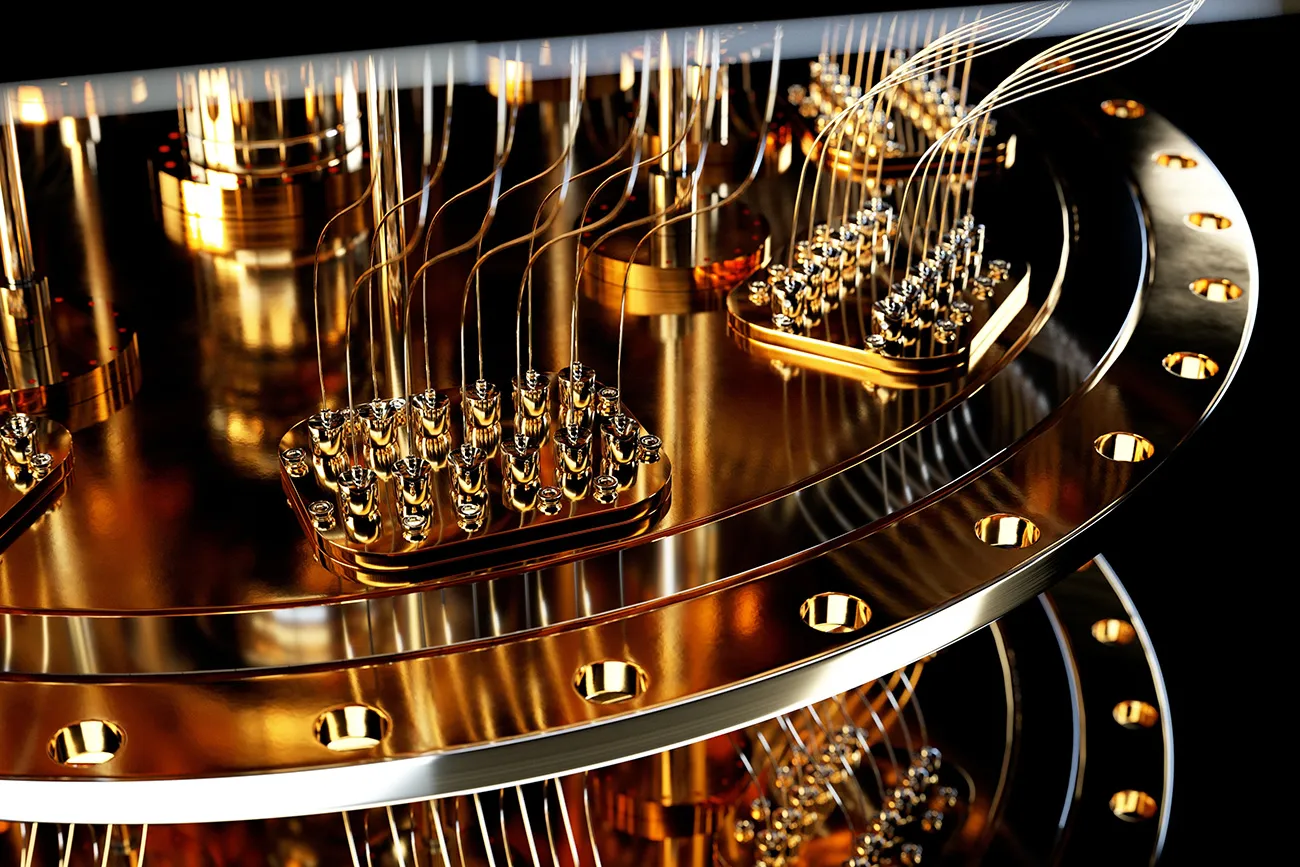
The basics are qubits. Feel free to compare them to the classical bits you know, but they can do one more trick. Using superposition, they can be in multiple phases at once. Whereas binary bits are limited to 0 or 1, qubits can be any part of 0 or 1, in superposition of either phase. This makes them capable of using algorithms to perform large numbers of computer calculations in parallel. They can be made of ions, photons, artificial or real atoms or even quasi-particles.
Quantum computing is nothing new under the sun. It has been talked about since the 1980s. But in order to build quantum computers, the main issue is to control the interference that can occur between qubits to ensure reliable results. A second concern has to do with that superposition and how to keep qubits in that quantum phase. That requires isolation and cooling (colder
than -250°C).
Applications
All well and good, but what can you actually do with such quantum computers? If the scientific community is to be believed, "the sky will be the limit. The main focus is on industry areas, where factors such as cost, quality and production time weigh heavily. With quantum computing, people will be able to invent new ways to control air traffic, deliver packages, store energy and so much more. In addition, quantum computers could accelerate the application of artificial intelligence. Although experts are not quite there yet. An important thing to keep in mind is that the algorithms we know and use today cannot be simply transferred. The rules in quantum technology are so different, at the most basic level. But the belief in the applications is there, including climate change. For example, it has already been proposed that quantum simulation of large molecules could be used to build a catalyst to remove CO2 directly from the atmosphere.
Plenty of experimentation
Future science? Yes, but quantum computers already exist and are being used today. But such large-scale applications will only be for later. Right now the focus is more on small molecules, for example molecular modeling of lithium hydrogen. That can be simulated with a supercomputer, but quantum simulation techniques offer an excellent opportunity to double-check the answers that emerge from classical simulation work. Thus, step by step, we are building further, toward experiments with larger particles. Want to get acquainted with it yourself already? There are cloud platforms that already let you sample the quantum experience. Playtime has begun.
Question about this story? Ask your question
Keep following this
Get an email when a new story is published. No account needed.
- SubjectSoftware, IT, OT & cybersecurity