Official support from the EtherCAT Technology Group for EtherCAT G
The EtherCAT Technology Group (ETG) Technical Committee has accepted EtherCAT G as an extension to the EtherCAT standard. From now on, EtherCAT G, which extends EtherCAT technology to 1 and 10 GB/s respectively, will be supported and promoted by the ETG.
Beckhoff Automation introduced EtherCAT G in 2018 as an extension to the EtherCAT standard. It recently submitted this addition of gigabit technology to the ETG. After careful consideration, the organisation’s Technical Committee accepted it. The ETG is currently working on integrating EtherCAT G and its associated technology specifications. Dr Guido Beckmann, Chair of the ETG Technical Committee, explains why the ETG welcomes the active integration of EtherCAT G into the organisation. “EtherCAT is already the fastest industrial Ethernet fieldbus, and will remain so thanks to its unique operating principle. EtherCAT G now also makes it possible to integrate data-intensive applications such as machine vision and high-end measurement technology. This significantly broadens the range of applications for EtherCAT technology and makes it even more relevant in the future.”
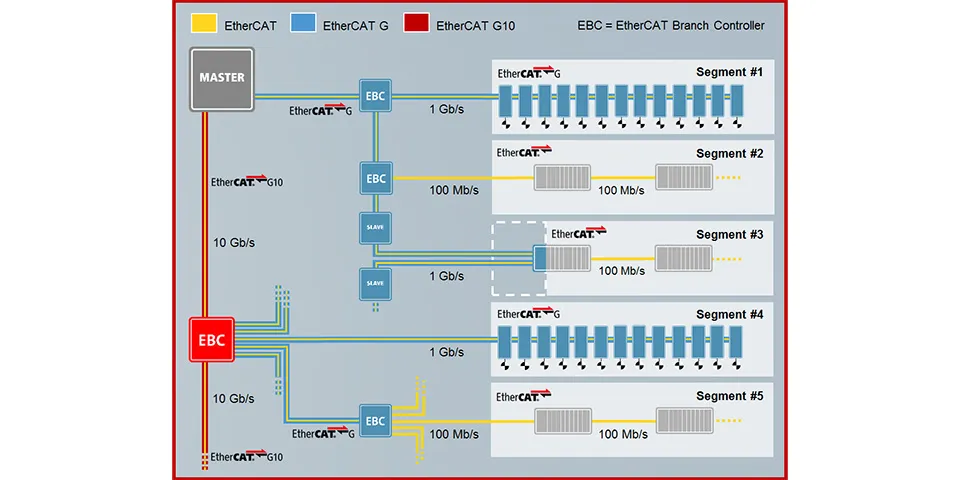
The established 100 Mb/s EtherCAT technology will remain the proven solution for most applications. Nevertheless, EtherCAT G offers users additional benefits, particularly in applications where large volumes of process data have to be transferred per device. Examples include machine vision, high-end measurement technology and complex motion applications that go beyond the capabilities of conventional drive control. As an extension to standard EtherCAT technology, EtherCAT G is fully compatible. Existing devices designed for 100 Mb/s can be seamlessly integrated into an EtherCAT G system. Conversely, EtherCAT G devices will also operate as conventional EtherCAT devices in a 100 Mb/s system.
EtherCAT G technology is built around the use of EtherCAT Branch Controllers, which perform two essential functions. First, they act as nodes for integrating segments of 100 Mb/s devices. Second, they enable parallel processing of the connected EtherCAT segments. This significantly reduces system latency, greatly increasing system performance compared with previous levels.
As is typical of EtherCAT, EtherCAT G is very easy to integrate, because the extension is fully compatible with the IEEE 802.3 standard and requires no software modifications to the controllers in standard mode. “The benefits of EtherCAT are well known and include direct processing, extensive diagnostics, simple configuration and integrated synchronisation,” says Beckmann. “These features are, of course, fully retained when using EtherCAT G.”
Question about this story? Ask your question
Keep following this
Get an email when a new story is published. No account needed.
- SubjectProduct information